|
Changing Waters, Changing Lives
Do the personal energies that Hantman and other private citizens expend on the region's stormwater troubles make any difference? Can they bridge the gap between theory and practice, between regulation and reality?
According to Hantman, the answer is a qualified yes. Until recently, she explains, county regulations gave contractors two weeks to stabilize disturbed sites — two weeks when heavy rains might flush clay and silt from land scraped raw. They now have 48 hours. Hantman credits this change to the hard work of the South River Federation and other activists. Though there are still holes in the sediment control requirements, she says, this represents a real, tangible improvement.
And now inspectors show up more often. That is what Osprey Development and Harkins Builders, the developer and construction firm putting up that apartment building, have told her. "We have never seen an inspector so often," they said. The site manager believes that the county has been "sensitized" to Hantman's concerns. She and her colleagues have evidently been heard.
"Some days it seems that people are really beginning to understand how our behavior affects the Bay. I'm amazed at people in my community who Ôwant to do something.' But they need to know what little things they can do. Otherwise," she says, "the news can sound pretty hopeless."
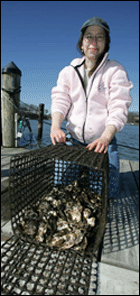
She still believes that "every shoreline project, every oyster garden can make a difference." She is also a big believer in low impact development techniques, and hopes to win grant funds so her community can undertake stormwater abatement efforts beyond what the Department of Public Works can afford.
Her community's focus on low impact techniques should help, according to engineer Allen Davis. "People worry about what percentage of a watershed is covered by impervious surface," he says, "but that's not the whole picture." While impervious surface can clearly degrade a watershed, Davis points out that size and location make a difference. Is the impervious surface in huge areas, like giant parking lots (bad); or is it broken up into smaller pieces (better)? Is it downstream or upstream? Are there best management practices that could slow runoff coming from those impervious surfaces, such as rain gardens, sunken medians, or terraces?
"All watersheds," he says, "are not created equal."
There are signs of hope in Hantman's community. Gas stations and car dealerships with deep grassy swales instead of straight gutters. Parking lots with sunken medians, and roofs planted with vegetation to absorb rainwater.
But the biggest challenge, she feels, is a lack of funds and a lack of leadership. "The inspectors I speak to are sympathetic," she says. "They do what they can for tighter controls on construction projects. But they just cannot inspect all the sites. The county code calls for inspecting every two weeks, which is not really enough, and they can't even do that," she says. "They just don't have the manpower. I feel an incredible sense of frustration about that."
"We need the infrastructure to catch up with the advocates," Hantman says, adding that this may mean no new development in some areas. "Some people seem to think that Ôall development is good.' We need to be thoughtful about where we live and where we work." She says that development invariably means more impervious surface, which means more runoff — especially without aggressive bioretention efforts to help gather and slow the flow.
Hantman has not yet heard about her complaint to the EPA and says that she still hasn't gotten good answers to many of her questions. How can permits allow new projects to feed into a stormwater system that the county itself says is failing? How will the county handle that $400 million backlog of stormwater infrastructure projects? Who will pay? Who will make sure it happens?
For the past six months Hantman's been working to promote the idea of a Watershed Restoration Fund for Anne Arundel County, built on the concept of a stormwater utility. The utility calls for county residents to pay a small fee, perhaps five dollars a month, to support stormwater upgrades, maintenance, and repairs. This would provide a strategy for chipping away at that $400 million backlog, but so far the plan lacks political momentum.
In many ways, stormwater has changed Hantman's life, something she did not expect when she first moved near Beards Creek with her infant daughter. "I wasn't really ÔBay aware' until I moved down to the South River," she says. Largely she knew what she read in the newspapers. "I knew there was a 'dead zone,' but I didn't understand the scope of the problem."
Now Fern is almost five, and the demands on Hantman's time and energy have only grown. Hantman estimates that she has worked 10 to 20 hours a week for the last two years — for free of course. "It's been a real experience," she says.
She thinks about changing careers. "I might want to do this full time," she says. She's thought about a career in environmental policy work, and perhaps a degree in environmental law.
"It all started with the stormwater work," she says. Others have enlisted Hantman's help as well. She now serves on the Western Shore Tributary Team, used by the Maryland Department of Natural Resources to guide the state's Chesapeake Bay initiatives.
Hantman has connected with others who have taken similar journeys. She has strengthened ties with a network of activists in the Chesapeake Bay Foundation, the local Watershed Alliance, and the South River Federation. She has come to rely especially on Drew Koslow, the South River's full-time riverkeeper. A paid citizen watchdog, Koslow travels the length of the South River in his skiff, Remedy, and keeps track of trends and changes, and follows up on complaints. With all the development in the South River watershed, stormwater has risen to the top of his list of concerns. (See "The River's Keeper".)
Will the determined intervention of activists and new techniques from engineers finally slow stormwater's destructive tide?
Hantman says that her concerns leave her somewhere between hope and despair. She sees hope in new construction techniques and in stricter adherence to both the letter and the spirit of stormwater regulations. But at times she feels despair watching a development boom that appears to have no end, and that threatens to overwhelm even our best-laid plans. Most of all, she says she wonders whether they will ever be able to raise oysters at the end of the dock, and if it will ever be safe for her daughter to swim in Beards Creek.
|




![[Maryland Sea Grant]](/images/uploads/siteimages/CQ/MD-Logo.png)