|
A Research Fellow's Perspective
How Old Is That Crab?
By Brandon Puckett
Known for their savory taste, awkward swimming motion and beautiful color, blue crabs remain an icon of the rich traditions of the Chesapeake. The largest fishery for blue crabs, both now and in the past, occurs in the Bay. Blue crabs also fill a key ecological niche as opportunistic bottom feeders, a role fundamental to the health of estuarine ecosystems.
But blue crabs face a growing threat, and each year the Bay continues to support a smaller percentage of total U.S. harvests of the species. Ongoing surveys suggest that both commercial landings and total abundance of Chesapeake Bay blue crabs have fallen below historical levels, stimulating questions among stakeholders about the status and sustainability of the fishery. While now may be the time for management actions, resource managers and decision-makers are counting on scientists to collect new information to answer old questions.
In particular, blue crab stock assessment methods used to inform management regulations rely on accurate estimates of age to determine growth rates, recruitment rates (age at legal harvestable size), longevity, and natural mortality rates (including predation).
Just as these feisty crustaceans are notoriously unwilling to release anything in their physical grasp, they also seem unwilling to release the mysteries of their age. Until recently, scientists have not had a direct method for aging blue crabs. The absence of accurate age estimates has not only plagued management applications to the blue crab fishery but has also affected crustacean fisheries around the globe (e.g., crabs, lobsters, and shrimp). Unlike fish that have scales and ear bones (otoliths) that grow proportionally to their age, crustaceans grow by molting –– thereby removing any evidence of previous size or age. Historically, shell width has been used as a proxy for blue crab age, but since blue crabs spawn over a protracted period (spring to fall) and grow at variable rates, size does not necessarily correlate well with age. As a result, research efforts have shifted towards alternate methods for determining age in blue crabs.
The hallmark of my thesis research is to determine blue crab age using lipofuscin, a fluorescing age pigment (also present in humans) that accumulates in neural tissue as a byproduct of metabolism.
Because the use of lipofuscin for age determination is a relatively new technique, the first goal of my research was to verify that the pigment accumulates at a rate proportional to the crab's chronological age. For this purpose, I used known-age juvenile blue crabs provided by the University of Maryland Center of Marine Biotechnology (UMBI) through their hatchery program. I released two groups about 80 days old, consisting of 300 crabs each, into separate earthen brackish water ponds. At monthly intervals, I measured the cohorts for growth, and at 2-4 month intervals sacrificed a small subset of each cohort for lipofuscin analysis. I extracted lipofuscin from crab eyestalks and quantified it by measuring its fluorescence. After establishing a lipofuscin concentration-to-age relationship, I will apply this to determine the age of field-collected crabs.
To collect wild crabs, I conducted monthly (June to October) bottom trawls in the Choptank River (2003) and Patuxent River (2004) –– collecting a total of about 1,000 crabs over the two sampling years. I also measured and analyzed field-collected crabs for lipofuscin concentration. I will use these age estimates from lipofuscin analyses to determine growth and recruitment rates of field-collected crabs. As an independent check on growth and recruitment rates, I used size data generated from the field and pond studies to group crabs into monthly size classes and monitored the progression of size classes from month to month.
For crabs of a known age, lipofuscin concentration increased predictably with chronological age over the first year of life. I am therefore optimistic that lipofuscin can be applied to age field-collected crabs.
It is well known that juvenile blue crabs are capable of extremely rapid growth, but our findings from the lipofuscin method of age determination suggest that growth rates may be even higher than originally predicted. Our experiments and models showed rates of around one millimeter per day during the first year of life. Based on these results, our studies of pond-reared blue crabs indicated that they can start to recruit to the peeler fishery at four months old and to the hard crab fishery at six months old. These recruitment rates are much faster than current age estimates based on size, which project that blue crabs recruit to the peeler and hard crab fishery much older - at one and two years old, respectively.
Although I have not yet applied lipofuscin methods of age determination to all of the field-collected crabs, I expect that the measured growth rates will be similar. Findings that suggest blue crabs enter the fishery earlier than we thought would likely affect our models of blue crab population and its age structure, which in turn could hold important considerations for management of the Bay's most valuable fishery.
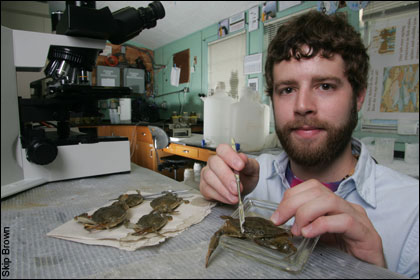
In the black eyes of blue crabs, Brandon Puckett searches for clues to their age and growth rate. He measures the amount of the fluorescent pigment called lipofuscin that accumulates in neural tissue as crabs get older. Photograph by Skip Brown.
|
|
Brandon Puckett is a graduate student working with David Secor at the Chesapeake Biological Laboratory in Solomons, Maryland. His tenure as a Maryland Sea Grant Research Fellow lasts from fall 2003 through summer 2005. In this article, Puckett writes about the process and significance of his ongoing thesis research.
|




![[Maryland Sea Grant]](/images/uploads/siteimages/CQ/MD-Logo.png)