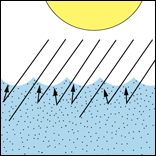
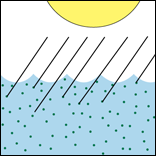
LIGHT HEADING FOR THE BOTTOM of the Bay gets lost in two ways, not counting shading. It gets scattered or it gets absorbed.
Scattering. When light hits water filled with fine inorganic sediment, it bounces around (see figure below left). Some light will eventually get to the bottom, though greatly reduced or "attenuated."
Absorption. When light hits an algae cell, much of it gets absorbed (see figure above right). Phytoplankton are great absorbers of light — in a very real way, they "feed" on light. Larry Sanford and Charles Gallegos are reaching between their disciplines to discover the ways in which the inorganic and organic interact to create the turbidity we now see in the Chesapeake Bay. To learn more about light and turbidity, see Related Links.