|
A Tree Grows on Bruce Street
By Erica Goldman
|
|
|
|
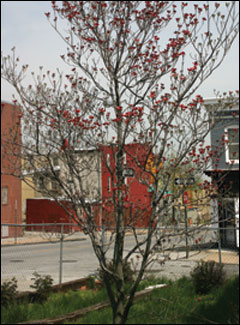
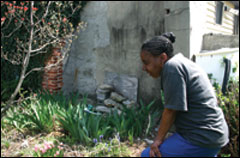
Charlene Pinkney's flowering dogwood tree (top right) casts a graceful silhouette on troubled Bruce Street. Her carefully tended garden (below, with Pinkney looking on) provides a welcome oasis on a block plagued by abandonment, vandalism, and drugs. Photographs by Erica Goldman.
|
Charlene Pinkney crouches near the base of her newly budded dogwood tree, her slight frame bent low. She points to a daylily poking up near the rain barrel she maintains in the corner of her garden.
"It's a determined flower," she says. "That daylily keeps poking its way through, even though the rain barrel blocks its path."
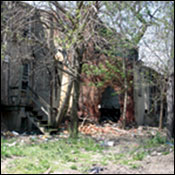
Some might say the same of Pinkney. For over 10 years, she's lived on Bruce Street, in the heart of West Baltimore, just down the block from the Bruce Street stables (see Greening Gray Streets). She lives in the only occupied house on her side of the street, next to an overgrown lot. Trash and broken glass litter the alleys and lots — it crunches underfoot as you walk. On the other side of the block, more than half of the rowhouses are boarded up. And where the boards are not secure, as she points out in one house, unauthorized tenants often make themselves at home. The street also sees its share of vandalism and "traffic," she says, meaning drug deals.
Pinkney grew up in this area and it pulled her back home. She's raised her two children here, now 15 and 16. And she's worked hard to cultivate a peaceful oasis on her corner of Bruce Street.
On the alley-facing side of the garden, two evergreen trees provide shade from the afternoon sun. Pinkney says that she sometimes brings a chair out here just to sit. "I need this place. The solitude gives me peace of mind."
But it takes most of her spare time to make her garden the place that it is — a green space filled with carefully chosen flowers and detailed landscaping. She can't grow anything edible in the garden because rats will get to it. "It's a constant struggle to keep them away," she says.
Early on, Pinkney's interest in gardening helped her connect with the Parks & People Foundation. They helped her get started with her garden initially and worked with her to set up a rain barrel to help with stormwater management. Now Pinkney also serves on the Watershed 263 Stakeholder Advisory Council.
Parks & People planted two large trees on the curb outside her garden and she helps maintain them, which makes the whole corner a little greener. Pinkney's children are both alumni of KidsGrow — an afterschool program run by the Baltimore Ecosystem Study since 1994 to help children understand their connection to the environment and promote stewardship.
Charlene Pinkney's garden helps her find the center of her inner world. But it also flickers a bright light on Bruce Street, helping to anchor the troubled block she lives on. Amidst the abandoned houses and littered lots, her corner is clean and her garden is carefully tended.
When Pinkney's hydrangeas bloom, she cuts them and hands them over the fence to children who pass by on their way to school. They've asked if they can take them to their teachers. She smiles at the thought that her flowers spread flashes of color to the neighborhood beyond. Something beautiful from Bruce Street.
|


![[Maryland Sea Grant]](/images/uploads/siteimages/CQ/MD-Logo.png)