|
Branding the Bay
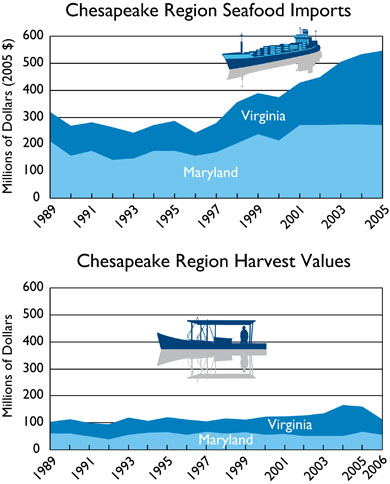
In the end, both the traditional Bay seafood industry and cutting-edge aquaculture like Marvesta and Marinetics face the same challenge. Neither can meet the demands of large-scale global markets. Gone are the days of oyster shells piled as high as a house. Both Bay seafood grown in culture and what comes out of the Bay itself need to find high-value markets and high-end outlets like fine restaurants. They need to brand Chesapeake seafood as a local delicacy to regional buyers and as something very special to everyone else. They may need to sell it over the Internet (see Blue Crabs Online).
The key for these businesses is to aim for the top of the market, not the bottom. That's the only way to go, says Jane Stoors, a marketing expert at the Maryland Department of Agriculture (MDA). She's spent years marketing Maryland agricultural products to a wider world and says what's true for meat and vegetables is probably true for seafood as well. "You need to find out what consumers want," she says, "and then give it to them." It's not enough to bring your product to market and then see if anybody wants it, she says. "That puts you at the end of the line," she says, "a place you don't want to be."
Her colleague, Noreen Eberly, who heads up seafood marketing for MDA, agrees. She's trying to ride the "buy local" wave that's caught on in many parts of the country. Eberly works with smaller companies, and says that the Bay just doesn't produce enough seafood to move through large distribution centers like Jessup, Maryland, or through large restaurant chains like Applebee's.
Eberly and others in the seafood industry are focusing on quality — for example, through a Crabmeat Quality Assurance program. This program, administered by Maryland Sea Grant Extension specialist Tom Rippen, focuses on quality control throughout processing and tests for problematic microbes. Participating processors gain the right to use special labels that denote genuine Maryland crabmeat, both in fresh cups and pasteurized cans.
They're banking on the Bay's reputation as a producer of high quality crab, and branding the superiority of Maryland crabmeat in particular.
"The Bay is still the blue crab capital of the country," says economist Doug Lipton. "Maybe of the world."
Lipton's a big supporter of the Maryland crab campaign and of the effort to buy local. But he says that even with crabs and crabmeat coming from other places, the Bay will continue to draw crab lovers because of its history, its sense of place. People come from all over to eat crabs by the Bay, he says, and apparently it doesn't matter to them that much of that crab comes from somewhere else. Most restaurant-goers probably don't even realize it.
Economists like Lipton and longtime processors like Karen Oertel would likely agree that the biggest asset the Bay seafood business has for now is the Bay itself. The Bay is still trading on a reputation it's built over several centuries. A long habit of serving seafood.
There is, however, a darker side. If the Bay's reputation becomes one of polluted water body, with badly overfished stocks and seafood advisories that warn against contaminants like PCBs and mercury, the celebrated image of iconic watermen and bountiful seafood could shift. Degraded water quality and declining stocks could not only reduce the Bay's seafood supply, it could also damage its most prized possession — its reputation, its sense of place. Its place in the market.
It's a short walk for Karen Oertel from the restaurant to the shucking plant next-door. She's scheduled to give a tour of the plant and a Chesapeake Bay pep talk to several dozen first-graders just arriving in a bright yellow Queen Anne's County school bus. Teachers are already lining them up by twos out front. She's going to let them touch squishy oysters and mushy soft crabs and she'll teach them "not to trash the Bay."
She has the future in mind. What will these youngsters know of the Bay's famed seafood industry when they grow up? What will they understand about the healthy waters that have sustained her family for more than three generations? Will all the fish, crabs, and oysters these children eat come packaged in plastic from somewhere far away?
"Do you want to lose all that history?" she asks, as she heads toward the kids waiting for her at the plant.
"We're heading in that direction," she says. "Wake up."
|



![[Maryland Sea Grant]](/images/uploads/siteimages/CQ/MD-Logo.png)