|
Preparing for the Next 30 Years
Global warming. Urban sprawl. Dead zones. To address these challenges in the Chesapeake and beyond will require new thinking. It will require new experts, new leaders.
For thirty years Maryland Sea Grant has helped prepare for the future by supporting researchers and students as they move into undiscovered territory. With Sea Grant support, scientists have explored new ways of tackling pressing problems. They have experimented with promising techniques and tested big ideas, often with modest funding that laid the groundwork for more ambitious efforts.
Since 1977, Maryland Sea Grant has funded graduate students to work with marine scientists and scholars, supporting them at a key point in their careers. Since 1979, Sea Grant has also awarded Knauss Fellowships to students seeking advanced degrees, sending them to Capitol Hill or to the nation's ocean agencies to apply their education to real-world problem solving. Many of these students are now researchers themselves, and some are leaders in marine science and policy.
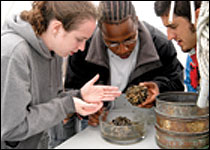
To expose undergraduates to the excitement and rigors of marine science, Maryland Sea Grant has, since 1989, run a Research Experiences for Undergraduates (REU) program supported by the National Science Foundation. The REU program brings college students from around the country to spend a summer working with researchers on Bay-related science projects.
In order to link K-12 education directly with the science and engineering enterprise, Maryland Sea Grant Extension connects middle and high school teachers with researchers through the Environmental Science Education Partnership (ESEP), a collaborative effort with the University of Maryland Center for Environmental Science (UMCES). Teacher fellows spend seven weeks of the summer working with scientists on projects at field laboratories at UMCES or at the University of Maryland Biotechnology Institute.
Another unique program, Aquaculture-in-Action, helps educators learn how to use recirculating aquaculture to enhance their science curriculum — providing a framework for integrating the teaching of biology, chemistry, engineering, and environmental science. Today 41 schools in Maryland, Pennsylvania, and West Virginia have aquaculture programs based on the Aquaculture-in-Action approach.
Increasingly, the Internet has created new frontiers for education. Students can share lessons and data in real time with students across the state or in other countries. Maryland Sea Grant's interactive web-based lessons have now been downloaded in all 50 states and in 58 countries.
To glimpse where Maryland Sea Grant has come in the past three decades, and to learn about our research and educational materials, visit www.mdsg.umd.edu/timeline. There you can comment on our past work and suggest new initiatives for the future. We look forward to helping to prepare the next generation to take on the challenges of the next thirty years.
|

![[Maryland Sea Grant]](/images/uploads/siteimages/CQ/MD-Logo.png)