|
Mussel Power
Can It Help
Clean The Bay?
|
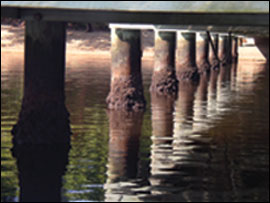
Top three photographs (pilings, dark false mussels on a hand and with siphons) by Peter Bergstrom and the bottom two photographs of a cage with mussels by Wayne Young.
Filter Power
Aside from oysters, filter feeders (also called suspension feeders) rarely draw much attention in Bay country. Who are these other filter feeders that call the Chesapeake Bay home? And do they — or could they — thrive in enough numbers to help clear the Bay's murky waters?
The strange epidemic of dark false mussels in the Magothy became an unanticipated biological experiment of sorts — a "proof of concept."
"What it showed is that if you could get some sort of suspension feeder in there in a sustainable fashion, it could start to improve the water quality," says Linda Schaffner, an ecologist at the Virginia Institute of Marine Science (VIMS) in Gloucester Point, at the southern end of the Bay.
These types of feeders, she explains, could help lock up (sequester) nutrients in their body tissues, paving the way for aquatic plants and animals that need clearer waters to survive. "I used to joke that we should hang ropes and let Molgula (a sea squirt that fouls dock pilings) grow," she says. But that, she says, is exactly what happened when the dark false mussel settled on every available surface — ropes, boats, pilings, cages.
What's keeping these other filter feeders from thriving in greater numbers in other habitats? Lack of substrate poses one definite problem. Opportunistic filter feeders grow essentially as fouling communities, Schaffner explains. Increasing the population size of these other species would depend on being able to increase the amount of available hard-bottomed surface in open water environments.
Salinity also presents an obstacle. In streams, freshwater filter feeders can do a good job of improving water quality. In tidal marshes, salinity-tolerant mussels grow prolifically. But fewer filter feeders thrive in mid-salinity, deeper water areas, which may leave an ecological niche empty in the mid-Bay, according to Roger Newell, an oyster biologist at the University of Maryland Center for Environmental Science Horn Point Laboratory. He believes that only oysters could fill that niche, since they thrive in deeper water and can tolerate the widest range of salinity.
Scientists don't know much yet about the potential for other filter feeders to affect water quality in the Chesapeake. In the York River, so-called opportunistic suspension feeders — sea squirts (tunicates), polychaete worms, clams, and mussels to name a few — outnumber oysters five to one, explains Schaffner. "If there is any effect of suspension feeders on water quality here [in the York River], it is from these opportunistic species," she says.
These species tend not to draw a lot of scientific interest, says Schaffner. She tried to secure a grant for a larger-scale effort to survey them in the Chesapeake Bay, but the project did not mesh with current funding priorities. She ended up limiting her survey to the York River since it was easier to mobilize a smaller-scale effort on a shoestring budget, but she'd like to do more.
Looking closely at this issue really should be the next step for the Chesapeake, says ecologist Danielle Kreeger. Kreeger works in a different estuary — the Delaware Bay — studying the potential for native mussels to help restore water and habitat quality in both the tidal system and up in the streams and rivers (see From Headwater to Bay). To thoroughly assess the potential impact of these other filter feeders, she says, you need to know what volume of water actually gets processed and how often that parcel of water comes in contact with the animal. Such an effort would require an interdisciplinary team of ecologists and hydrodynamic modelers, according to Kreeger, who is the science director for the Partnership for the Delaware Estuary, one of the 28 National Estuary Programs modeled after the Chesapeake Bay Program.
Kreeger has started down this path already, working with researchers from several institutions and students from Drexel University in Philadelphia, where she maintains her research lab. She's made preliminary calculations for several species, including the marsh mussel, Geukensia demissa, which thrives in the Delaware Bay's tidal marshes. Kreeger estimates that the mass of marsh mussels in summer filters 60 billion liters per hour, more than six times what the current population of oysters in Delaware Bay can filter.
|



![[Maryland Sea Grant]](/images/uploads/siteimages/CQ/MD-Logo.png)