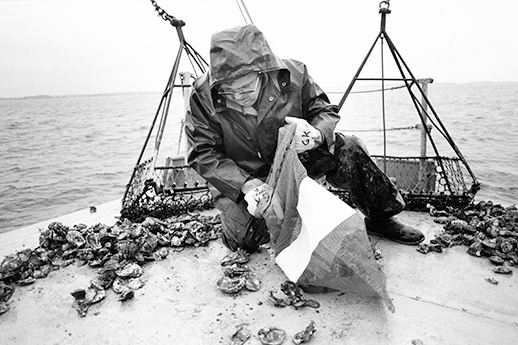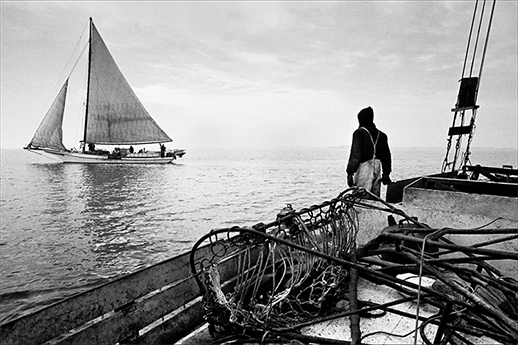
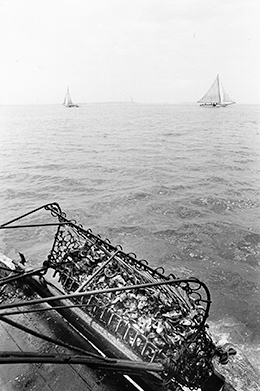
SKIP BROWN WAS STILL AN UNDERGRADUATE STUDENT at the University of Maryland in 1979 when he came looking for part-time work as a photographer with a new science program called Maryland Sea Grant. As the leader of the communications program, I decided to hire him because we had a darkroom and he had experience running one.
Better than his darkroom experience was his portfolio. It was skimpy on photojournalism, but strong on portraits and on fairly abstract art photography. And in nearly every shot he showed me, you could see an artist's eye at work: a compelling, almost formal sense of composition, a command of tones and shapes and lines of perspective. Based on that eye I hired young Brown, lent him my copy of Robert de Gast's book The Oystermen of the Chesapeake, and crossed my fingers when I sent him out to photograph scientists and watermen working the Chesapeake.
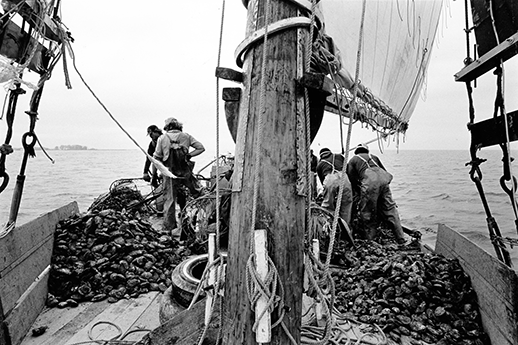
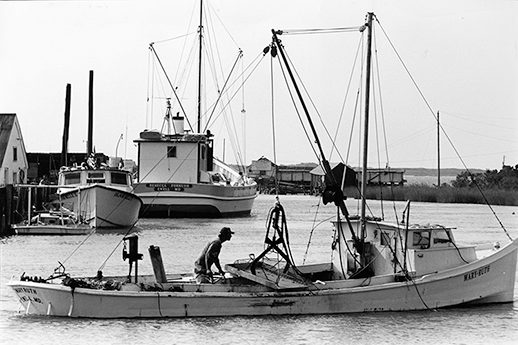
It may be coincidence, but Brown's best black-and-white photography on and around the oyster boats and crab boats of the Bay were soon resembling Robert de Gast's work. In retrospect, de Gast may be been influencing me more than Brown. After all, I was the one choosing which Skip Brown images to publish. And I tended to choose the de Gast look-alikes.
It turned out the student I hired was both genetically and geographically programmed for taking artful photographs of life around the Chesapeake Bay. One of his uncles, John Brown, taught the philosophy of art at the University of Maryland. Another, Dean Brown, was a professional photographer who did assignments for Time/Life Books. And Skip grew up in sight of the Bay. His childhood home on Grandview Island, a waterside enclave near Hampton, Virginia, included nearby views of a large salt marsh and distant vistas of large ships entering the mouth of Chesapeake Bay. He started early on watersports and outdoor photography.
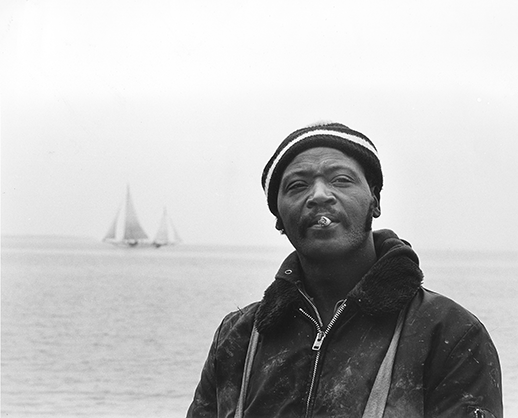
Brown worked part time for Maryland Sea Grant for several years, the black-and-white years when color printing was too expensive, and his artful work gave our early newsletters and magazines a distinctive look. Our first publication to win an award featured his photo essay focused on watermen dredging oysters from the deck of a skipjack under sail. We featured his work in publications, in prints that still line the hallway at the Sea Grant office, and in a photo exhibit at the University of Maryland Student Union.
As a professional photographer, Brown transitioned early on to color photography where he shot travel, adventure sports, and portraits for a variety of editorial, corporate, and advertising clients. With the ongoing evolution of imaging technology, he now produces professional and award-winning work with his Canon camera, his Go-Pro camera, and his iPhone. The Go-Pro in particular has helped him develop a specialty in what he calls "adrenaline sports," like hang gliding, whitewater kayaking, and most recently whitewater paddleboarding. His assignments have taken him around the world, including a photo shoot running the Grand Canyon and a National Geographic expedition with a team of pro kayakers who made the first-ever successful descent of the lower Congo River in Africa.
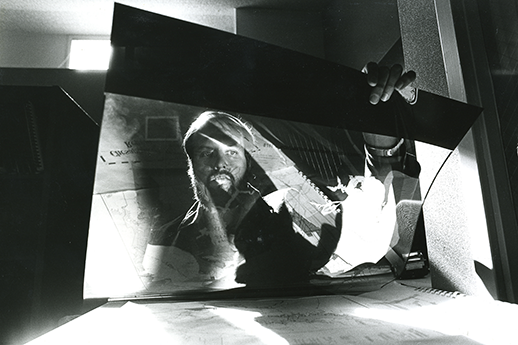
Brown's work with Sea Grant and the Chesapeake never ended. Since we began our new magazine, Chesapeake Quarterly 15 years ago, we have used him on frequent freelance assignments to photograph scientists, watermen, and Bay landscapes. He has contributed 14 iconic cover shots for the magazine.
Brown lives in Cabin John, Maryland, with his wife and three children, who often end up as subjects in his sports and nature shots. Many of his Chesapeake Bay photographs can be seen at www.art.com; just search for Skip Brown and Chesapeake Bay. His other work can be found in the National Geographic stock library and through his own web site at: www.skipbrownphotography.com.