
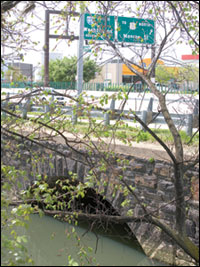
Beneath the vroom of traffic on Russell Street, the mouth of an outflow pipe yawns into the Middle Branch of the Patapsco River. Hidden under this busy Baltimore thoroughfare, the 25-foot-wide masonry pipe opens onto garbage-lined banks. Plastic bags and newspaper hang from drooping tree branches. Styrofoam containers bob in sickly green water.
That is just what's visible. Unseen are loads of unsavory substances — heavy metals, bacteria, nitrogen, and phosphorus, not to mention millions of suspended particles that bind toxics tight. This spoiled backwater flows under a crisscrossing tangle of highway overpasses before emptying its load into the main expanse of Baltimore Harbor. Out of this pipe flows some of the dirtiest water heading for the Chesapeake Bay.
They call it pipe 263.
Pipe 263 drains untreated stormwater from the most urban of urban watersheds. It's filled with pollutants that wash off streets and sidewalks or seep into the system from illicit sewage connections. Far from the Bay itself, the pavement here stretches in concrete waves and crabs come only as carry-out. Watershed 263 doesn't harbor a single flowing stream. Not one rocky streambed. No fish. No water striders. No ducks.
Watershed 263 is more accurately a "stormshed," an antiquated system of underground pipes that carry away stormwater coursing off Baltimore's city streets. Named simply for the giant pipe at its terminus, Watershed 263 drains 930 acres encompassing twelve neighborhoods in West Baltimore. Few trees dot the landscape — too few to support even birds and squirrels, the hardiest residents of an urban forest. If not for the vibrant colors of Baltimore's rowhouses, Watershed 263 would be a very gray place.
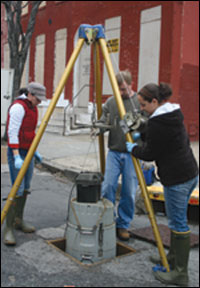
On Lanvale Street, Matt Cherigo pulls on latex gloves and a Tyvek suit. He's getting ready to climb into a storm drain in the mid-watershed neighborhood of Harlem Park, where he works as a field technician. His two assistants, Emma Noonan and Melissa Grece, are hooking up a barrel-shaped, automated water sampler to a steel cable. Cherigo's head is uncovered. He forgot to order the suits with hoods.
The day's forecast warns of heavy rain and the air hangs low. That's why Cherigo and his field team are taking water quality samples from the Lanvale storm drain, as well as from another storm drain at nearby Baltimore Street. Over the last four years they've sampled each major storm event and taken baseline samples every two weeks from the two sites. Cherigo works for the Dundalk, Maryland-based contract lab called Microbac, but the overall sampling effort is conducted through a partnership between the Baltimore Department of Public Works and the Baltimore Ecosystem Study, a project that studies urban Baltimore as an ecological system. The water samples are analyzed for levels of nitrogen, phosphorus, bacterial load, and heavy metals. The resulting data make up the first quantitative record of stormwater quality from an ultra-urban area within the Chesapeake watershed.
Cherigo cleans rust off battery terminals on the automated sampler and programs the computer. He's going to anchor the sampling device inside the storm drain, where it will remain through the duration of the storm. Rising water levels inside the storm drain will activate the automated sampler. The trick is to get the sampler in place, then get out of the way before the storm hits.
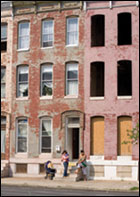
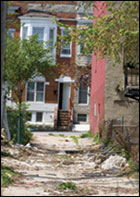
Stormsheds like Watershed 263 interweave much of Baltimore City's subterranean landscape. There are 114 outflow pipes like pipe 263 that deliver untreated stormwater directly into Baltimore Harbor or the Patapsco River. In Watershed 263, as urban growth paved over natural streams, city planners built a 43-mile network of 355 storm drains to funnel water out of the city. Like the natural streams they replace, many of these storm drains have base flow, even in dry weather. Due to a deliberate structural decision to leave the joints leaky, groundwater percolates into the pipes - an engineering solution designed to shunt water away from basements and house foundations.
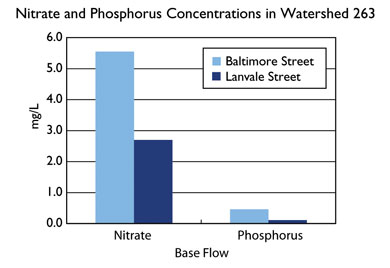
The water that flows beneath Baltimore's streets contains concentrations of nitrate comparable to the region's agricultural areas (nearly 6 milligrams per liter during low flow periods). And levels of lead, copper, and zinc routinely exceed the Environmental Protection Agency's legal levels during storm events, according to water quality monitoring data.
This stormshed has actually been defined as a watershed based on water flow patterns (hydrology). And it's being managed as such.
It's daunting. Life is hard in the neighborhoods within this watershed. Residents grapple with economic hardship, crime, drugs, and homelessness. Block after block, houses stand abandoned. In some neighborhoods, the number of unoccupied homes exceeds one in three. The median income of the watershed is $20,000 and unemployment tops 60 percent. In these neighborhoods, no streams flow through urban parks. The stormwater pipes that drain into Baltimore Harbor hide out of sight, buried deep under asphalt. The Chesapeake Bay — its flat expanses of water, its marsh grass, and its osprey — seems a distant world. Given this gaping disconnect between city and Bay, can the people of Watershed 263 come together to improve the health of the urban environment? Can they help clean the waters that flow through hidden streams?
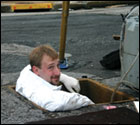
At the bottom of the square-shaped storm drain, Cherigo's white Tyvek suit lights up the dark tunnel. He shouts numbers to Noonan and Grece as they record background measurements and qualitative descriptions of conditions in the drain.
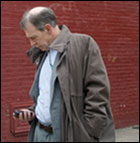
Cherigo is still in the hole when Bill Stack arrives. Dressed for the weather in a long gray raincoat, Stack pauses briefly to answer a quick email on his Blackberry before heading toward the storm drain. The sampling efforts in Watershed 263 hold intense interest for Stack, the water quality chief for the Baltimore City Department of Public Works. Stack's the one who manages pollution control efforts for the city's stormwater, the one charged with making things better. He needs a way to assess whether community greening and other Best Management Practices (BMPs) are actually improving the quality of Baltimore's stormwater.
Before monitoring efforts began in Watershed 263 in 2004, Stack had no quantitative data to identify the scope and scale of the problem. Monitoring data from the Chesapeake Bay Program reaches only as far as the outer portion of Baltimore Harbor, where tidal water mixes and dilutes pollutant loads flowing from the outfall pipes.
Data also help Stack make the case for urban stormwater as part of the bigger landscape of Bay restoration priorities. He recently presented some of the data from Watershed 263 at the annual meeting for the Bay Tributary Strategies, roadmaps for implementing river-specific cleanup strategies for the state. Stack also testified before the state legislature in March to appeal for targeted funding for urban stormwater BMPs in the new Chesapeake Bay Trust Fund created this year.
Cherigo climbs out of the drain, strips off his grimy Tyvek suit and gloves and walks over to greet Stack, who quickly finishes typing a message and stuffs his Blackberry in the pocket of his raincoat. Data collection has been running smoothly at the Lanvale site, Cherigo reports, but nearby Baltimore Street has problems. The base flow in the storm drain at Baltimore Street is so high that the added storm flow velocity seems to be overwhelming the automated sampler. It may be necessary to alter the sampling protocol, Cherigo tells Stack.
As it turns out, high base flow isn't the only irregularity in the Baltimore Street catchment area. The water quality data from this site show unusually high levels of nitrogen and phosphorus — high even for Watershed 263. Where might these nutrient loads be coming from?
Arriving at Bruce Street, a street so narrow that a single car can fill its width, Guy Hager closes and locks the car door and crosses the street. On one side of the street sneakers hang from overhead power lines in an empty lot, overgrown and full of litter. On the other side of the street metal doors barricade the opening to the Bruce Street stables. The doors stand partially ajar, framing several bright red wagons with yellow wheels.
"The Chesapeake Bay model doesn't have point-source pollution from city horse manure in its calculations."
Standing outside the stables, Hager announces his presence, identifying himself with the Parks & People Foundation. Wearing a baseball cap, he squints against the glare as he looks inside. Over the barks of a large dog tethered just inside a gate, a young man working in the outer courtyard nods at Hager and shouts to stable owner Ed Chapman to alert him that he has visitors.
Inside the stable, where ponies live in close quarters, Hager finds Chapman stooping low under the weight of a shovelful of horse manure. His small, wiry frame tenses with the effort. The pungent smells of manure and hay fill the stable, a historic building that has stood on Bruce Street for more than 150 years.
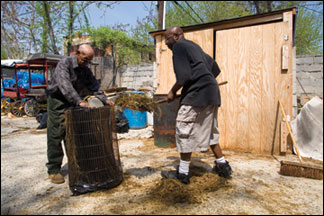
Chapman turns the shovel over an empty wheelbarrow and pushes the load toward the stable entrance, arousing a whinny of interest from a small brown pony in the corner. Steering the wheelbarrow over a makeshift ramp — a board propped over the uneven curb — he pushes into the glare of the outside courtyard. There the manure shed stands with doors open.
When the younger man starts unloading the manure from the wheelbarrow Chapman finally stops to greet Hager. They haven't seen each other for a while.
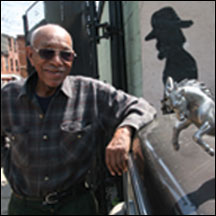
Chapman and his friends are part of a dwindling group of Baltimore "arabbers." The term "arabber" derives from British slang, "arab," used to describe people who made their living hawking on the street. Arabbers drove colorful horse-drawn carts filled with fruits and vegetables to areas underserved by grocery stores, announcing their arrival by distinctive hollers or songs. A historic way of life in Baltimore, arabbing was once common all over the East Coast, an entrepreneurial practice that dates back to the Civil War. Now it's disappeared from every city except Baltimore. The number of arabbers today hovers around a dozen. Chapman has been doing the job since he was 12, and on occasion he still drives his horse-drawn cart to sell produce in West Baltimore. At 88, he'll probably retire soon.
Back in 2006, Hager knew nothing about the Bruce Street stables. He was working across the street on a greening project when a film crew from The Wire, an HBO police drama, showed up on Bruce Street and began painting a mural of horses and cowboys on the outside of the stables. That tipped Hager off to the horses and gave him the clue that horse manure might be leaching into the catchment area's stormwater.
He discovered Chapman and other elderly stable hands had been leaving manure on the concrete pad outside the stables. When it rained, the manure washed straight through a hole into the alley adjacent to the stables. The nutrient-laden water then rushed into the storm drain and through the pipe that runs under Baltimore Street.
 |  |
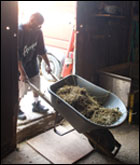
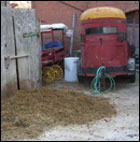
At the Bruce Street stables, Hager and his team had uncovered an off-grid hotspot of pollution — one that had been missed by the detailed Geographic Information System (GIS) mapping conducted at the beginning of the project in 2005.
The runoff of manure in Baltimore City came as a surprise. "I can tell you that the Chesapeake Bay model doesn't have point-source pollution from city horse manure in its calculations," says Hager.
Hager quickly realized that any solution that would require hauling the manure an extra distance would prove difficult for these elderly men. But clearly the problem needed to be addressed.
Hager and his team from the Parks & People Foundation began to work with the men at the stables, first helping Chapman and fellow arabbers build an exercise yard for their horses in the adjacent lot. They worked to explain the watershed connection and brainstormed ways to troubleshoot the manure problem. The team proposed a metal pallet-type device that would keep the manure off the concrete pad. The men could wheel it out to meet a garbage truck that could pick up the manure on the street. It would be a fairly low-cost solution. But so far, Hager says, he's not succeeded in making the case for funding.
Chapman understands there's a lot at stake in keeping manure out of the storm drains and making sure that his stable is well run and clean. The city-owned stable at Retreat Street was closed last year, condemned by the Housing Authority. When that stable closed, 49 horses faced relocation outside the city.
Arabber stables are generally exempt from city zoning laws because of their historic designation and the priority placed on preserving the cultural heritage of arabbing in the city. According to Baltimore city health code, only arabbers and participants in the carriage trade are allowed to keep horses within city limits. But the stables have recently come under scrutiny for their structural integrity and horse care practices. Chapman has a lot vested in making sure the Bruce Street stable does it right. And he's made some changes to make sure he's on track.
The manure shed now boasts a new roof, sidewalls, and wooden doors — Chapman has overseen its recent rebuilding. He and his fellow arabbers are now using the shed properly, storing the manure piled high behind closed doors until it can be bagged and moved out. It's tough going, shoveling manure and negotiating the heavy wheelbarrow at his age. He's not sure how much longer he'll be able to do it. But for now there's no other way. And Chapman is still going strong. For 75 years and counting, he's been selling on the streets of Baltimore. And now he's buying into cleaning them up.


Tension crackles in the air of the drab conference room at the Bon Secours Hospital Community Center on North Fulton Street. The turnout at the monthly meeting of the Watershed 263 Stakeholder Advisory Committee is smaller than usual. Only three out of the twelve neighborhoods have representatives present, and one of them is upset.
This is despite today's good news. A considerable infusion of cash is coming into the watershed - the Department of Transportation has earmarked $900,000 for a proposed greenway, and it's put a plan on the table for how to spend it. But Inez Robb isn't ready to buy in. Not yet.
 |  A bright spirit, community leader Inez Robb (left) has served her Sandtown-Winchester neighborhood ever since she became a homeowner there 20 years ago (her block above, with its new grassy median). Robb's connection to community made her a natural for her role on the Watershed 263 Stakeholder Advisory Council. She helps link residents in the watershed with an ambitious pilot project aimed at improving both environmental quality and the quality of life. Photographs by Skip Brown. |
"It looks like it's already planned," she objects. "We only have a couple of people from the watershed here. Had we known this [would be discussed], we could have had a huge crowd.... That is what should have happened."
The problem isn't the plan. Jessica Keller, the Planning Division Chief for the DOT in Baltimore, proposes putting the money into greening efforts in the area near the MARC train, where the city is already investing a hefty sum. Keller's plan would leverage the impact of a relatively small dollar amount.
The problem is the process. The decision on where to spend the money seems to be a done-deal - and a deal done when many of the stakeholders are not in the room, especially those representing the affected neighborhoods of Union Square and New Southwest. "I believe in teams, in hearing people, in buy-in," says Inez Robb, who represents the watershed from the neighborhood of Sandtown-Winchester. Without that buy-in, the best-laid plans will seldom work, whether it's cleaning old stables or building new greenways.
Community plans have a better shot at success when people like Robb buy in. Soon after she bought her first home in Sandtown-Winchester, on a newly renovated block in an otherwise troubled neighborhood, she joined the board of her condominium association and soon became its president. It is "not a thankful job," she says, but she's served faithfully for 17 years. "I'm a committed person," she says. "That's with everything. If I say I'm going to do it, I'll do it."
Robb's work with her condo board spawned a deeper involvement in community issues. She now serves on at least five different neighborhood or community advisory groups, including the Watershed 263 Stakeholder's Advisory Council. That's in addition to her day job as an IT specialist for the Social Security Administration in Woodlawn, where she's worked for 41 years.
But it is not just about doing it herself. It's about building capacity, she says. "I like empowering, sharing what I know to help you grow...I'm there with you 110 percent, but you need to do it."
True to character, Robb takes her commitment to Watershed 263 seriously. She sees communication and education as essential to success. "Those that are aware of the watershed and make the connection between greening, renovated lots, [Baltimore] Harbor, and the Bay, I think they love it.... But [with water] being underground, we don't often think about it." She says it is hard for people to make the link between eating crabs from the Bay and trash on the streets of Baltimore.
Hager walks into the center of the "reading circle" at Franklin Square Elementary Middle School. His baseball cap shields his eyes from the noon sunshine, a distinctive white beard on his otherwise youthful face. He sees dogwood trees just beginning to flower around the ring, shrubs growing full and thick and grass in the center that needs trimming - all signs that the rich organic soil is doing its job, all signs that community buy-in can work in unexpected ways.
A reading circle in the middle of an asphalt schoolyard didn't seem to make sense from a landscaping standpoint, says Hager, but the students asked for it. And it made a visual statement — an island of green in a sea of black asphalt.
Then the island grew. The city pitched in the funds to remove the rest of the asphalt in the courtyard. Volunteers from the community and the school went to work with Parks & People to fix up the schoolyard. Their tally: 24 trees planted along with 200 perennials and shrubs, 3 benches built, 100 square feet of garden habitat installed, all designed by the students at Franklin Square. Green now covers the 1.1-acre schoolyard, except for one small parking area near the school entrance.
There were no "reading circles" when schools were built in West Baltimore. In the 1970s, during a period of attempted urban renewal, the city quickly tore down residential houses, and schools were literally "dropped in place," says Hager. The planners and builders failed to remove existing basements, simply laying asphalt over existing property, thinking it would be easier to maintain, he explains. Paving over existing foundations instead generated the so-called "heat island" effect, Hager says, a dome of elevated temperatures that baked the asphalt schoolyard, discouraging recess and outside play.
So far Watershed 263's efforts have removed more than 4 acres of asphalt in schoolyards and 14 acres citywide. Schoolyard asphalt removal has been one of the "runaway successes" of the project, says Hager. Bill Stack made the case to the city that removing these impervious surfaces would improve water quality, according to Hager. So the city of Baltimore has made money for asphalt removal available. It's not cheap, roughly $70,000 per acre in each schoolyard. But it is money well spent, says Hager.
School children at the four different West Baltimore schools have helped green their schoolyards, planting trees and wetland plants to create bioretention areas by the schoolyard storm drains. Harlem Park Elementary School now hosts an Urban Watershed Ecology Center, which teaches students and trains teachers in environmental education. Franklin Square Elementary Middle School hosts the KidsGrow Environmental Education Program, developed by the Baltimore Ecosystem Study. Since 1994, the after-school curriculum has helped elementary and middle school youth in Baltimore appreciate their natural environment and become better stewards of their community.
These efforts to green the watershed, beginning with the schoolyards, have built momentum and capacity, according to Hager. The original Schoolyard Greening Task Force has now evolved into a Green School Task Force, which is working to implement a green school certification process. An active and committed Community Stakeholder Council, with representatives from each of the neighborhoods, now helps to monitor the overall efforts of Watershed 263 and set priorities.
One of the most ambitious elements of Watershed 263's so-called "Framework for Greening" is a proposed "greenway," six miles of trail that would link parks, schools, trails, and business districts, explains Hager. The trails would be more than an intervention to reduce impervious surface area, although it will do that too. The network could have a key impact on the quality of life in the watershed, Hager says. The proposed greenway, which will see its first progress with money from the DOT earmark, would connect with the existing 15 miles of the Gwynn Falls Trail in the adjacent watershed. The hope is that it will help foster a pedestrian and bicycle culture in Watershed 263, help build community, and provide safe outdoor spaces for neighborhood youth.
Like a stone tossed in a pond, the "reading circle" spread outward, the island of green grew wider. Hager now points to the success of asphalt removal in the schools with a sense of pride. In his 10 years with Parks & People, and his 40 years as a public official and city planner before that, Hager sees his work with greening efforts in Watershed 263 as a highpoint in his career of service to the community.
Noontime traffic roars down Russell Street, a continuous stream of cars heading for I-95 and the Baltimore-Washington Parkway. Guy Hager parks at the BP gas station adjacent to Watershed 263's outfall pipe and starts down the "riverwalk," part of the 15-mile Gwynns Falls Trail. He's walked this chainlink fence-lined path dozens of times, but the water looks pretty bad — even to him.
The Watershed 263 demonstration project can point to many significant accomplishments — more than 800 trees planted, 4 schoolyards and 200 vacant lots restored, 14 acres of asphalt removed, school children engaged, and stakeholder involvement growing everyday.
The "kicker," says Hager, would be "if we've changed the quality of stormwater... if we've had environmental outcomes that we can detect and monitor," he says. But the water quality data does not show signs of improvement yet. "We're not quite there."
Where the garbage strewn, murky green water flows from the outfall of Watershed 263 marks the site of the proposed "Celebration Park," according to the project's Framework for Greening. But the watershed has a long way to go before it will be celebrating improved water quality.
To make a difference in water quality in Watershed 263 will take a full frontal assault: removal of impervious surfaces combined with focused greening, construction of a pedestrian and bicycle "greenway" throughout the watershed, and full implementation of urban Best Management Practices.
It won't come cheap. Roughly $7.5 million will buy treatment of only 25 percent of the watershed's impervious surfaces, according to the Watershed Management Plan developed to meet the requirements of the City's stormwater permit (see Urban Stormwater and the Bay). And that price tag does not include the greenway or the treatment of stormwater in the remaining 75 percent of the watershed's impervious surfaces.
Watershed 263 will need more than public funds. The health of the water flowing beneath Baltimore's streets depends on the people above. The watershed needs the professional commitment of people like Bill Stack and Guy Hager, the personal investment of community residents like Inez Robb and Ed Chapman, and ultimately the stewardship of the next generation, the school children that are learning to cherish green space in their lives.
Improving water quality remains a tall-order task for a watershed with an already overflowing plate. The fix will not be quick or easy. But people are hard at work.