
By Jack Greer
Karen Oertel walks along the wintry edge of Kent Narrows, a slash of slate gray that runs between Kent Island and Maryland's Eastern Shore. She glances toward the Route 50 bridge and at the marinas and pleasure boats that now line the Narrows. There's not much room here for traditional seafood processors anymore.
Arriving at an unassuming white shed, she steps inside, parting heavy plastic strips, like those that might mark a supermarket food locker. Here, amid the sounds of oyster shucking, the Chesapeake seafood industry seems very much alive.
Oertel ducks to avoid the metal cages that creak around the ceiling on a track, like miniature coal cars. The cages deliver a steady stream of oysters from the loading room. When tilted, they spill their white coal onto the table with a clatter. She circles around a group of large metal tables, where two rows of oyster shuckers wearing big yellow rubber gloves face each other across piles of shell. As she inspects the work she stands out in her red jacket, covered by a white windbreaker.
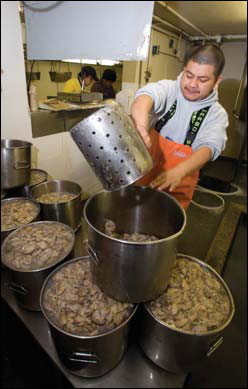
The tables take up the whole center of the tight room. It's loud. This is Harris Seafood, in February, after a fresh shipment of oysters has arrived from Pamlico Sound in North Carolina, along with some oysters from Deal Island down the Bay. The shuckers — almost three dozen of them — are a miracle of movement. They first jab each oyster against an electric grinder to knock off a spot on the shell. Then they use a short shucking knife to pry open the shell and slice the adductor muscle. The oyster slips out and into a pail. The shuckers get paid a dollar a pound and can make $20 an hour. This is piecework. Move on.
There are men and women here of every hue. Above the noise one friendly woman, African American, says there used to be more money in shucking oysters. Now business is down. She only does this sometimes — other times she drives a school bus.
Talking is difficult, and most focus on their work, casting quick glances around at the mayhem. When conversation does come, it may be in Spanish. More than a third of these workers hail from Mexico. Everyone is working like crazy. One man rocks from foot to foot as though hearing music in his head. Oertel says that sometimes they play the radio — loud — and then you can hardly talk at all. It used to be hymns.
And the oysters all used to be from the Chesapeake.
While cash crops like tobacco first fueled the Chesapeake's growing economy, another harvest sprang up that did not require large capital investment and did not depend on owning large stretches of land. This was the Chesapeake seafood business, and it proved the lifeblood for many Bayside settlements. Up any good-sized creek or cove a traveler would find watermen's workboats, crab shedding floats, oyster shucking houses. Some eked out a living along the shore, others launched full-fledged seafood businesses and prospered. Either way, those who harvested, processed, and sold Chesapeake seafood shaped a rich waterside culture soon known around the country. They passed on a heritage of sleek workboats, weather-toughened watermen, and legends of bountiful fish and shellfish. That heritage is now threatened by dwindling stocks, labor shortages, and global competition.
Most of all, it's threatened by the ecological decline of the Bay itself. This is the theme struck most often by Oertel, who's become a prominent voice for the Bay's traditional seafood industry.
The morning Karen Oertel came into the world, in November 1946, her father harvested 78 bushels of oysters near the mouth of the Corsica River on Maryland's Eastern Shore. That's the story told by her husband, Art Oertel, now sixty-five, and the historian in the family. Her life, it seems, was bound to oysters from the start.
Together Art and Karen Oertel, along with her brother and sister-in-law, Jerry and Pat Harris, have built a life on oyster shells — and now on crabs and other seafood as well.
Oertel says they could have sold out to condos a long time ago. But they didn't. "We're in this for the long run," she says.
With her sharp brown eyes and quick wit, she soon became a spokesperson for the family business and eventually for the local seafood industry. She's served on advisory committees, councils, task forces, and chambers of commerce. Now she's on the Board of Directors of the Maryland Agricultural and Resource-Based Industry Development Corporation (MARBIDCO), created in 2004 by Maryland's General Assembly to give the state's farming, forestry, and seafood industries an economic boost.
It has not been an easy path. The Bay has seen sharp declines in oysters since her father, W.H. Harris, first launched his seafood business back in 1947, after he returned from serving overseas. That year Maryland's oyster harvest came in around 2 million bushels a year. Though it saw some ups and downs, thirty-five years later the catch was still hovering around 2 million bushels. It must have seemed that the oysters would go on forever.
Then, in the mid-1980s, two oyster diseases, MSX and Dermo, rode a drought-driven salt wedge well into Maryland waters. They soon decimated oyster bars in the northern Bay, as they had in Virginia. The harvest plummeted, reaching rock bottom in 2004, with a commercial haul of less than 7,000 bushels.
All through this time, the Harris-Oertel clan worked to keep their seafood business going. They now run a seafood restaurant that sits right next to the oyster shucking plant. Seated around a cozy table there, they recall the heyday of the oyster business.
Art Oertel points along the walls of the restaurant, where two rows of shelves hold a collection of oyster packing cans. Their labels sport all manner of graphic designs and names. There's Jack's Oysters, Sailor Boy, and Silver Sea. There's Tred Avon River and J.C. Lore.
The best lithographs grace cans from about 1900 to 1920, he says. The companies could afford to pay for them — the oyster canning business was booming.
Back before World War II, Karen Oertel's uncle told him, a local company, A.C. Harris, shucked 1,900 gallons of oysters in a single day. The shuckers went to work at midnight, he says, and didn't stop until 4 o'clock that afternoon.
Around Kent Island alone, he figures there were some two dozen packing houses. Oscar Dunn, Brown Brothers, Calvert Jones, Alec Thomas, Harvey Ruth, Kneeland Shellfish, Diggs Seafood, John Coursey, B & S Fisheries, and many others. There was also A.C. Harris, Holton Harris (Karen Oertel's grandfather, who owned Kent Oyster Company), and W.H. Harris.
More than 650 old oyster cans fill Oertel's collection, tin ghosts of hundreds of oyster companies — companies that have all faded away. Or almost all.
One by one the packers around Kent Narrows closed, he says, until there were only two. B & S Fisheries and W.H. Harris. About four years ago, Jean Stelmach, the owner of B & S, closed up shop. That left W.H. Harris, now operating as Harris Seafood, as the last full-time oyster shucking plant in the Narrows and — according to Art Oertel — in the entire state of Maryland.
Whether counting on oysters or fish or crabs, so many of the seafood businesses that supported Bayside communities from Kent Island, Maryland to Hampton, Virginia, have slipped away.
 |  |
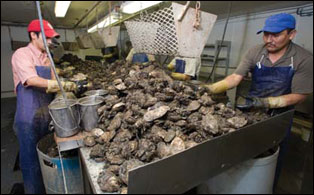 |
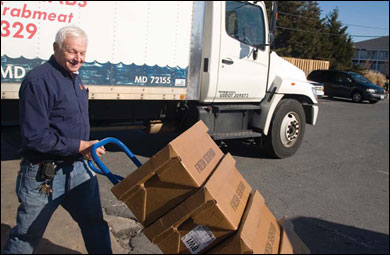
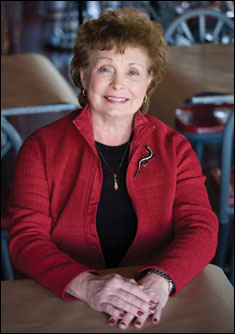
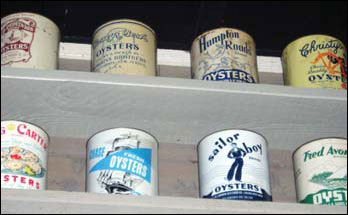 | Champion of traditional industries, Karen Oertel (above) and Jerry Harris (below, lower right) inherited a love of seafood from their father, William H. Harris. Sixty-two years after its founding, Harris Seafood still shucks and packs oysters (above and below left), often counting on seasonal workers from Mexico. Oyster cans (below) bear mute witness to hundreds of packing plants, now gone. Photographs by Skip Brown, except oyster cans by Jack Greer. |
 |  |
Sibling synergy emanates from Karen Oertel and her brother, Jerry Harris. Along with their spouses, Art Oertel and Pat Harris, they have pooled their energies to run a thriving seafood business and popular restaurant in the face of sagging local harvests and tough competition. Photograph by Skip Brown.
Low in bad fat, high in good fat, full of protein and nutrients, seafood has risen toward the top of many American menus. Americans now spend over $50 billion a year for fishery products, according to the National Oceanic and Atmospheric Administration (NOAA). U.S. consumption has topped 16 pounds per person per year. That's a lot of seafood, and that means a lot of business. Big business.
Just ask big-time buyers like Bob Arnold or Steve Schneider. Arnold directed the seafood programs for Marriott Corporation for seventeen years and now buys shrimp for the seafood company, Contessa. Schneider worked for years in Cambridge, Maryland for Icelandic Seafood and now lives in Boston, where he buys seafood for Fishery Products International.
To them, the seafood business now means large companies and increasing consolidation. Schneider's move to Boston, for example, came after a merger closed the Cambridge plant — bought out by another Icelandic company, Samband of Iceland. It was, he says, a sign of the times.
While traditional Bay processors may handle crabs by the bushel and oysters by the gallon, dealers like Arnold and Schneider buy their shrimp in 40-foot containers that arrive on oceangoing ships.
Seafood companies have moved toward becoming "global sourcing entities," says Schneider. For shrimp. For salmon. For tilapia and other popular species.
Where a specialty seafood business may once have sold local catch and regional favorites, he says, now seafood moves through large brokers, distributors, and grocery chains. They bring a much broader selection — and they get it wherever they can, from anywhere in the world.
According to Schneider there's a "threshold" for national markets, a minimum of 40,000 pounds a year for small suppliers to "a quarter million pounds" a year for the larger suppliers. He says the big suppliers also want large quantities at a uniform size, a demand small-scale operators may find difficult to meet.
With more big businesses getting into the game, competition is stiff. The difference of a few cents per pound can mean getting a large contract or losing it, say Schneider and Arnold.
In the new global economy, the seafood marketplace — as with other commodities — is fluid. Labor and sources shift as supply and demand change, as big money moves. In this climate of big business, how can local small-scale Chesapeake seafood businesses ever expect to survive?

Scott Fritze is banking on the Bay's seafood business taking a different turn. Fritze, along with partner Guy Furman, grew up not on the Eastern Shore but in the North Baltimore neighborhood of Roland Park. They represent a new generation that uses the word "sustainable" often. Fritze thinks that seafood buyers and restaurant owners now care more about where their seafood comes from, and whether those sources are sustainable — whether fishers will leave enough behind to allow stocks to continue to reproduce at a reasonable rate. Fritze, Furman, and their third partner, Andrew Hanzlik — all under thirty years old — feel that consumers are now more concerned with food that's fresh, not frozen, and with "what they put in their bodies." And they believe that they are providing the product those customers want — shrimp grown in completely controlled conditions.
Fritze and his partners have launched Marvesta Shrimp Farms, a high-tech aquaculture operation near Hurlock, Maryland that's gotten good press in the Washington Post and elsewhere. Marvesta's idea is intriguing: ship tiny (one-sixth of an inch) post-larval shrimp up from Florida then grow them from start to finish in large covered pools that look like greenhouses. No destruction of the mangrove forest. No by-catch that kills other sea creatures. No chemicals or impurities. No pollution. And, they're grown right here on the Eastern Shore. Marvesta's business plan is very specific. They grow large shrimp (5 to 8 inches long) and sell it fresh, not frozen, directly to high-end buyers — especially to the chefs of fine restaurants (see A Good Catch)
The facility has the capacity to grow some 40,000 to 50,000 pounds of shrimp a year, according to Fritze and Furman. Construction now underway will multiply that amount by three or four times.
That's a lot of shrimp for the Eastern Shore, but not a big haul compared to the shrimp farms of, say, Central America. According to the upscale chain, Whole Foods, the Bluecadia shrimp operation in Belize covers more than 20,000 acres, has three farms, two hatchery sites, a modern processing facility, and provides jobs for 350. Their facility is capable of freezing 100,000 pounds of shrimp per day. That's per day.
Nevertheless big seafood buyers like Arnold are intrigued with the Marvesta operation. They will have to be careful not to expand too fast, Arnold thinks. It will be a delicate dance between producing enough volume to be a player but not growing so fast that they get ahead of themselves in terms of scale and cash flow.
Will Fritze's faith in astute consumers and discriminating restaurants bear fruit? So far Marvesta's business model seems to be working, and he is not alone in the world of high-tech aquaculture. In western Virginia, for example, Blue Ridge Aquaculture, far from the Bay, raises tilapia, trout, salmon, cobia — and, just beginning, shrimp — all in closed systems. Big retailers from high-end groceries like Whole Foods to high-volume outlets like Wal-Mart are also getting on the sustainability bandwagon, and with so many wild stocks under pressure, eco-friendly aquaculture may be looking better all the time (see Evolution of a Movement).
But what about traditional seafood businesses that rely on getting oysters and crabs the old-fashioned way? Is there room for them in this brave new world?
The Mexican workers who shuck oysters around the metal tables of the Harris seafood plant are one sign that the Bay's seafood businesses are already adapting to change. Faced with a severe labor shortage, oyster processors and crab pickers have turned to migrant labor.
"We tried everything," says Jack Brooks of J.M. Clayton Seafood, a crab picking plant in Cambridge. Even busing in workers from the city. But according to Brooks and other processors in both Maryland and Virginia, the manual labor and seasonal nature of shucking and picking just don't appeal to local workers anymore. Things have changed, and many, they say, would rather work cleaner, more regular jobs in retail or other areas.
The seafood processors have themselves become part of globalization, bringing labor across borders to keep their industry going. They have also run straight into U.S. immigration controversies and the government's strict caps on guest workers. Brooks and others see guest workers as a make-or-break issue for the industry, and they've taken their cause to Capitol Hill (see Bay's Labor Lost).
While workers travel to Bay country to shuck oysters and pick crabs, those oysters and crabs often come from somewhere else as well. Many of the oysters now shucked at the Harris oyster plant come from the Gulf of Mexico, especially Louisiana. They also come from Delaware, New Jersey, and Connecticut.
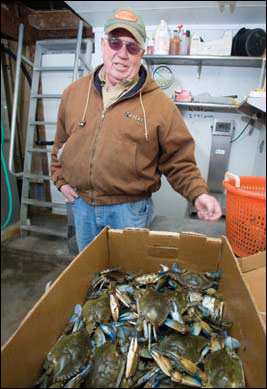
The same goes for crabs. During the winter, when crabbing shuts down in the Bay except for a small dredge fishery in Virginia, the Harris Crab House gets over 90 percent of its crabs from the Gulf. And even during the summer, with Bay harvests down and watermen scrambling to find decent-sized crabs, the restaurant still gets the vast majority of its crabs from the Gulf — despite its location right on the Chesapeake.

Jerry Harris, who does most of the buying for the business, says he can get a more consistent supply of big crabs from Louisiana than he can from the Bay, for essentially the same price. He also wants to keep his Gulf coast suppliers happy, so he can depend on them year-round.
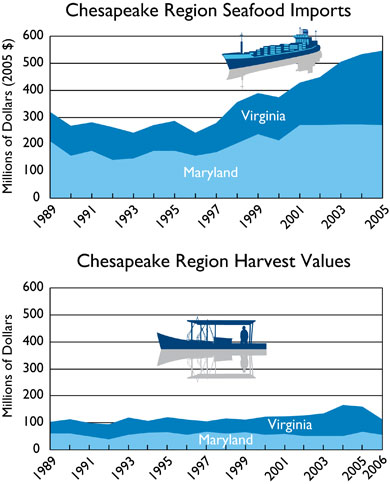
Harris buys whole crabs for their restaurant and plans to keep his sources inside the country. But when it comes to picked crabmeat, shipments headed for the Bay region may arrive from anywhere in the world. Venezuela. Thailand. Cambodia. Indonesia. The Philippines. Those in the Bay area who buy and distribute crabmeat, shrimp, and other seafood have turned to foreign sources in increasing numbers. According to University of Maryland economist Doug Lipton, who heads up the Maryland Sea Grant Extension Program, the annual value of seafood imports arriving on foreign ships at the ports of Baltimore and Norfolk doubled between 1995 and 2005, from less than $300 million to almost $600 million (see graph, above).
Seafood is pouring into the region from overseas, and some local dealers are doing very well — perhaps none better than Steve Phillips. Phillips, a local boy from Maryland's Eastern Shore, traveled to Asia to tap the large crab stocks there, and helped to turn a family business into the international giant that Phillips Seafood is today (see The Phillips Story). In this model, the workers, the product, and even the processing plants are all overseas. The only thing that makes it to the Bay is the crabmeat.
"That's a fine model if it works for him," says Karen Oertel. "That's not what we do." The Harris-Oertel family considered opening another restaurant and expanding, but so far they've decided not to. "If the next generation wants to do that, that will be their decision," she says. For now, even if their crabs come from the Gulf, they're still domestic, and she says they want to keep it that way.
Those who want to keep their seafood local face a serious shortage of supply. Except for striped bass, almost every major Bay species is struggling.
In an effort to grow more product locally, some traditional seafood businesses are also turning to aquaculture. Their techniques are less high-tech than Marvesta's closed-system shrimp farm, though some are trying new methods. Cherrystone Aqua-Farms has a clam hatchery in Cheriton on Virginia's Eastern Shore and is profitably growing clams in the open environment of Cherrystone Creek. The Bevins company, a longtime Virginia processor, is growing sterile oysters that grow fast enough to reach harvest size before diseases like MSX can kill them. In Maryland, the Marinetics company is growing oysters they call Choptank Sweets in floats — some 3,000 of them — near Cambridge.
Such enterprises are promising. But for traditional processors focused on volume, the output is small. The Marinetics operation, for example, is aiming to produce some 5 million oysters a year. Last year, Harris Seafood alone shucked about ten times that amount, almost 50 million oysters, according to Jason Ruth, who now runs the shucking operation. Aquaculture operations at the current scale, he says, could not take the place of his out-of-state suppliers.
For More Information
Maryland Seafood & Aquaculture
Maryland Crabmeat Quality Assurance Program
Video on local fishing communities
Maryland Sea Grant's Video Journal
Wild Caught: The Unheard Voices Project
In the end, both the traditional Bay seafood industry and cutting-edge aquaculture like Marvesta and Marinetics face the same challenge. Neither can meet the demands of large-scale global markets. Gone are the days of oyster shells piled as high as a house. Both Bay seafood grown in culture and what comes out of the Bay itself need to find high-value markets and high-end outlets like fine restaurants. They need to brand Chesapeake seafood as a local delicacy to regional buyers and as something very special to everyone else. They may need to sell it over the Internet (see Blue Crabs Online).
The key for these businesses is to aim for the top of the market, not the bottom. That's the only way to go, says Jane Stoors, a marketing expert at the Maryland Department of Agriculture (MDA). She's spent years marketing Maryland agricultural products to a wider world and says what's true for meat and vegetables is probably true for seafood as well. "You need to find out what consumers want," she says, "and then give it to them." It's not enough to bring your product to market and then see if anybody wants it, she says. "That puts you at the end of the line," she says, "a place you don't want to be."
Her colleague, Noreen Eberly, who heads up seafood marketing for MDA, agrees. She's trying to ride the "buy local" wave that's caught on in many parts of the country. Eberly works with smaller companies, and says that the Bay just doesn't produce enough seafood to move through large distribution centers like Jessup, Maryland, or through large restaurant chains like Applebee's.
Eberly and others in the seafood industry are focusing on quality — for example, through a Crabmeat Quality Assurance program. This program, administered by Maryland Sea Grant Extension specialist Tom Rippen, focuses on quality control throughout processing and tests for problematic microbes. Participating processors gain the right to use special labels that denote genuine Maryland crabmeat, both in fresh cups and pasteurized cans.
They're banking on the Bay's reputation as a producer of high quality crab, and branding the superiority of Maryland crabmeat in particular.
"The Bay is still the blue crab capital of the country," says economist Doug Lipton. "Maybe of the world."
Lipton's a big supporter of the Maryland crab campaign and of the effort to buy local. But he says that even with crabs and crabmeat coming from other places, the Bay will continue to draw crab lovers because of its history, its sense of place. People come from all over to eat crabs by the Bay, he says, and apparently it doesn't matter to them that much of that crab comes from somewhere else. Most restaurant-goers probably don't even realize it.
Economists like Lipton and longtime processors like Karen Oertel would likely agree that the biggest asset the Bay seafood business has for now is the Bay itself. The Bay is still trading on a reputation it's built over several centuries. A long habit of serving seafood.
There is, however, a darker side. If the Bay's reputation becomes one of polluted water body, with badly overfished stocks and seafood advisories that warn against contaminants like PCBs and mercury, the celebrated image of iconic watermen and bountiful seafood could shift. Degraded water quality and declining stocks could not only reduce the Bay's seafood supply, it could also damage its most prized possession — its reputation, its sense of place. Its place in the market.
It's a short walk for Karen Oertel from the restaurant to the shucking plant next-door. She's scheduled to give a tour of the plant and a Chesapeake Bay pep talk to several dozen first-graders just arriving in a bright yellow Queen Anne's County school bus. Teachers are already lining them up by twos out front. She's going to let them touch squishy oysters and mushy soft crabs and she'll teach them "not to trash the Bay."
She has the future in mind. What will these youngsters know of the Bay's famed seafood industry when they grow up? What will they understand about the healthy waters that have sustained her family for more than three generations? Will all the fish, crabs, and oysters these children eat come packaged in plastic from somewhere far away?