
At the end of a long driveway, flanked by fields of wheat-colored grass, Michael Pelczar walks towards the house and ushers two energetic Chesapeake Bay retrievers into a fenced yard. He moves slowly, using his cane to hold open the door as he carefully makes his way up the steps and enters a brightly lit farm kitchen that smells of freshly roasted coffee. When he first started coming to this family farm more than half a century ago, the kitchen still had a dirt floor.
Today a modern picture window in Pelczar's living room frames a garden ripe with peppers and tomatoes. An intricate array of duck decoys lines the windowsill. The window also frames the Bay, which sparkles an almost healthy shade of blue in the forgiving light of early autumn. Pelczar has lived on Avalon Farm on Kent Island full-time now since 1984, moving down soon after he retired from 31 years as a scientist and administrative leader at the University of Maryland. Now in his mid-90s, he's watched and contemplated the Bay from this spot for more than 60 years.
A lot has changed in the waters off Avalon Farm since the 1940s. Underwater grasses grew so thick then that they tangled the seine the Pelczars cast to catch fish. On any given day in the winter, upwards of 30 oyster boats would work the patch of the Chesapeake known as Crab Alley Bay, as rich then in oysters as it was in crabs.
The oystermen are gone. He hasn't seen a single boat in years. Only a few crab boats cruise Crab Alley. The invasive plant Phragmites has usurped the place of native cord grass. Once abundant diving ducks have all but disappeared. Just past the turnoff to Avalon Farm's long dirt driveway, cars pour down Route 50 in a steady stream and clusters of condos push up through the ground like mushrooms after a rain. Mute swans cruise the water under the Kent Narrows Bridge, indignant in their graceful, destructive beauty.
"Everything is down, down, down," says Pelczar. "The only things going up are jet skis and mute swans."
To Pelczar, the mute swan is a visible symptom of a sick Bay, of an ecosystem gone awry. This invasive species eats 10.5 million pounds of underwater grass each year, destroying habitat for waterfowl, fish, and shellfish. And underwater grass has a tough time bouncing back, with all the other problems in the Bay standing in the way — too much nitrogen, not enough oxygen, too much algae, not enough light. Burgeoning development, traffic, more sewage, more impervious surfaces, even more nitrogen. These are the harsh refrains of the Chesapeake's swan song.
Pelczar hears subtler sounds too, bringing the ear of his own scientific discipline of microbiology to his perspective on the Bay. He knows that many processes in the environment start with microbes — the tiniest of algae species, bacteria, single-celled protists, and even viruses. He knows that the Bay functions as an interconnected web spanning many orders of magnitude — from the tiniest microbe to the 27-lb mute swan and beyond. But he also knows that connecting the dots across scale and scientific discipline is no small matter.
When Michael Pelczar joined the faculty of the microbiology department at the University of Maryland in 1946, the Chesapeake Bay Bridge connecting the Western and Eastern shores of the Bay would not be built for another six years. Although the population was on the rise after World War II, suburban development would not hit full force for another decade. Modern roads were just starting to shrink distances around the region, but much of the Bay still relied on slow ferry service.
Pelczar's own field of microbiology would soon see a major revolution. That year, 1946, saw the invention of the first large-scale electronic computer. Computing power that now fits in a wristwatch then filled a room. That same year, scientists first discovered that bacteria could exchange genetic information with each other in a form of sexual reproduction known as conjugation — a discovery that would lay the groundwork for genetic engineering. Scientists would also realize that it is DNA that acts as a transforming agent in cells, but it would be another seven years before James Watson and Francis Crick would unravel its famed double helix.
Teacher and researcher in the microbiology department (top right), Michael Pelczar shaped plans to rebuild the microbiology building in February 1963 (middle right). His vision for Horn Point Environmental Laboratory (now HPL) came to fruition in 1973 at the groundbreaking ceremony for the oyster hatchery (bottom, Pelczar in white suit, far right). Top photographs from the University of Maryland College Park archives. Bottom photograph courtesy University of Maryland Center for Environmental Science.

Above photograph by
Erica Goldman.

The degree of technological advance and the extent of change in the Chesapeake watershed fated for the next half century were perhaps inconceivable when Pelczar first began his career at the University of Maryland. But he soon recognized that the organization of the scientific enterprise would have to keep pace as the scale of information grew.
To study a place like the Chesapeake Bay, he realized, would take capacity, expertise from multiple disciplines and across varying scales of organization — from microbiologists to oceanographers. Pelczar's administrative vision soon gained recognition within the University of Maryland. In 1966, he became the Vice President of Graduate Research. From this position, Pelczar helped to shepherd several key administrative changes in the scientific landscape of the Chesapeake region.
Most research grants from University of Maryland researchers began to make their way across Pelczar's desk. He soon realized that Bay science was diffuse and fractionated. The Smithsonian Environmental Research Center, John Hopkins University, the University of Maryland, and Virginia Institute of Marine Sciences were all major players in the region, but no central body existed to coordinate these efforts.
One day Pelczar fielded a call from the director of the National Science Foundation (NSF). "No more funding for separate institutions to study the Chesapeake Bay. Put together a single program to identify regional priorities." This was the mandate handed down from NSF. The directive resulted in the creation of the Chesapeake Research Consortium (CRC), Inc., a nonprofit corporation chartered by the State of Maryland. The consortium, which now comprises an association of six institutions, provided an umbrella for Chesapeake science, one under which collaborations between institutions could begin to grow in a more integrated manner.
With the CRC in place as a foundation, Pelczar continued to work to build capacity at the University of Maryland for studying the Chesapeake Bay through an interdisciplinary lens. When the city of Cambridge approached the University in 1970 with a proposal to build an Eastern Shore campus on the old Horn Point estate of Francis du Pont, Pelczar chaired a university-wide committee to decide what that new campus should look like. The committee developed a proposal to create the Horn Point Environmental Laboratory (HPEL), now Horn Point Laboratory (HPL).
Pelczar's vision for Horn Point grew from the need to bring scientists from different disciplines to a central place to study the Bay, from oceanographers to biologists to chemists. According to the proposal Pelczar helped author, Horn Point would serve as the administrative home for a new Center for Environmental and Estuarine Studies, which would bring together university-based efforts to study the Bay.
There is "a unique opportunity to create something new and different at Horn Point," Pelczar wrote in the proposal. "The physical and the intellectual resources are clearly available. What remains to be seen is if we have the institutional will to redirect these resources to meet real problems of real people."
Together Horn Point and the Chesapeake Research Consortium boosted the capacity for environmental science in Maryland, creating a platform to go still further. For Pelczar, the next step would be to resume planning efforts to bring a Sea Grant program to the University of Maryland, a process that had begun in 1970 but was displaced by efforts to start up the Chesapeake Research Consortium and the Center for Environmental Studies.
Pelczar helped shape a proposal to the National Sea Grant office based on the need to solve the problem of the declining oyster population in the Bay. Recognizing the growing capacity in Maryland to apply marine science to real world problems, the National Oceanic and Atmospheric Administration awarded the University of Maryland Sea Grant Program status in 1977. Pelczar tapped fellow microbiologist Rita Colwell, a colleague at the University of Maryland who shared his vision for interdisciplinary research, to become Maryland Sea Grant's founding director.
In 1977 the Chesapeake Bay was already a changing place. The floodwaters of Tropical Storm Agnes in 1972 had tipped the balance, transforming the Bay from a state with clear waters and abundant underwater grasses to one overrun by algae.
That same year, the Environmental Protection Agency commissioned a Bay-wide study to uncover reasons for the Bay's decline, a study that would take six years to complete. With the added capacity and coordination brought to the region by the Chesapeake Research Consortium, Horn Point Environmental Laboratory, and Maryland Sea Grant, the scientific community was better poised than ever before to confront the Bay's problems — problems that seemed to increase in complexity every day.
At the end of a long hallway that smells of fresh paint, Rita Colwell's office in the new center for Bioinformatics and Computational Biology at the University of Maryland is one of the only occupied offices on the floor. Most of her boxes are unpacked, save a few stacks of journal reprints. A bowl of fruit and miniature Oreos on the table in the middle of her office invite visitors to make themselves at home. Pictures of Colwell's children and grandchildren sit on a bookshelf under the window, next to a picture of herself with former president Bill Clinton. Diplomas and honorary degrees hang next to simple canvas artwork that looks like it was collected overseas. Three hard hats sit high on a shelf, souvenirs of various ground-breaking ceremonies — one from the University of Maryland Biotechnology Institute, where she served as founding director and president, one from the Christopher Columbus Center, which she helped create, and one from AAAS, where she served a term as president.
Colwell is at home in the new center, one dedicated to multidisciplinary research on questions arising from the genome revolution, a revolution in scientific thought that's been 30 years in the making. It seems a logical fit for the road she's traveled. The center aims to bring together scientists and engineers from many fields, including computer science, molecular biology, genomics, mathematics, statistics, physics, and biochemistry to answer questions about the complexity of the biological world. This crosscutting approach resonates at her intellectual core.


Microbes, she thought, might hold clues to what makes the marine environment either resilient or vulnerable to change.
When Colwell became director of Maryland Sea Grant in 1977, the idea of mounting researcher efforts across departments was just beginning to gain traction. So was the intellectual challenge of understanding the world at varying scales Both ran counter to traditional reductionist science, which distilled systems down to their smallest constituent parts. Within a few years, ideas such as the Gaia hypothesis would had popularized the notion that living and nonliving parts of the earth operate as a complex interacting system.
Scientific discovery had also begun to penetrate new levels of observation, especially the molecular realm. 1977 ushered in a new era of understanding the microbial world and how it functions. That same year, scientists discovered life at deep-sea hydrothermal vents, thousands of meters beneath the ocean's surface, revealing a strange new world fueled by sulfur-breathing bacteria. The first method to sequence DNA also came online that year. And for the first time, a human protein was produced inside bacteria, which proved the start of the field of genetic engineering. New companies focused on molecular approaches began to sprout like weeds. Many cite 1977 as the "Dawn of Biotechnology."
But for Colwell, a sense for the complexity of biological interaction and the need for integrative approaches to study them predate this new era by many years. She remembers spending unstructured summer days as a child near Beverly, Massachusetts. These were the kind of days that kids rarely experience anymore, where she "would pack a lunch, go out on the beach, and come back by dinnertime." She recalls storms that roared through and left her wondering how the beach, with all of its life and structure, could rebound from such an insult.
The marine environment would come to exemplify to Colwell "the origin or protection of life on earth, or both." She developed her research program in marine microbiology at a time when the very field was in its infancy. Gravitating towards interdisciplinary questions, she sought to apply tools of yeast genetics to microbes from the marine environment. She was immediately impressed by the complexity of the coastal and estuarine habitat. And microbes, she thought, might hold clues to what makes the marine environment either resilient or vulnerable to change, an idea ahead of its time.
"Microbes allow us to look at populations and derive fundamental principles that we couldn't before," she says. When she completed her graduate work at the University of Washington in Seattle in 1960, Colwell was one of just a handful of scientists working in the field.
Colwell's own research program merges her interest in microbes with her passion for understanding the complexity of the biological world, taking her all the way from the Chesapeake Bay to Bangladesh, from microbial ecology to human health. She studies the marine bacterium Vibrio cholerae, which can cause the disease cholera. What started in 1970 with the discovery in the Chesapeake that the bacteria that causes cholera is a natural inhabitant of brackish water environments — one which associates with shrimp-like copepods — evolved into a paradigm for studying the environmental conditions that can lead to cholera outbreaks worldwide. The integrated framework that ultimately emerged from her work provided the tools to predict and control pandemics of cholera in regions like Bangladesh, where the disease is endemic. It can also help predict how environmental changes like global warming might impact epidemics of the disease.
That a microbe with a reputation for causing virulent disease could occur naturally in a marine ecosystem proved a major sea change in thinking. Some had argued that airplanes that dumped their lavatory waste while in flight were spreading cholera. The fact that Vibrio cholerae functions as a natural part of many estuarine systems issued a challenge to scientists to look at the microbial world through a new lens, one that until recently belonged more comfortably to ecologists that study the world on macro scales. And as the tools of molecular genetics started to become available, the ability to explore these kinds of ecological questions on the microbial scale became like "opening a Venetian blind," Colwell says.
Colwell's vision of the inherent complexity of the marine environment also provided a frame through which she approached the problems faced by the Chesapeake Bay. Sea Grant in particular, according to Colwell, provided a unique opportunity to apply basic science to address real world problems. "Sea Grant will provide us the best of both worlds: we can enlarge the scope of our scientific inquiry to include those events governing the estuarine ecosystem while simultaneously seeking solutions for the Chesapeake Bay," she wrote in 1977.
To understand why oysters and crabs are diminishing in numbers, she articulated, "we must learn more about the species we are harvesting, about the chemicals, wastes and materials discharged into the Bay...." Questions about basic biology, physiology, and ecology were of utmost importance to Colwell. For example, in order to understand how waste discharges might affect oyster populations, she believed that it would first be necessary to understand the basics of oyster reproduction and larval settlement.
The earliest projects funded by Maryland Sea Grant reflected Colwell's vision for understanding how a system functions in order to drive the discovery of applied solutions to environmental problems. Projects funded ran the gamut from a study investigating the microbial indicators of water quality to recruitment dynamics of blue crabs to the development of collection devices for oyster spat. Colwell also set a tone for rigorous peer review that carries through to the present day. "I got accused of setting up a mini-NSF," she says, with no irony despite the fact that she did go on to serve as the director of the National Science Foundation (NSF) from 1998 to 2004.
Strong basic science, bolstered by the emerging tools of biotechnology, could help uncover the mechanisms behind the Chesapeake's decline, according to Colwell. And scientific efforts that could transcend disciplinary boundaries would be key. Where would the major breakthroughs about the Bay's health originate? What scales of observation would prove most informative? As it had with Colwell's cholera discovery, would unraveling the complexity of the Chesapeake's microbial realm aid in the Bay's recovery?
Michael Pelczar leaves the kitchen table and heads for his home office in the next room. His desk is piled high with papers and, like Colwell's office, the walls are covered with photographs and diplomas. Pictures of each of his six children, grandchildren, and great-grandchildren hold places of honor. He returns to the table carrying a copy of the textbook Microbiology. Pelczar first authored and published the book in 1958. He's updated it over the years as the field has changed, publishing the most recent edition in 1986. The book has become a classic in undergraduate courses. Now colleagues in India want to carry the torch. Pelczar's book sold over 29,000 copies there in 2006 and publishers have recently contacted him for advice on updating it again. "Let me take this opportunity to convey my heartfelt appreciation for the wonder that your text on microbiology is," begins the note from publisher McGraw-Hill, Inc.
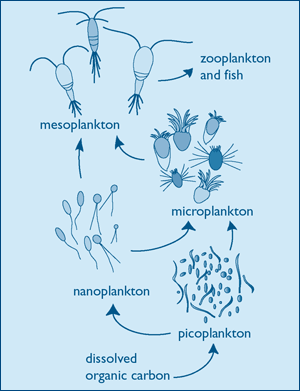
One of the major breakthroughs in the field of marine microbiology that Pelczar had not been able to capture in the first edition of his book was the discovery of the so-called microbial loop in marine food webs, a paradigm-shifting change that began to gather momentum in the mid-1970s. Selected by NSF as one of the landmark discoveries in ocean sciences in the past half century, the emerging concept of the role of microbes in the open water (pelagic) food web upset the commonly held belief that phytoplankton, zooplankton, and fish were the major players.
Questions about whether the marine food web is actually microbe-centric began in the early 1970s with work by Tom Malone, now at the University of Maryland Center for Environmental Science, who introduced the notion that very small plankton (picoplankton) and micrograzers might be playing an important role in the food web (see "Thinking Deeply about the Shallows"). A prescient paper published in 1974 by ecologist Lawrence Pomeroy at the University of Georgia receives credit for propelling the microbial loop into the limelight. In his paper, "The ocean's food web: A changing paradigm," Pomeroy posed a series of questions about the marine food web. He asked whether single-celled grazers (protozoa) played an important role as consumers of other microorganisms in the food web and as recyclers of dead matter. He questioned whether microbes, more than any other group of organisms, might carry out the bulk of the cellular respiration in the food web, using oxygen to make energy to live.
But the answers to Pomeroy's questions would not be possible until two technological breakthroughs took place. The first came in 1977, with the invention of a fluorescent staining technique that permitted rapid counting and discrimination of bacteria, protozoa, and phytoplankton. The second, flow cytometry, a technique which uses laser light to count, examine, and sort microscopic particles suspended in a stream of fluid, came in the mid-1980s. Flow cytometry enabled the discovery of a novel microbe (a picoplankter, so-called for its size range of 0.2 to 2 microns) that would prove to be the most abundant photosynthesizer (autotroph) in the world.

Understanding the complex role that microbes play in marine food webs like the Chesapeake's was a major advance in basic science. This discovery would help map the flow of energy through the Chesapeake Bay's food web and show how microbes could shunt energy away from larger organisms like fish, crabs, and birds to feed their own metabolism. By inserting the concept of the microbial loop into the Bay's food web, scientists would learn how to connect the dots between excess nutrients like nitrogen, algal blooms, and low oxygen conditions (hypoxia) — filling out a picture for how microbial demands for oxygen would pull it away from fish and the tiny animals that they eat (zooplankton).
The current hypothesis: Excess nitrogen fuels more algal growth than can be eaten by zooplankton, fish, oysters, and others. When the algae dies and sinks to the bottom, it becomes food for microbes — populations of single-celled protozoans and bacteria that comprise the microbial loop. The microbial population grows in response. Since small organisms have faster metabolisms than large organisms — a pound of bacteria consumes more oxygen than a pound of fish — microbes can suck oxygen away from larger organisms.
Today, the identity of most of the microbes in the microbial loop remains a mystery. In fact, some 90 percent of the microbial world is still believed to be unknown to science. And approaches that can go the next step to connect specific microbes to their function in the food web are still in their infancy (see "Biocomplexity and the Bay"). But not for long. The Sorcerer II's journey of microbial exploration, led by the J. Craig Venter Institute, recently started publishing the findings of a trans-oceanic voyage of discovery meant to recreate the expedition of Charles Darwin's HMS Beagle. Researchers sampled the ocean in 41 locations, isolating and subsequently freezing bacterium-sized cells. They also recorded the temperature, salinity, pH, oxygen concentration, and depth. So far their efforts have turned up over 400 novel species of microbes able to make millions of proteins that were previously unknown to science.
As in the 1970s, microbiology once again may be poised on the cusp of revolution. In March 2007, a new report from the National Research Council stated that the emerging field of environmental genomics (metagenomics), where the DNA of entire communities of microbes can be studied simultaneously, presents the greatest opportunity — "perhaps since the invention of the microscope" — to revolutionize understanding of the microbial world.
As 1977 was dubbed the dawn of biotechnology, will 2007 begin an era of microbial rule?
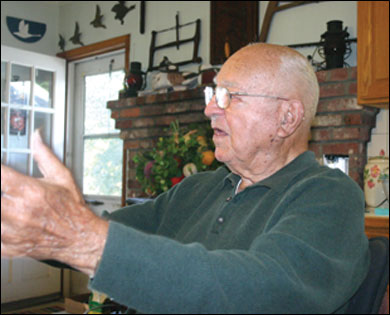
Back at the kitchen table, Pelczar opens Microbiology and prepares to autograph it. He adjusts his thick glasses and flips past the Table of Contents, pointing to the beginning of the book's Preface. It opens with his favorite quote by Louis Pasteur, one of the founding fathers of microbiology. "Messieurs, c'est les microbes qui auront le dernier mot." Or "The microbes will have the last word."
Most still don't look at the problems of the Chesapeake and think about microbes orders of magnitude smaller than the eye can see. But what if Pasteur proves right? What if microbes do have the last word to say about the Chesapeake Bay? Will we be ready to hear what they are saying?