
As Peter Bergstrom wades into Old Man Creek, he's grateful he's wearing neoprene socks. Calf-deep in the chilly water of early spring, he floats his blue kayak just past the ramp at Stewart's Landing in Severna Park, Maryland and climbs in carefully, tucking his slight frame into the hull. The riskiest time for capsizing is getting in.
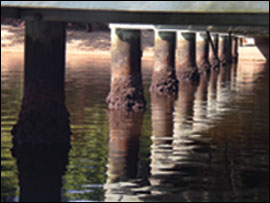
Bergstrom paddles into the creek, wending his way along a coastline packed with houses, their narrow backyard docks jutting into the water. The tide is on the ebb and already the water level is low enough to expose the wooden pilings beneath the piers. Bergstrom maneuvers his kayak next to a piling, reaches into the water, and runs his hand down the pole.
In 2004 just a faint touch of Bergstrom's fingers on the piling would have sent strange little bivalves cascading to the creek's silty bottom. That summer the dark false mussel, as mysterious as its name, grew thick in Old Man Creek, a tributary off the Magothy River near Annapolis. Mussels clung like heavy carpets to almost every hard surface. They would tumble off under their own weight.
Now as Bergstrom drifts from piling to piling, he comes up empty-handed, feeling only a few rough-edged barnacles. He's not surprised the mussels are gone. A biologist for the National Oceanic and Atmospheric Administration (NOAA), Bergstrom has served 16 years as the volunteer monitoring coordinator for the Magothy River Association. And he had never before seen the likes of what happened in the summer of 2004, when hundreds of millions of these creatures found a temporary home in creeks of the Magothy, South, and Severn rivers.
Bergstrom thinks that the dark false mussels rode in on the coattails of Hurricane Isabel in late 2003, their larvae catching a plume of water that moved up from the saltier mid-Bay, where these creatures tend to live among oyster reefs. Finding their surroundings suitable, they settled on any hard surface they could find — pilings, riprap, the hulls of boats. And they ate. And ate.
The dark false mussel proved its punch as a powerful filter feeder that summer. Native to the Chesapeake and a close relative of the zebra mussel, the dark false mussel at its peak abundance was estimated to filter nearby Cattail Creek in just under two days.
The mussels ate algae and the waters of Old Man Creek cleared. In 2004 the creek measured the clearest it had ever been since Bergstrom started monitoring there in 1991. Fewer solid particles (total suspended solids) clouded the water. Bottom dissolved oxygen levels improved. Underwater grasses started to come back. According to locals, more juvenile blue crabs scuttled through new nursery grounds.
Then they were gone. The population of dark false mussels exploded practically overnight — then, just as suddenly, they disappeared. Perhaps the mussels needed saltier waters to reproduce successfully or perhaps they fell victim to predation. Scientists still don't know for sure. But to those who live on the Magothy, who fight for the health of their river, the clear waters engineered by the dark false mussel became a symbol for the power of prolific filter feeders, of what once was, and what could be again.
Bergstrom's kayak paddle draws ripples in the still morning water as he makes his way among the pilings of Old Man Creek. These days his white paddle disappears almost instantly as it dips below the creek's surface. Old Man Creek is murky again, as murky as it has ever been. And the dark false mussel is nowhere to be found.

 |  |


Aside from oysters, filter feeders (also called suspension feeders) rarely draw much attention in Bay country. Who are these other filter feeders that call the Chesapeake Bay home? And do they — or could they — thrive in enough numbers to help clear the Bay's murky waters?
The strange epidemic of dark false mussels in the Magothy became an unanticipated biological experiment of sorts — a "proof of concept."
"What it showed is that if you could get some sort of suspension feeder in there in a sustainable fashion, it could start to improve the water quality," says Linda Schaffner, an ecologist at the Virginia Institute of Marine Science (VIMS) in Gloucester Point, at the southern end of the Bay.
These types of feeders, she explains, could help lock up (sequester) nutrients in their body tissues, paving the way for aquatic plants and animals that need clearer waters to survive. "I used to joke that we should hang ropes and let Molgula (a sea squirt that fouls dock pilings) grow," she says. But that, she says, is exactly what happened when the dark false mussel settled on every available surface — ropes, boats, pilings, cages.
What's keeping these other filter feeders from thriving in greater numbers in other habitats? Lack of substrate poses one definite problem. Opportunistic filter feeders grow essentially as fouling communities, Schaffner explains. Increasing the population size of these other species would depend on being able to increase the amount of available hard-bottomed surface in open water environments.
Salinity also presents an obstacle. In streams, freshwater filter feeders can do a good job of improving water quality. In tidal marshes, salinity-tolerant mussels grow prolifically. But fewer filter feeders thrive in mid-salinity, deeper water areas, which may leave an ecological niche empty in the mid-Bay, according to Roger Newell, an oyster biologist at the University of Maryland Center for Environmental Science Horn Point Laboratory. He believes that only oysters could fill that niche, since they thrive in deeper water and can tolerate the widest range of salinity.
Scientists don't know much yet about the potential for other filter feeders to affect water quality in the Chesapeake. In the York River, so-called opportunistic suspension feeders — sea squirts (tunicates), polychaete worms, clams, and mussels to name a few — outnumber oysters five to one, explains Schaffner. "If there is any effect of suspension feeders on water quality here [in the York River], it is from these opportunistic species," she says.
These species tend not to draw a lot of scientific interest, says Schaffner. She tried to secure a grant for a larger-scale effort to survey them in the Chesapeake Bay, but the project did not mesh with current funding priorities. She ended up limiting her survey to the York River since it was easier to mobilize a smaller-scale effort on a shoestring budget, but she'd like to do more.
Looking closely at this issue really should be the next step for the Chesapeake, says ecologist Danielle Kreeger. Kreeger works in a different estuary — the Delaware Bay — studying the potential for native mussels to help restore water and habitat quality in both the tidal system and up in the streams and rivers (see From Headwater to Bay). To thoroughly assess the potential impact of these other filter feeders, she says, you need to know what volume of water actually gets processed and how often that parcel of water comes in contact with the animal. Such an effort would require an interdisciplinary team of ecologists and hydrodynamic modelers, according to Kreeger, who is the science director for the Partnership for the Delaware Estuary, one of the 28 National Estuary Programs modeled after the Chesapeake Bay Program.
Kreeger has started down this path already, working with researchers from several institutions and students from Drexel University in Philadelphia, where she maintains her research lab. She's made preliminary calculations for several species, including the marsh mussel, Geukensia demissa, which thrives in the Delaware Bay's tidal marshes. Kreeger estimates that the mass of marsh mussels in summer filters 60 billion liters per hour, more than six times what the current population of oysters in Delaware Bay can filter.
Planting her ski pole on the uneven trail, Harriette Phelps begins the half-mile trek down to the Potomac River near Indian Head, Maryland. She's recovering from leg surgery and moves cautiously down the trail, part of Fort Foote Park. Earl Greenidge, her former student and current data technician, carries her field collecting gear and walks nimbly ahead, easily managing the bulky equipment.
By the time Phelps reaches the sandy beach, Greenidge is already hunched over in the knee-deep water of low tide, scooping sand from the bottom using the exterior cage of a fan (the so-called fan guard) as a sieve. With each fan-full, he brings up more than a dozen small clams that remain behind in the fan guard after the sand falls through. Phelps, an emerita biologist at the University of the District of Columbia (UDC), instructs Greenidge to keep sampling until he gets 200 of these small, ridged clams, called Corbicula fluminea.
Greenidge meets the target number in under five minutes — Corbicula thrives at high densities in the Potomac. He wades back to the beach and transfers the clams into shellfish bags made from hard plastic. Phelps and Greenidge pack up their equipment and head back up the trail.
A potent filter feeder, Corbicula may take some of the credit for improving water quality conditions in the Potomac River, according to Phelps. Scientists first identified Corbicula in the Potomac in 1977, and they watched as populations of these clams rapidly increased. By the mid-1980s, Phelps, with help from her students at UDC, calculated that the spring-summer clam population could filter one-third of all the water in this region of the estuary daily. As early as 1981, researchers reported a tripling of water clarity in the region of the clam beds. In 1983, submerged aquatic vegetation (SAV) reappeared for the first time in 50 years. Starting in 1984, the Washington, D.C. Christmas Bird Census reported significant increases in several aquatic bird populations. By 1986, fish populations had increased up to seven times in the newly grown beds of underwater grasses. Corbicula may have helped trigger these system-level changes in the Potomac River, as Phelps reported in a 1994 article in the journal Estuaries.
But the river experienced other changes at the same time, so the role that the clams played proves tough to parse. Improved sewage treatment at the Potomac River-based Blue Plains Waste Treatment Plant, along with a ban on phosphorus in laundry detergent, helped improve water quality by decreasing the flow of nutrients to the river. The fast-growing invasive plant Hydrilla verticillata also appeared in the Potomac in the mid-1980s. Hydrilla may have also helped transform the ecosystem by stabilizing the bottom, producing oxygen, and encouraging the growth of native plants.
Corbicula's positive impact on water quality comes in a complicated package. Like Hydrilla, it is a non-native, invasive species. From its native range in Asia, Corbicula was imported to the west coast of the U.S. in the 1930s for food in Asian markets. When scientists first identified this clam in the Potomac River, they braced for the worst, fearing that it would behave like the dreaded zebra mussel, attaching to every available hard surface, clogging water intake pipes at power plants, and transforming the fundamental who-eats-whom structure of the Chesapeake's freshwater rivers. A research note published by U.S. Geological Survey scientists in Estuaries in 1980 adopted a warning tone, stating that this addition of Corbicula fluminea to the Potomac River ecosystem must be followed attentively. The paper cited another researcher who called the clam "the most costly liability of all exotic mollusks in North America."
Despite these fears, the worst did not come to pass. Unlike the zebra mussel or the native dark false mussel, Corbicula lacks byssal threads and cannot attach to hard surfaces. The clam did cause some problems due to fouling — the Potomac Electric Power Company reported operational problems caused by clamshells and silt clogging their condenser cooling water tubes. As they drift downstream, juvenile clams also get caught inside the intake wells of power plants. But with an open ecological niche available along the sandy bottom sediments of the river, Corbicula could spread rapidly without crowding out populations of native species in the Potomac. As a result, scientists do not think the clam has had a major impact on the river's food web, except as a food source for birds and muskrats.
When Phelps reaches her Honda back in the parking area, she realizes she forgot to bring the ice packs to keep the clams cold while in transit. She makes plans to stop for ice at a nearby fast food restaurant on their way to the Anacostia River.
Phelps is moving these clams from the now relatively unpolluted Potomac to the very polluted Anacostia, to a point in the contaminated northeast branch in Maryland. She uses them as a biological indicator of pollution, a white rat of sorts, harnessing their skill for concentrating chemicals in their body tissue to reveal the source of contaminants from upstream. The clams will stay in the polluted water for two weeks before they are retrieved and analyzed. The transfer carries no risk of invasion to the Anacostia, according to Phelps. The transplanted clams, she explains, are carefully contained in tethered cages and they can survive in the polluted river (just barely) but won't reproduce because the sediments are too toxic.
Rolling down the car window, Phelps pulls the Honda up to the intercom at the takeout window of a nearby Kentucky Fried Chicken and asks for some ice. The voice on the other end tells her to pull around to the service door. A woman soon emerges and gestures for Greenidge to follow her inside with the cooler bag. She reaches for it then hesitates. "What's in the bag?" she asks. "Clams from the Potomac. We are taking them..." Greenidge starts to explain, but she cuts him off and pulls her hands back, giving him a look that says, "Really, I don't need to know." Keeping her distance, the woman scoops ice while Greenidge holds the open bag. The clams, now comfortably cool, continue on their way to the Anacostia.
  |
There are no plans to move Corbicula intentionally into habitats in which it could reproduce for the sake of improving water quality — despite its seemingly positive, ecosystem-scale impacts in the Potomac. "Wherever it has already exploited, yes, it is OK in its competitive abilities in that habitat," says Rochelle Seitz, a benthic ecologist at VIMS. Corbicula, however, is still a non-native species, she warns, and may behave unpredictably in a new environment.
On the other side of the country, in the tidal freshwater areas of San Francisco Bay, Corbicula did cause major ecological disturbances, according to Jim Cloern, a biologist with the U.S. Geological Survey. Unlike in the Chesapeake, algae grow in limited supply in that estuary where Corbicula competes for food with native algae-eating zooplankton. Worse yet, the clam actually eats certain zooplankton (rotifers) outright, further decreasing their abundance in the middle level of the food web and reducing the food available for fish.
Another invasive clam, Corbula amurensis, proved even more disruptive than Corbicula in San Francisco Bay, engineering major ecosystem changes in the brackish regions. "Resource managers here think about these two invasive clams in the same way people think about nitrogen and phosphorus in Chesapeake Bay," says Cloern.
Back in the Chesapeake, non-native species simultaneously provoke concern and signal opportunity. The capture this year of a third invasive Chinese mitten crab incited much worry. But, for some, a non-native oyster inspires hope for clearing the Bay's waters and bringing back a collapsed industry. Scientists, resource managers, and politicians are currently debating the pros and cons of Crassostrea ariakensi, an Asian oyster that could prove a powerful filter feeder and, if it thrives, boost commercial harvests.
Introducing a non-native species is an option that should be approached with caution, says Cloern. "Whenever we do these kind of biological interventions, there are always surprises," he warns. That's why it's critical to take an ecosystem-level perspective, he says. "We are never smart enough to predict what all of the consequences might be."
The Chesapeake's murky water needs all the filter power it can get. The Bay has one species of oyster, but it's home to dozens of native species of clams, mussels, worms, crustaceans, anemones, and sea squirts — just to name a few (see Sampling Life at the Bottom of the Bay). These species are neither commercially desirable nor susceptible to disease. And each plays a key role in cycling nutrients through the Bay's food web. Perhaps it's time to focus on the filter power and other benefits of these little-noticed species, says ecologist Danielle Kreeger.
How might managers maximize restoration opportunities with these less charismatic creatures? Restoring oysters could be the key, according to scientists, but only if they are restored as large, vertical reefs — and those reefs are then protected from harvest. If we rebuild the three-dimensional structure of the oyster reef, they say, and leave it alone, these other species will come.
"One could argue that the most important role for the oyster is making the structure for other animals to settle on."
There's only one oyster living on this concrete block used as an artificial reef, but there's a veritable smorgasbord of sea squirts, hooked mussels, and barnacles. Photograph by Kennedy Paynter.
And they will come in mind-boggling numbers. In a recent study, University of Maryland scientists William Rodney and Kennedy Paynter found that restored plots in sanctuary oyster bars held ten times as many filter feeders as degraded, unrestored areas. The sheer numbers of organisms proved even more impressive. The hooked mussel, an important filter feeder that grows in association with oysters, was more than 200 times more abundant in the restored plots. Rodney and Paynter counted over 11,000 hooked mussels in these areas, compared to just over 50 in the unrestored areas.
At these numbers, Paynter says, the hooked mussels could be filtering even more water than oysters on a restored reef. Though no one has yet done calculations that include the filtration rate of the hooked mussel, he says, the combined impact of the two together could be quite significant.
Moreover, these restored reefs attract more than mussels and oysters, according to the study. The structural complexity of a mature oyster reef provides both surface area for other fouling organisms — such as sea squirts, anemones, and barnacles — and a spatial refuge from predation for species such as the insect-like amphipods and small fish, explains Paynter.
"One could argue, then," he says, "that the most important role for the oyster is making the structure for other animals to settle on."
These lesser-known species not only help clear the water, they also redirect nutrients to other parts of the food web. The abundance and diversity of species like amphipods, that eat the feces and pseudofeces produced by filter feeders like oysters and mussels, creates "a huge catalytic flow" into other levels of the food web, says Paynter, sequestering nutrients away from the water column.
Oyster reefs also grow dynamically over time, like coral reefs, he says. So if the oysters can remain relatively disease-free, structure will beget even more structure and even more surface area as oysters increase in size and their offspring settle on top of existing shell.
Artificial reefs, a recent innovation, might serve similar functions, according to another recent study. Researchers Romauld Lipcius and Russell Burke at VIMS measured how mussels and oysters colonized an artificial concrete reef set out in the Rappahannock River. In four-and-a-half years the concrete reef, a design not suited for conventional harvest techniques, attracted the equivalent of nearly 10,000 filter feeders per square meter of river bottom. These are among the highest densities ever recorded for natural and restored oyster reefs. And the vast majority of the filter feeders were mussels, not oysters. Hooked mussels, in fact, outnumbered oysters by more than eight times.


For oyster reefs, with all their fellow inhabitants, to work best, they need to remain undisturbed — safe from dredges, tongs, and boat anchors. Biologist Roger Newell suggests that restoring oysters to improve water quality may simply not be compatible with a wild-bottom commercial fishery. He predicts that in the next ten years, we'll start to see a partial moratorium on harvesting and more and more oyster bars protected as sanctuaries for their ecosystem services — in low salinity areas especially, he asserts, where recruitment of larvae is poor.
The promise of ecosystem services provided by oyster reef communities holds great appeal back on the Magothy River. After the dark false mussels first appeared in 2004, the Magothy River Association, under the leadership of dive master Richard Carey, mounted a large-scale community science initiative to survey the size of populations and to calculate how much water they could filter. They counted the mussels and did the math: more than 400 million mussels in one creek (Cattail Creek) could filter all the water in 46 hours. The dark false mussels clearly had an impact on the health of their river. Now that the bivalves have gone, local citizens remain convinced that the right filter feeder could clean up the Magothy.
"If the mussels could clean up the creeks, a big enough biomass of some filter feeder could clean up the whole river," says Carey, who established the protocol and organized teams of kayakers and divers for the 2004 dark false mussel survey.
The Association looked at some of the other possibilities — clams, other types of mussels. But ultimately the group decided that oysters and their related communities would probably have the biggest impact on water quality. They also figured that the oysters would naturally resist disease because of the low salinity in the Magothy.
In June, the Magothy River Association published an ambitious oyster restoration plan. Based on their calculations of filtration rate and river area, they are hoping to plant some 250 million oysters on stone base material. If they can get the oysters — which won't be easy — the Association hopes to plant 25 million a year for the next 10 years. Planning for no harvest pressure and 50 percent survival rate for the oysters, they believe that 125 million living oysters in the river will lead to a significant boost in water clarity. Even if the oysters live just long enough to allow underwater grasses to come back, says Carey, it could make a difference. And if other organisms come along for the ride, the restoration effort may bring even more more filter power than they bargain for.
Gliding alongside a green wedge of lawn in Severna Park's Magothy waterfront, Peter Bergstrom maneuvers his kayak until he's lined up beside a riprapped bulkhead. Just then, raindrops begin to fall and he pulls on a windbreaker and wipes off his round, wire-rimmed spectacles. He turns over a large, triangular rock and sets it gently back in place. Methodically, he reaches down and picks up another one.
There, clustered on the rock's undersurface, clings a small cluster of dark false mussels. Their shells are clamped tight, a potential sign of life. Bergstrom pries one off the rock. Quickly, its shell gapes open ...empty. The mussel is dead. He didn't really expect to find it alive, but for a second, his face flashed a brief sign of hope. Just a tease, really, but those few dead mussels reminded him that for a brief interlude in the creek's history, the waters had cleared, underwater grasses had come back, and crabs had flourished. Could it happen again?