
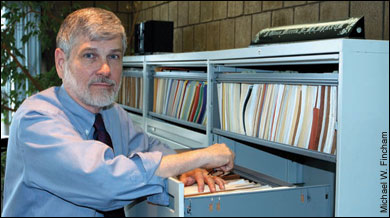
On a Friday morning in August 1997 he climbed aboard a large van in Baltimore and got ready to give his first Pfiesteria speech. On board with him was a team that he'd recruited from the medical schools at the University of Maryland and Johns Hopkins University. By 7:30 they were threading their way through rush hour streets headed for rural Somerset County, the last county down on the tail end of Maryland's Eastern Shore. Watermen along the Pocomoke River were telling the press they were getting sick, and a local doctor named Ritchie Shoemaker was backing them up. They thought the culprit could be a mysterious microbe in the water named Pfiesteria piscicida.
By the time the van hit the Bay Bridge, Morris was deep into his speech. A trim, calm-spoken professional with dark hair and a beard that was going gray, Morris leaned across the seat and gave his team their charge. "The state needs an answer," he told them. "Is there or is there not a human health effect associated with Pfiesteria? It's a yes or no sort of thing."
One week later, on the last Friday in August 1997, he announced the team's spectacular findings. Their answer was a Yes: Watermen and state workers exposed to the Pocomoke River had developed "profound" neurocognitive deficits, primarily problems with short-term memory.
The culprit could be Pfiesteria piscicida, a dinoflagellate in the river that was suspected of releasing a toxin that could cause sick fish — and now sick fishermen. Exposure to waters with Pfiesteria or its unnamed, look-alike cousins could be a health risk to people working, boating, or living around the Bay.
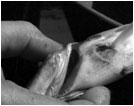
Howard were finding fish with lesions and sores in the Pocomoke River during the spring of 1997. Photograph by Michael W. Fincham.
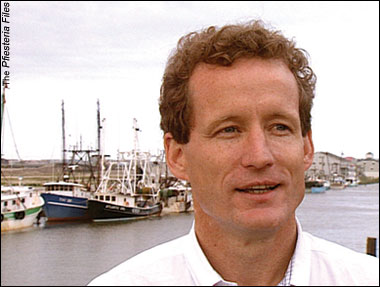
Tommy East motored out of a small harbor in Shelltown in an open boat and headed down the Pocomoke River in the pre-dawn twilight. His early morning commute — in good weather, at least — was enviable. Under a brightening sky, he glided past woodlands, scattered homes and farms, and then broad stretches of tital marsh.
Three miles downstream, where the river widens into Pocomoke Sound, East went to work as the sun came up, wrestling with a dip net to pull fish out of large, roped-off fish pounds. He usually dumped shad and perch into his boat along with croaker and stripers. Ten years ago he kept finding fish — a lot of fish — with ugly red lesions. He would drop to his knees in the bottom of the boat and start throwing sick fish overboard. Photograph by Michael W. Fincham.
 |
The medical report was a "bombshell" going off in newsrooms, said a reporter for The Baltimore Sun. "It was feast time," said a reporter for The Washington Post. The press responded with an explosion of coverage that churned out thousands of newspaper and television stories over the next year. The media barrage led to public confusion, political controversy, and economic loss. Charter boat captains lost customers. Tourists stayed home. Swimmers stayed off the beaches. Many anglers and boaters stayed off the Bay, as did some water-skiers and windsurfers and sailors. Sales of Maryland seafood plummeted, causing an estimated $40 million in lost income.
Last year, in 2006, after a decade of follow-up research, Morris announced another spectacular finding. But now his answer was a No. "The bottom line was we could find no evidence that having Pfiesteria in the water was having any effect on health," said Morris. Exposure to waters with Pfiesteria — in the Pocomoke or any other river in the Chesapeake — was probably not a threat to people who live or work around the water.
This kind of "good news" medical report was not a bombshell in any newsroom. The Baltimore Sun, which once carried over 170 Pfiesteria stories in one year, now gave the new report one short article. The Washington Post, which carried over 130 stories in one year, competing neck and neck with The Sun, decided to give the report one (even shorter) story. Reporters and editors who once feasted on the "bad news" about Pfiesteria seemed to have a long-term memory deficit.
The new medical finding, though barely mentioned in the press, begs this question: How did a Yes turn into a No?
And this question also: If Pfiesteria is not a serious threat, then what really happened ten years ago on the Pocomoke River?
As the big state van carried his medical team south down the Eastern Shore, Glenn Morris looked out the window and saw a television truck also headed for Somerset County. The press had immediately played up the idea of a medical dream team from the big city invading rural Maryland, ready to give locals what one reporter called "the mother of all medical exams." The exam would answer the question: Was something in the river making people sick?

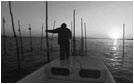 |
For much of the spring Tom East kept throwing away 30 to 40 percent of his catch. And he kept getting sick. A waterman with pale red hair, a healthy build, and a history of hard work, East found himself struggling with headaches, a crampy stomach, and breathing troubles. The watermen working with him, could see he was losing weight. He was also losing his memory. He could remember jobs from 10 years ago, but he couldn't remember conversations from 10 minutes ago. In the middle of a job — cleaning a boat or repairing an engine or patching a net — he would pull up short like a boxer taking a rib shot and suddenly go blank. He'd stand there wondering what he was doing. He'd never been like that before. Photograph from The Pfiesteria Files. |
Morris thought he already knew the answer — and it was No. As chairman of the Department of Epidemiology at the University of Maryland School of Medicine, he had studied the existing evidence about Pfiesteria piscicida, a dinoflagellate so small it could only be seen under a microscope. In North Carolina, the microbe had been blamed for killing fish and for making scientists sick during laboratory experiments. It had been found several times in Maryland waters, but only once around fish nets with sick-looking, lesioned fish. Watermen, prodded by the press, said Pfiesteria might also be making them sick. Morris, however, thought the health problem was probably an episode of mass panic. This might simply be "Pfiesteria hysteria," he told his van load of doctors.
"Pfiesteria hysteria" became a popular catch phrase in the summer of 1997, both with the press and the general public, often as a way of dismissing watermen's worries as simple mass hysteria. In the growing medical literature, however, mass hysteria is far from simple, either as a definition or a diagnosis. It's usually called "mass psychogenic illness," a term that describes episodes where groups of people develop the same physical symptoms — but where medical exams reveal no organic causes for those symptoms.
When professionals talk of "mass psychogenic illness," they are never being dismissive. "It is very difficult to explain to people affected by mass psychogenic illness that they aren't crazy, that they aren't imagining their symptoms," says Tim Jones, an epidemiologist and author of a report in the New England Journal of Medicine. "These are real symptoms," he adds. "They are not malingering or making this stuff up to get out of work." Pains with no physical cause are still pains. Disabilities are still disabilities.
The history of mass psychogenic illness stretches back to the Middle Ages with hundreds of accounts of demonic possession, often striking nuns in convents or suspected witches living in villages like Salem, Massachusetts. The preferred treatments in the past were exorcism or execution. In recent centuries, mass episodes have been reported in factories and cotton mills and more frequently in schools — many of them girls' schools — in Europe, America, Asia, and the Middle East.
Ancient ideas about demons have now given way to fears about toxics in our food, our water, and our air, fears often triggered by a strange odor. Since the gas warfare of the First World War, fears of toxic gasses — rather than any actual gasses — have been implicated in a number of prominent mass illnesses. After the anthrax episodes that followed 9/11, an epidemic of mysterious rashes showed up in elementary schools in half a dozen states around this country.
As a working hypothesis for the complaints along the Pocomoke, "Pfiesteria hysteria" made a certain amount of sense. The illness usually takes one of two forms, according to Simon Wessley, a psychiatrist who has written widely on the disease. "Motor hysteria" includes twitches and spasms and strange speech, the kind of symptoms once found among nuns and witches. A second form called "anxiety hysteria" includes headaches, dizziness, nausea, shortness of breath, and general weakness — and nearly all these symptoms were cited by watermen exposed to the Pocomoke River.
 |
John Rafter put his kayak in the water and paddled out into the Pocomoke River. Rafter was not a waterman, but a field technician with Maryland's Department of the Environment, and one of his jobs was to take water samples near the sewage outflows for Pocomoke City. The river is narrower there, miles upriver from Shelltown. Gliding out to the middle, Rafter put his paddle down, picked up a sampling bottle and slid his bare arm down into the water up to his elbow. During lunch time at the Pizza Hut in town, he suddenly went blank. He walked out of the rest room, then simply froze. He had no clue, no memory of where he was.
When he went to bed that night, he suddenly felt like his head was in free fall, sinking down through the pillow, the mattress, the floor. The next morning when he woke up he was totally disoriented. His girlfriend drove him to an emergency room. He thought he had a brain tumor. Photograph from The Pfiesteria Files.
The medical expedition that Glenn Morris was leading down to Somerset County was, in many ways, a classic contemporary response to a potential mass hysteria event. According to Tim Jones, writing in the American Family Physician, the best ways to halt mass psychogenic illness are to perform medical exams, provide credible reassurances from respected authorities, and spread the word there is no health problem. "Our major objectives," Morris told his team during the bus ride, "are to try to relieve anxiety and reassure everybody that everything is fine."
When Glenn Morris and his team arrived at the Somerset County Health Department, nearly twenty television trucks were in the parking lot pointing satellite dishes at the skies, and reporters and cameramen outnumbered patients nearly four to one. Morris began a day of medical exams by putting on his white doctor's coat and holding a press conference.
He told the press throng that the doctors came from both the University of Maryland and Johns Hopkins University (only one physician represented Hopkins). The two-school strategy was the idea of Marty Wasserman, then Secretary for Health and Mental Hygiene, who said he didn't want one Maryland medical school criticizing the other in the press. Often blamed in the medical literature for extending mass hysteria, the press could now perhaps help in spreading the word. A clean bill of health from a two-school team — widely reported in the press — could help calm the mounting anger and panic along the Pocomoke.
By the time he'd talked to five patents, Morris began to change his mind about his hysteria hypothesis. Medical care begins with narrative, with the patient's oral history of his problems, and all the examining doctors kept hearing story after story about forgetfulness and mental confusion.
The medical team examined 13 people that first day in Somerset County: seven watermen, the wife of a waterman, four state workers and one water-skier — and nearly all of them reported the same odd symptoms. There's something going on here, thought Morris.
Lynn Grattan climbed on the van that August morning, carrying briefcases full of mind games. A neuropsychologist with the University of Maryland School of Medicine, she would be screening for any brain misfunctions that might lie behind all those odd stories of memory lapses. Her job was to use science to investigate storytelling — and she had 14 tests ready.
Grattan culled these tests from the array of psychometric tests used to uncover unusual brain pathologies. Some screens could assess language and visual/spatial abilities. Others could test cross-brain connections and problems with concentration and divided attention. Several could probe memory and mood, including anxiety and depression. Many of the tests had questions designed to dig out symptom faking and exaggeration.
As she worked through the day Grattan was not listening closely to the stories her patients told. She spent her time setting up tests, asking questions, recording answers, measuring response times — in short, taking data. She wouldn't make much sense of that data until she could go back and score all the tests.
By the time she climbed on the van for the ride home, all the doctors were buzzing with talk about the stories they'd heard. Like university researchers everywhere they were jazzed by the idea of a new discovery, a new syndrome for the medical literature. It's one of the reasons you do science, Morris liked to say, finding something new. They kept the lights on in the bus, tabulating data all the way back on the long drive up the Eastern Shore and across the Bay Bridge.
The only one who wasn't talking much was Grattan. As the neuropsychologist for the group, she didn't want to say anything until she could work through all her data.
Lynn Grattan sat down at her kitchen table at 5 a.m. the next morning, a Saturday, and went to work scoring her tests. By early afternoon she was able to call Morris, the team leader, with some disturbing findings. Out of 14 screening tests, nearly everyone was performing poorly on the same three tests. The Stroop Color-Word Test was one. It starts with a list of words, each naming a color, but then adds a twist: The word "red" might be printed in the color green, while the word "green" might be printed as purple. "What's that color? she would ask, pointing at the word "green." The correct answer, of course, is purple, but it's easy to feel a disconnect, to hesitate. If you hesitate a lot, you could have a slow connection between the right brain (which processes color) and the left brain (which handles words). You could have a problem with divided attention.
A second test — called the Grooved Peg Board Test — also measured cross brain connections, concentration, analytical skills as well as manual dexterity — all on a timed trial.
The strongest findings came from the simplest test. With Rey's Auditory Learning Test, Grattan would show her patients simple, unrelated words (BELT, RAIL, FORK, INCH) one at a time — then ask them to recall as many words as they could. Later in the evaluation, she would suddenly ask her subjects to recall the first list again.
The scores on this widely used test were startling. When she checked the normative data base for this test, a collection of scores from hundreds of thousands of people of similar age and occupation who had answered the same questions, she found nearly everybody scored better — much better than the people from the Pocomoke. Those with moderate exposure to the Pocomoke were scoring near the bottom eight percent on word recall. Those with high, nearly daily exposure to fishing areas along the Pocomoke were scoring in the lowest two percent for their age and occupation.
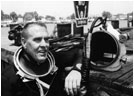 |
Tim Murray was diving in the Wicomico three rivers north of the Pocomoke. Crew cut, stocky, and well-muscled, Murray was replacing X beams on piers at a yacht club. Working in a dive suit, he wore a heavy helmet attached to an air hose, but he kept losing his breath — not just under the water but up on land. In the middle of eating a sandwich, he’d have to stop to catch his breath. He also began losing weight.
His girlfriend told him he was also losing his memory. He finally noticed his memory problem when it slowed down his work. Looking for a tool, he would climb out of the water, wrestle his massive diving helmet off and clump over to his step van. Standing there, staring at his tool racks, he would completely blank out. He thought he was losing his mind. Photograph by Michael W. Fincham.
Grattan told Morris she was seeing evidence of a clear, consistent pattern of cognitive deficits. The Pocomoke patients had problems with divided attention, response inhibition, and especially short-term memory. For most of us, short-term memory is the engine for new learning, the mental machinery that takes in new information — whether from a conversation, a phone call, a newspaper. She thought the results were frightening.
If it was "a Yes or No sort of question," then the answer was a Yes: There did seem to be a health effect from Pfiesteria or some other toxin in the water.
When Glenn Morris hung up the phone, he knew he was facing a classic public health dilemma.
Do you take action before you know everything about the threat? Or do you wait for more evidence, at the risk of exposing more people to the threat? If you take action, do you cause other, greater problems?
Morris solved his quandary with a question: Would I let my daughter go swimming in the Pocomoke? When he realized the answer was No, he gave Wasserman and other state officials the answer nobody wanted to hear: Exposure to river waters associated with sick fish and Pfiesteria-like organisms was somehow causing short-term memory loss. The press and the public and the politicians could drop the mass hysteria hypothesis.
Faced with this kind of finding from this kind of medical team, Maryland Governor Parris N. Glendening had little choice. On the Friday before Labor Day weekend, he called a major press conference in Annapolis. "The public must be informed of this connection to human health," he announced, and then — because of the health threat — he closed seven miles of the Pocomoke River. "There is," he added, "no reason to panic."
What followed looked a lot like a low-level panic. Newspaper and television reporters now drove down by the dozens from Washington and Baltimore and began wandering the backcountry roads around Shelltown and Nanticoke looking for locals who might be suffering memory loss. All those reporters were quickly turning Pfiesteria in the Pocomoke into a national story. More reporters then flew in from New York, Atlanta, Europe, and Asia, turning Pfiesteria into an international story.
The dream team strategy had backfired. Alerted by the press, a second wave of potential patients called in to hot lines set up by the State Department of Health and Mental Hygiene and state officials were soon listing 31 diagnosed cases.
For David Oldach, crossing the Bay Bridge was usually a homecoming — but not today. He grew up in the Eastern Shore town of Salisbury, but today he was driving down to West Ocean City and Chincoteague, oceanside fishing ports where he used to work on scallop boats and ocean clam boats. Slim, articulate, and confident, Oldach was an infectious disease doctor who had talked his way onto the Pfiesteria medical team, and today he had Lynn Grattan riding shotgun in his Jeep Cherokee hauling her briefcase of tests. Oldach knew there were holes in the medical team's findings and he was hoping they could patch one of them.
Thirteen people showing memory problems on three tests taken on one day. Could these medical findings be a fluke? Was this enough evidence to close down a river, kick off a media blitz, and perhaps cause a panic? Could the science case hold up?
Here was one hole in their science: The findings about Pocomoke watermen had no control group study to back it. Perhaps the memory problems among watermen were not caused by a biotoxin. Perhaps commercial fishermen everywhere — not just watermen on the Pocomoke — were more likely to score poorly on tests for memory and mental agility. Perhaps they were affected by antifouling paints or diesel fumes or long days on the water. Perhaps they were simply poor test takers.
Oldach was headed for West Ocean City because he thought they could find the perfect control group. Dozens of commercial fishermen motored out everyday headed out for fishing waters well beyond the beaches and boardwalks and high-rise hotels of Ocean City. He knew from experience they worked as hard as watermen on the Pocomoke — but had no exposure to the Pocomoke or other estuarine waters with Pfiesteria-like dinoflagellates that might cause memory problems. Screening a group of these fishermen could verify (or falsify) their findings about a Pfiesteria-connected health problem.
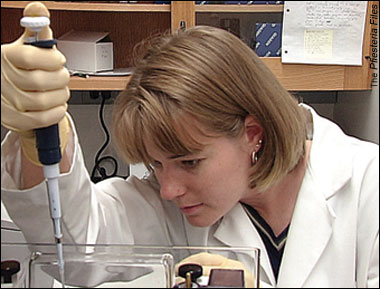
To test fishermen, they first had to find them. When they drove up to the work docks at West Ocean City, Grattan, at least, was still nervous. They had no hotel rooms booked and no testing appointments lined up. What they had was Oldach's optimism and chutzpah. When the boats pulled up, he began walking the docks asking fishermen, most of them back from a long work day, if they could hang around for another hour or more. He wanted them to sit for a medical interview evaluating their medical status and then take neuropsychological tests measuring their mental status.
His straightforward approach worked. None of the fishermen were happy about the Pfiesteria controversy, but nearly all of them agreed to testing. Grattan was able to give eight ocean fishermen the same screens and mind games she gave the Pocomoke watermen. While the tests were the same, the results were different. The ocean fishermen scored remarkably well on the same tests that befuddled the Bayside watermen. Something peculiar to the Pocomoke must be causing memory loss among watermen and state workers.
With findings from the control study, the case for Yes, the science case for a Pfiesteria health syndrome, got a little stronger. officials were soon listing 31 diagnosed cases.
There were other holes in the science case: Where in the Bay was Pfiesteria living? What kind of toxin, if any, did it make? What was the route of exposure? Were there other toxic-forming dinoflagellates out there? Elsewhere in the country, other dinoflagellates were known to cause devastating diseases like Paralytic Shellfish Poisoning, Neurotoxic Shellfish Poisoning and, more recently, Amnesiac Shellfish Poisoning. Was Pfiesteria the new toxic threat?
Flush with that first excitement of a new discovery, the medical team went after the illness question with high hopes and research smarts. Led by Morris, Oldach, and Grattan, the team went into the medical tool box of the time and pulled out a number of techniques, some classic, some cutting edge. In addition to control studies, they tried brain scans, rat studies, cohort studies, and a new, high-tech gene probe. Not every question, they found, had an answer.
Development of the gene probe by Oldach was an early breakthrough. His technique could find Pfiesteria and find it fast, primarily by detecting its DNA fingerprint in water and sediment. As a medical researcher at the Institute of Human Virology, a high-tech department of the University of Maryland Biotechnology Institute, Oldach was familiar with new techniques that doctors were using to track fast-changing viruses in the human body. By collaborating with aquatic biologists in Maryland, North Carolina, and Norway, he was able to adapt these medical techniques and create a probe that marine scientists could use to track dinoflagellates in water bodies like the Chesapeake Bay.
The probe produced an immediate and practical payoff: Pfiesteria could now be identified in hours instead of weeks. When state workers began using it, however, they came up with an unwelcome payoff. They began detecting the DNA of Pfiesteria nearly all over the Bay.
That discovery raised the stakes for everybody. Pfiesteria was not some rare, perhaps alien species that somehow snuck into the Pocomoke and a few distant Eastern Shore rivers. The organism was clearly at home all around the Chesapeake. What showed up in the water down in the Pocomoke could show up in Baltimore Harbor.
When Glenn Morris and his medical team climbed aboard the van that muggy August morning, they were embarking unknowingly on a 10-year road trip full of discoveries, unexpected detours, and more than a few dead ends. The destination seemed clear enough at first — figure out what was making people sick — but over the next decade the goal seemed to retreat down the road before them like a water mirage disappearing in the distance.
Some holes in their science case are still there. What happened, for example, in the brains of people exposed to a toxin from the Pocomoke, a toxin that chemists struggled for over a decade to identify. Without a toxin sample to work with, the medical team tried techniques like high-tech scans of human brains and lab studies of rat brains, but the best they got from all this work were hints and hypotheses for further testing.
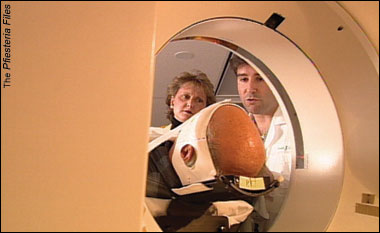
From the brain scans came hints that the Pocomoke toxin may slow down brain areas like the hippocampus, one of the sites for short-term memory. From the rat brain studies came evidence the toxin may turn off a neuroreceptor (the NMDA receptor) that receives signals aimed at the hippocampus and other memory structures. Short-term memory loss in that case could come from poor communication at the cellular level in the brain, according to Morris. New information comes in but new memory is never laid down. As far as your brain is concerned, the job you just started, the conversation you just had, this article you've been reading — all those events never happened.
Short-term memory loss was, luckily, not a long-term event for people along the Pocomoke. When they were retested, three months after their exposures, most of the Pocomoke patients were again scoring within normal range on their memory tests, and at six months all the patients had improved enough to bring their scores within national norms for their age and gender. Whether they all came all the way back, however, remains another unanswered question.
Did Pfiesteria pose a major public health threat? With Pfiesteria DNA turning up all around the Bay, the Morris-led team pinned their highest hopes for a clear answer on a classic research tool called a "cohort study," an epidemiological study designed to give a definitive "Yes or No" sort of answer.
The basic idea was a before-and-after study tracking a group of watermen, a "cohort" that was likely to be exposed to water with fish and Pfiesteria. Over four years, they would test watermen at the beginning of each work season, creating a baseline on their medical status, much as your family doctor does with your annual physical. By retesting at the end of the season — and during the season if anyone was encountering toxic blooms or developing symptoms — the team could see any changes pointing to a Pfiesteria-like health effect. The expected results should be the cleanest data yet on how Pfiesteria affected anybody working the Bay.
The unexpected result, however, was four years with no documented toxic Pfiesteria blooms, no large fish kill episodes, no reports of new episodes of neurocognitive deficits. Fish kills occurred in the Bay, but none of them broke out near the watermen in the study group. Pfiesteria might be all over the Bay, but it seemed to have stopped forming toxic blooms.
That was bad news for the researchers, but good news for the Bay's watermen, state workers, and waterskiers. No new cases came from this cohort group, not even from all those watermen clocking heavy work weeks on the water. The study began with 123 test-case watermen and finished up with 88 who hung in for four years of twice-yearly testing and biweekly reporting. During those years state officials and watermen took 3,500 samples from the waters they were working, and Pfiesteria showed up in 110 or 3.2 percent of the samples.
Those are samples large enough for strong conclusions, and the strongest, according to Morris, is that Pfiesteria is not a health threat to working watermen — or probably to anybody else. "For the average waterman or Sunday boater," says Morris, "I would say with a high degree of confidence, there is no risk."
That "no risk" finding — based on 88 people — has drawn criticism, especially from Ritchie Shoemaker, the doctor from Pocomoke City who first began diagnosing a Pfiesteria-like syndrome back in 1997. Six dropouts from the cohort study came to see Shoemaker, claiming they were sick with classic symptoms of toxic exposure. "Seven percent of the people they followed got sick," says Shoemaker. The cohort study, he also points out, failed to track recreational boaters and waterside residents. Shoemaker estimates 20 people have come to him over the last six years with symptoms from low-level exposures to toxins in the water.
Over the last decade, however, the estimate of cases from Maryland waters remained low. The question that Morris and his team first set out to answer — Is there a major public health risk? — seems to have a new answer. Nine years after 1997, his Yes answer had become a No.
That answer leaves a large question: whatever happened to the watermen and state workers on the Pocomoke River?
"Pfiesteria ten years ago still remains an intriguing and puzzling mystery." says Morris, sitting in his office in Baltimore still looking trim and calm, if slightly grayer, his high hopes dwindling into some humility in the face of the unexplained. "It is very frustrating in today's world with the sophistication of science today not to be able to explain what happened."
A lot of science happened over the last decade, he points out, and some of it produced useful findings. The cohort study came up with a "good news" finding that is important for policy makers as well as for watermen and waterskiers and boaters. Rat studies showed evidence that Pfiesteria diminishes new learning, at least among rats running a maze, and they turned up clues about how toxins affect neuroreceptors.
That's good progress, but the sick-people question remains unanswered. "I have to agree with Glenn. We just don't know," says Oldach, whose DNA probe put a new technique in the tool box of marine biologists and field workers.
Both will tell you the Pocomoke syndrome was not "Pfiesteria hysteria," their original hypothesis. "There was no mass hysteria," says Morris. This wasn't the kind of population likely to experience mass psychogenic illness, he explains. The similar stories, the testing, the screening — all this evidence convinces him. The finding was too specific, too focused for people to fake. "There was a real event on the Pocomoke," he says, "but whether it was related to Pfiesteria, I have no idea."
Both scientists agree that another toxic event could happen, either in the Pocomoke or elsewhere, even though it hasn't happened again in the last 10 years. "Perhaps we have to think of Pfiesteria events like this as a 25-year storm," Oldach says. "Or a 100-year storm."
The Pfiesteria next time will probably not bring on another Pocomoke syndrome. "The Pocomoke was a unique natural experiment," says Morris. "People kept being told, �It's okay. There's no problem. Go back. Keep working.' So we had people who were constantly being exposed to the point that there were profound deficits."
Thanks to fast findings from new DNA probes, state officials can now close a river before people suffer repeat exposures. "Ethically," says Morris, "we can never let that happen again." The uncontrolled experiment is over.
At the end of the research road then a classic Catch 22 was lying in wait for Morris and his medical team. Thanks to the progress of science, there may be no more progress on the science question that started them down the road.
Scientists may not have many more subjects to study, or more natural experiments that might help them answer the question that first took them into the field.
"I can't tell you what happened in the Pocomoke in 1997," says Morris, "And I'm not sure I'm ever going to be able to tell you."
A note on sources: Descriptions of events and reactions were drawn from personal reporting and multiple interviews conducted with participants and experts between 1997 and 2007. For a list of articles consulted, go to www.mdsg.umd.edu/Pfiesteria.