
When water temperatures dropped, this blue crab swam to the bottom and buried itself in the mud — only to have researchers dig him up again, disturbing his long winter's sleep. They're hoping to get a count on how many crabs, come spring, will be rising out of the mud and scrambling around the Bay. Since 1989, watermen like Roger Morris (below right) and his mate Eddie Weber (above left) have been working with scientists like Chris Walstrum and Heather Brown (above right) to dredge crabs out of the mud at more than 1500 sites around the Bay. Their data help researchers gauge blue crab stocks in the Chesapeake Bay.
Beneath a steel gray January sky Roger Morris backs down on the Mydra Ann. Propwash boils at the stern. This channel off Kent Narrows, lined with pilings and white workboats, is slim and his workboat carries an out-sized wooden platform on the stern. He guns the engine again and the bow swings easily past the closest piling.
This is the fourth winter that Morris has put his crabbing boat, a white 45-foot Bay workboat, in the service of science. His ambitious assignment: to help the Maryland Department of Natural Resources (DNR) determine how many crabs are in the Chesapeake Bay by surveying them during their winter sleep.
Counting crabs is an important job in a bay that produces more blue crabs than any other estuary in the country — a bay where most working watermen depend on crabs for the majority of their fishing income. Regulations that can cut into a waterman's catch ultimately come from assumptions about the size of crab stocks — assumptions that lie at the center of heated arguments among crabbers, managers, and conservationists. This winter survey is meant to help settle disputes by providing a concrete census of blue crabs in the Chesapeake.
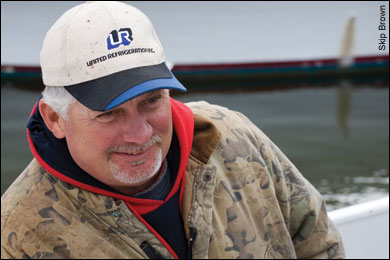
Counting crabs is an important job in a bay that produces more blue crabs than any other estuary in the country.
Morris, who hails from Church Creek, south of Cambridge, is a fifth-generation waterman. At forty-four, he's hunted crabs up and down the Bay for thirty-one years. From April through December, he runs crab pots with his mate Eddie Weber and, before she got too old, his dog Tilly. Some winters he used to go after crabs with a heavy metal dredge, down near Cape Charles where the Bay meets the Atlantic. That's cold hard work, and Morris says he's lucky to have this winter contract where the workdays are shorter and the pay steady.
He steers south against the tide running into Kent Narrows and heads along the east side of Kent Island on Maryland's Eastern Shore. As the Mydra Ann pulls away from the Narrows, the hulk of an old oyster shucking house slides by, its beach a scatter of shell. Farther out the shore fades to a long low line of pine, still green in the heart of winter. Morris is the only crabber on the water this morning, and he's come to search for crabs in a most unusual way — by looking where he doesn't expect to find them.
In the cabin with Morris, watching the readout from the computerized global positioning system (GPS), stands Chris Walstrum from the Maryland DNR. At thirty-two he's young and athletic, with short hair, an easy smile, and a can-do attitude. In another life he might've been a test pilot, but when he was five his family moved from Baltimore down to Kent Island, and he learned to crab and fish with his father and four brothers. He eventually married a local girl and settled on the Eastern Shore. He also got a joint environmental degree from Salisbury University and the University of Maryland Eastern Shore, with a marine emphasis. The Bay never left him, and when he graduated in 1996 he picked up a job with the DNR.
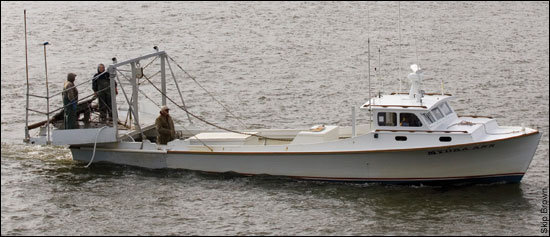
Long and low, the 45-foot Mydra Ann is a classic Bay workboat. Spring, summer, and fall she carries captain Roger Morris out for crab potting with his mate Eddie Weber. In winter, for the past four years, she's taken aboard experts like Chris Walstrum (below right) from the Maryland Department of Natural Resources and pulled up crabs to count for the winter dredge survey.
Walstrum's now on his tenth year of the winter crab survey — known as the winter dredge survey because the tool of choice is a Virginia dredge, the same dredge that Morris once used to hunt crabs near the capes, the same dredge that now sits on the wide wooden platform in the stern.
The Virginia dredge is imposing, some six to eight feet wide and weighing about 250 pounds. Protruding from a metal bar are iron teeth five to seven inches long. That dredge and this unconventional quest have brought together these two men — a waterman and a biologist — on a winter's day to seek blue crabs out of season.
Morris leaves the wheel in the cuddy cabin and walks to the outside steering station on the starboard side. He wears tan camouflage overalls and a blue-brimmed white hat that says "United Refrigeration" across the front. Morris is clean-shaven, except for a close-cropped goatee that is going white, and he has sharp blue eyes that look right at you. As he gets ready to drop the dredge he handles the controls without looking.
The computer displays a random coordinate, and as Walstrum marks the spot with the GPS, Morris releases a long length of rattling chain from a drum in the center of the boat. The dredge rumbles over a roller at the stern and into about 19 feet of water. When the metal teeth dig into the bottom, the chain snaps tight and the Mydra Ann lurches, then regains her pace, pulling like a plow horse. Morris will drag the dredge for exactly one minute at exactly three knots. He has done this the same way every time, for every dredge, for four winters.
Standing on the platform ready to bring up the heavy dredge are his regular crabbing mate, Eddie Weber, and Heather Brown of the DNR. While Weber comes from the Eastern Shore near Cambridge, Brown was born and raised in Canada, and she's not bothered by the winter weather, since she has "a bit of polar bear" in her.
When the dredge comes up Morris drags it behind the stern for a moment to wash it clean, and then hauls it aboard. Weber and Brown each grab an end of the metal dredge's cloth net and dump the contents onto the wide platform. There is a clatter of empty oyster shells and then silence. A single horseshoe crab, flat on its back, wags its prehistoric spike of a tail. But there are no blue crabs here. Not a one.
Where are the crabs? Is this simply a place where they chose not to bury themselves this winter, or is the empty dredge a sign that blue crabs are dwindling?
When blue crabs get scarce, people get nervous in Bay country. The Chesapeake is a tidal kingdom for crabs. Maryland and Virginia have recently landed some 50 to 60 million pounds of hard crabs between them in a single year. That's a good number of crabs, but only half of what the two states landed in 1993, when watermen pulled in a reported 120 million pounds. From picking houses to soft-crab sheds to high-priced restaurants, there's a lot riding on the Bay's blue crab.
Knowing for sure how crabs are doing, and whether or not the population is stable or sliding, can only come after more than a thousand scrapes have sampled more than a thousand random sites — sites where crabs may or may not normally hide. That's the random part.
It's not easy for a crab hunter to dredge for crabs where he doesn't expect to find them, but Morris says that after four years he's getting used to it. He says it's the way it's got to be done.
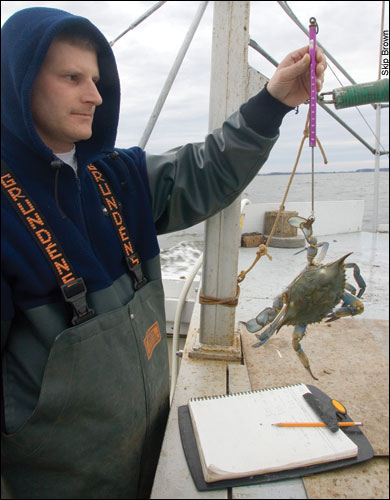
Maryland and Virginia have recently landed some 50 to 60 million pounds of hard crabs between them in a single year. That's a good number of crabs, but only half of what the two states landed in 1993.
Walstrum explains that the winter dredge survey uses a random sampling protocol to remove the human variable as much as possible. Consider, for example, if every survey captain went looking for crabs where he expected to find them. Some captains would have more luck, some less. In the end the survey would largely measure the varying skill and good fortune of the different survey teams. In addition, results would be biased toward a larger abundance of crabs, since undoubtedly all the captains would discover places where crabs congregate. If the survey teams were lucky, every year would look like a good year, says Walstrum.
To get a more objective reading, the surveyors use a method devised by fisheries scientist Brian Rothschild, when he was with the University of Maryland Center for Environmental Science (UMCES), at the Chesapeake Biological Lab. Rothschild developed a plan for random samples, using test sites picked by computer. Some of those sites would have more crabs, some would have less, and some would have none at all. In the end, if they were all sampled the same way year after year, one would get a complete picture of where crabs were and where they weren't, and a statistically reliable number.
In the mid-1990s, many watermen reported that they were fishing harder and longer to catch fewer crabs, and some scientists warned that the stock could be nearing collapse.
By any account, this winter undertaking is impressive. Since 1989, following the pilot effort in 1988 at UMCES, both Maryland and Virginia have conducted a winter dredge survey. It's the only ongoing crab survey that samples sites throughout the whole Bay — 1,500 random sites and 125 fixed sites. Originally funded by the Chesapeake Bay Office of the National Oceanic and Atmospheric Administration (NOAA), the survey is now supported by the states of Maryland and Virginia.
When Morris arrives at the next station he drops the dredge a second time. Again the chain snaps tight and the Mydra Ann digs in. Will this random walk along the Bay bottom turn up any crabs this time? Looking south past Kent Island across the broad expanse of the Bay and down toward Virginia, one wonders — how could anyone ever expect to count all the crabs in the Chesapeake?
If place of birth means anything, practically every crab in the Chesapeake is a Virginian. All the Bay's female crabs migrate south to the lower end of the estuary to spawn during the warmer months, from June to September. Though scientists believe females mate only once, they can have multiple broods, and their production is prolific — as many as 8 million eggs per spawn, when things are working right. After spawning, crab larvae drift to sea, where they grow in salty seawater. Beginning 
While Bay crabs are Virginians, many apparently move to Maryland for personal growth. Whatever the reason for their wanderings, by early autumn falling temperatures catch them and wherever they are 
Young crabs spend their first winter buried in the mud. In fact all Bay blue crabs, young or old, remain buried throughout the cold months, in a remarkable state of suspended animation. They don't move, don't feed. They barely breathe. As with all animals that hibernate, this capacity to wait, to slow down their physiology to just this side of death, allows them to make it through cold temperatures. Since they can't heat themselves metabolically, as warm-blooded creatures do, they have evolved a way to wait for warmer waters, when they can move again.
And move they do as Bay temperatures begin to rise above fifty-five degrees in the spring. A wave of crabs begins to emerge from the bottom, generally from south to north as the sun works its way back up from the equator. While some crabs are literally on a march up the Bay, scientists believe that many are simply emerging from their burrows as warmer temperatures gradually move up the estuary. This south-to-north warming may make it appear that crabs are moving north when in fact they are just popping out of the mud in sequence, from the lower Bay to the top — like sports fans rising in a wave.
With warmer waters, crabs go into high gear. They feed and molt and grow. Last year's crop of tiny crabs will now mature rapidly and mate during the summer. In less than a year, this batch of crabs will go from drifting larvae to mature adults, capable of mating. After they mate, female crabs will travel back down the Bay. Most overwinter and spawn early the next summer, though some precocious females spawn before water temperatures drop. Then the cycle begins again.
Tracking crabs during all this seasonal coming and going presents a real challenge. In addition to the winter dredge, scientists use a number of other surveys to keep up with blue crabs. Both the Maryland DNR and the Virginia Institute of Marine Science (VIMS) have run summer trawl surveys for many years, and George Abbe at the Morgan State Estuarine Research Center has run a crab pot survey since 1968.
These surveys, and especially the winter dredge survey, have proved crucial. In the past, resource managers relied largely on harvest reports to gauge the abundance of crabs in the Bay. Harvests are still an important barometer of blue crab stocks, but harvests respond to everything from weather to economics. When prices go down and costs go up, for example, crabbers may simply pull their pots.
Independent surveys paint a more accurate picture of the Bay's blue crab stocks by counting crabs the same way year after year, using statistically reliable methods. They also raise serious questions. Now that we can count crabs better than ever before, who will answer the question of how many crabs constitute a sustainable population? How many crabs are enough?
There is arguably no one who has tried harder than Tom Miller to count the Bay's blue crabs. As a researcher, he is on the receiving end of all those data collected by Walstrum and Morris and the small army of others who labor at surveying the blue crab. A researcher at the UMCES Chesapeake Biological Laboratory, he works out of a small office in Kopp House, a quaint white cottage on the shores of the Patuxent River. Stacked with books and reports, his desk sports a crab sculpture that raises bronze claws toward the ceiling. On the wall a bumper sticker proclaims, Attack Crab on Duty. Deskbound this morning, Miller has to adjust the blinds to dim the bright winter light that bounces off the Patuxent just outside the door.
In the course of all his crab counting, the soft-spoken Miller has found himself smack in the middle of a noisy controversy. Disagreements over how blue crabs are doing — and whether recent declines reflect natural cycles or dangerous overfishing — have led to red-faced debates among watermen, researchers, environmentalists, and resource managers. And those debates have drawn the combatants to the types of studies that clutter his desk.
With a kind round face, spectacles, and close-cropped thinning hair, Miller looks at home here in his casual V-neck sweater, but it's been a long road to this perch on the Patuxent. Unlike Roger Morris or Chris Walstrum, Miller did not rise from the shores of Dorchester County or Kent Island. Born in Southeast London, Miller is the son of a London cab driver and, along with his sister, the first in their family to attend college. When he was about five his family moved downriver past Greenwich, and he still remembers playing by the marshes along the Thames. "It wasn't like this," he says, indicating the broad Patuxent just outside the window. "It was more like New Jersey."
Nevertheless, an interest in nature and in things marine stayed with him, and he is now a well-regarded expert. His expertise: the population dynamics of fish — and crabs.
When Miller came to the Chesapeake in 1994, he could not foresee the central role he would play in the great two-state debate over the blue crab. The question at the center of that debate: how much fishing pressure can the Bay's crab stocks withstand?
In the mid-1990s nervousness over the heavily fished blue crab had reached a fever pitch. Many watermen reported that they were fishing harder and longer to catch fewer crabs, and some scientists warned that the stock could be nearing collapse. Other watermen said crabs were fine, and some scientists stated that the stock decline was just part of a long-term cycle. Decision makers heard contradictory arguments from both scientists and watermen, as concern rose among seafood processors, environmental groups, and the general public.
While many watermen shared those worries about the crab, they also feared that new regulations could curb their catch. To address the controversy, the Chesapeake Bay Commission formed the Bi-State Blue Crab Advisory Committee (BBCAC), chaired by Delegate John Wood, Jr. from Maryland and Delegate Robert Bloxom from Virginia. BBCAC, as it came to be called, brought together legislators, scientists, watermen, seafood processors, and resource managers to seek consensus.
Miller, with his quiet manner and steady focus, played a central role in providing the group with understandable estimates of Bay crab stocks and fishing pressure. He led meetings of researchers from different laboratories around the Bay to reach an important consensus: that there was a point at which fishing pressure could threaten the blue crab, and we were right on that danger line.
In countless meetings Miller presented this warning to politicians, to environmentalists, to watermen. The force of this and other scientific information led the Bi-State Committee in 2001 to issue an Action Plan for managing the Bay's blue crab fishery. The plan called for establishing the first-ever Baywide thresholds for the blue crab fishery.
"It was remarkable to see Tom Miller's evolution," says Ann Swanson, Executive Director of the Chesapeake Bay Commission. "Just to see how much he grew in terms of explaining these complex ideas in his head, and how he was able to express all those ideas in a way that people could understand."
Miller gives a lot of credit for the success of BBCAC and the work that followed it to the strong state and federal funding support that researchers have received and to the good science that's come out of it. "We wouldn't be having this conversation," he says, "without all this work that's gone on for the last ten years."
Though Miller is a modest man, and declines to take credit for the importance of his role in the crab debate, in 2001 UMCES presented him with the President's Award for Excellence in the Application of Science.
In 2005 Miller and other researchers released a new analysis of Bay crab stocks, funded by the Chesapeake Bay Office of the National Oceanic and Atmospheric Administration (NOAA). This assessment confirmed that fishing pressure on the Bay's blue crab stock had reached dangerous levels during the late 1990s and early 2000s.
Correcting for changes in past recordkeeping, the researchers found that the biggest catch of blue crabs occurred back in 1966, and the lowest came in 2001. In fact, 2000, 2001, and 2002 catches were all at the bottom of the list. Miller and his colleagues found that fishing pressure — at its worst when stocks are low and fishing effort is high — crossed into the danger zone three times: in 2001, 2002, and 2004.
In Miller's words, in the years immediately prior to 2005 we had been "skating on thin ice." In 2005 fishing pressure dropped below the target, and the stock size increased enough to move away from the precautionary zone (see graph at left).
Even with recent improvement in the stock, the Bay's blue crab population continues to linger below the long-term average.
Having spent more than a decade laboring to understand the blue crab population, Miller still worries about how we manage the Chesapeake's great crab factory. In particular, he asks, when will we establish a well-thought-out target for fishing pressure, a level that will allow productive harvests without threatening the crab stock?
In fisheries science a target represents where you do want to go, in contrast to a threshold, which defines where you don't want to go.
The thresholds drawn by BBCAC set the limits of fishing pressure and of stock size. BBCAC also set a target that would keep fishing pressure comfortably below the danger line — and preserve 20 percent of the spawning stock to ensure future generations of blue crabs.
The thresholds and the target were major accomplishments, says Miller, but he still isn't fully satisfied. The target may be right in terms of general stock dynamics, he says, but he's disappointed that it doesn't do more. "What kind of fishery do we want to manage for?" he asks. "Do we want more hard crabs or more soft crabs? Do we want more protection of females? In certain places? At certain times?"
His biggest disappointment is that in the Chesapeake Bay, and especially with BBCAC no longer funded, there is no effective forum for discussing these issues or making these choices. "We need to move forward collaboratively [working with the watermen]," he says. "This is our biggest challenge."
Aboard the Mydra Ann, the crew hauls the Virginia dredge over the roller and onto the wide stern. Weber and Brown each grab a side of the net and spill oyster shells onto the platform, but this time there are a few live oysters in the pile and dangling from the net two good-sized male crabs. Weber pulls them off and sets them down so Walstrum can measure and weigh them.
The bigger one measures 159 mm (over 6 inches) from spine to spine and weighs in at 272 grams (almost 10 ounces) — definitely a keeper if this were summertime and you were stocking up for a crab feast. But this is a survey, not a hunt, and Walstrum flicks the Jimmie crabs back into the water. Will they survive? Hard to say, he says. Walstrum believes that the smaller the crab the better chance it has. Then again, the water's not too cold so far this winter — with any luck the crabs will seek the mud and wait for spring.
The Mydra Ann, almost 14 feet wide and powered by a 375-horsepower Caterpillar diesel, steams steadily from station to station through one-foot seas. When headed up-wind, the cuddy cabin helps to block cold spray thrown back from the bow. Inside the cabin a heater keeps the crew warm between stations, though it's not too cold today. Not like some days, when they endure freezing rain or snow. According to the crew, it has to blow a gale before they'll call off a survey trip.
It's also unlike other days when a single dredge may bring up as many as a 100 crabs. On those runs Morris has to power around in circles until they can count and measure them all.
The next scrape is not one of those big hits, but a half dozen crabs come aboard, including a male with a bent claw and a large female (called a sook). Though the winter dredge survey cannot tell us why these crabs have come to the deeps off Kent Island, it provides us with the concrete particulars. It shows, without prejudice, where the females are in winter, where the males are. Because hibernating crabs don't move, it allows the design of a random survey, plotted over miles of Bay bottom.
The results have been remarkable. Thanks to the winter dredge survey resource managers now have some confidence that they can approximate how many crabs (see graph, p. 10), and of what size and sex, inhabit the Chesapeake Bay.
Despite our new knowledge, mysteries remain. We still can't determine the age of blue crabs, and we still don't know how old they get. We don't fully understand the effects on blue crab stocks of prolonged periods of low dissolved oxygen or dying Bay grasses. Most importantly, researchers are not certain what's happening to female crabs in the Chesapeake. While the winter dredge survey shows female crab numbers evening out, an annual assessment by VIMS shows a disturbing picture of decline that has lasted more than a decade. (See The Case of the Missing Females)
As Roger Morris powers the Mydra Ann back to the Kent Narrows marina, he too voices concern. He knows a half dozen watermen who have left the crab business and gone to work on tugboats. It's a steady job and it keeps them on the water. "The water is all they know," he says.
Morris sees fewer and fewer young people going into commercial fishing, and as he turns into his slip he says, "Just look at the boats in this marina. They're all run down. It's a shame."
Working the water, he says, "it's history."
And yet there are still blue crabs in the Chesapeake. Sooks still migrate toward the sea each fall, and a new crop of crabs moves up the Bay each spring, spreading into countless rivers and creeks, where even children can catch them with a chicken neck. So far blue crabs keep playing their role in the food web, as key predators and scavengers. And as long as there are blue crabs in the Bay, we have to believe that there will be men like Morris who, despite the economic odds, will go out to catch them. This is because one mystery surrounding blue crabs remains — how they take whatever they find on the bottom of the Bay and through some divine alchemy transmute it into the sweetest seafood. If we can find the right balance between catching crabs and conserving them, we can only hope that this magic will endure.
For More Information
A team of researchers, led by Elizabeth North (shown above with a jar containing crab larvae), is currently tracking tiny blue crabs that drift offshore and then journey back into the Chesapeake and Delaware bays. Learn more about this regional effort supported by the Sea Grant programs of Maryland, Delaware, and Virginia at northweb.hpl.umces.edu/research/BlueCrab_SG.htm.