
By Erica Goldman
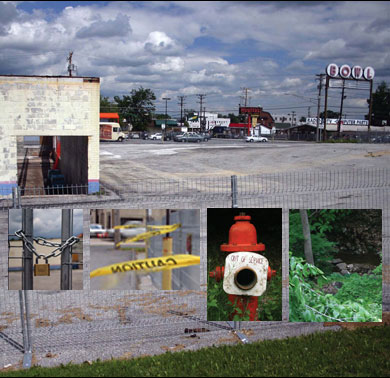
Its red letters are now faded and rusty, but the old "BOWL" sign still towers above an abandoned parking lot in Towson, Maryland, a reminder of a time when teenagers flocked to Fair Lanes and customers brought their rumpled shirts and slacks to Kings Cleaners, a dry cleaning operation that stood next door. Now the bowling alley is a roofless cement hull. Yellow and blue paint peels off the sides, rows of steel girders rust beneath the sky. In the old bowling alley's vast interior, gleaming new construction equipment rests idle — the only sign that the site will soon be redeveloped.
Deep below the paved lot surrounding the abandoned bowling alley, and well out of sight, a contaminated groundwater plume slowly creeps toward Mine Bank Run, a tributary of Gunpowder Falls. Kings Cleaners has vanished entirely — except for a square gravel stain in the center of the parking lot. But its chemical signature lingers strong and clear. Twenty feet beneath the former dry cleaning operation, tetrachloroethene (PCE), a widely used cleaning solvent, persists in the groundwater at high concentrations, measured at 16,400 parts per billion (ppb) in 2004, more than 3,000 times the legal limit of 5 ppb set by the U.S. Environmental Protection Agency.
PCE is a suspected human carcinogen and difficult to clean up. It can contaminate groundwater, a grave concern in rural areas that rely on wells for their drinking water supply. When this compound percolates close to the surface along with groundwater, it can intrude into the soil, releasing volatile, noxious gases. Short-term PCE exposure can cause dizziness, headaches, and problems with balance. Over the long term, PCE exposure has been linked to cancers of the esophagus, bladder, and blood.
Kings Cleaners closed in 2000, after continuous operation for 32 years. In 1998, the Maryland Department of the Environment (MDE) began a series of environmental assessments that lasted for years — testing contaminant levels in the groundwater, in soil gases, and in nearby residential wells — to determine whether remediation would be necessary prior to any future development.
In October 2005, MDE decided to allow limited industrial and commercial development at the site, as long as the groundwater remains untouched. Tests had deemed the soil gases free of PCE. So the chemical poses no immediate threat to future occupants of the site. The agency issued what is known as a "No Further Requirements Determination" to the current property owner, meaning that no remediation steps would be mandated. But no residences can ever be constructed on the site. No wells can ever be dug.
Sites like the former Kings Cleaners exist all over the United States. According to a study by the State Coalition for Remediation of Dry Cleaners, 75 percent of all active dry cleaning facilities are contaminated (some 17,000 sites nationwide), and that doesn't include sites that have been abandoned.
Are there tools to clean up these toxic messes? Scientists know that there is one species of bacteria — only one — that can break down PCE and its chemical cousin TCE (trichloroethylene), a compound with a similar chemical structure used in metal degreasing and paint stripping. To this "bug" (Dehalococcoides ethenogenes), chlorinated solvents such as PCE and TCE are the air that they breathe. So shouldn't cleaning up PCE-contaminated sites be as simple as providing this toxin-breathing bug unfettered access?
It's not that easy. In nature, a single species of bacteria rarely acts alone. Microbes live in intricate consortia and interact with other organisms — in the marine environment these include algae, corals, and sponges. Different bugs may play complementary roles, or they may compete fiercely. Scientists have long worked to harness the power of microbes to clean up human messes. Now, more and more, they are looking to the ecology of bacteria for clues about how to tackle tough challenges — like erasing the environmental signatures of industrial pollution.
Jennifer Becker leaves her office in the Biological Resources Engineering Department at the University of Maryland in College Park and walks briskly across campus to the Plant Sciences Building to give an invited lunchtime seminar. She sets up her computer and plugs into the room's audio-visual system as the previous class files out.
Her first Power Point slide features two potato-sized shapes, thousands, maybe millions of times the size of the bacteria they represent. Their stick figure arms wear boxing gloves. Facing each other, they square off, ready to duke it out.
In fierce competition for hydrogen, the bug Dehalococcoides ethenogenes squares off against Dehalobacter restrictus, another chlorine-breathing microbe. Scientist Jennifer Becker uses this drawing to explain her work to students and colleagues. Both bugs need hydrogen for cellular respiration. But fans should root for D. ethenogenes (red boxer), the only bug that can use hydrogen to render PCE, a toxic chemical used by the dry cleaning industry, completely harmless as ethene and chlorine (shown below in another of Becker's drawings). | 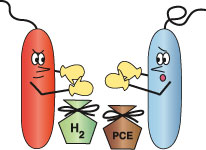 |
 | |
Microbes operate in complex environments, she explains as she clicks the remote. If, she says, our goal is to clean up human-made messes, like chlorinated solvents from the dry cleaning industry (PCE), we need to understand not only how these bugs function metabolically, but how they interact with each other.
Becker's schematic duel depicts a simulated competition between two different species of bacteria. One bug (D. ethenogenes) can render toxic chemicals totally harmless. The other bug can only go halfway, leaving a still nasty chemical compound (dichloroethene) in its respiratory wake.
This microbial duel showcases a classic battle for a limited resource. In this case the bacteria fight over hydrogen, a microscopic version of two carnivores fighting over a ravaged wildebeest in the African Serengeti. Hydrogen, explains Becker, is especially important because it acts as an electron donor, providing the engine for cellular respiration. But other bacteria also rely on hydrogen to power their metabolic needs and some can use it faster than D. ethenogenes, beating it to the punch. In these cases, competition may not favor the complete breakdown of the toxic compounds if the faster microbe only does half the job.
The trick, she explains, is to engineer the situation so competitors do not overwhelm the more thorough bug, the one that can take the chemical completely out of commission.
Becker's pictorial representation frames a conceptual model she's developed to simulate the effects of competition among bacteria in the environment — a model that revamps traditional thinking. The current paradigm in the bioremediation industry for PCE cleanup is simply to determine whether the best bug (D. ethenogenes) is present in the subsurface aquifer, explains Becker. If it is not, consultants will recommend that you add it. According to one count, such projects to clean up groundwater contamination related to industrial dry cleaning operations have already been implemented at 17 sites in ten states.
"But I've shown through modeling that competition in the environment could cause the added bug to be lost," she says. If we know that different bugs are competing for a limited amount of hydrogen, she explains, we may have to develop new strategies to ensure that both organisms get the hydrogen and other resources that they need. Becker describes her modeling work in the July 15 issue of the journal Environmental Science & Technology.
As Becker continues her talk, the audience listens intently, trying to absorb detailed information about how D. ethenogenes breaks down chlorinated compounds like PCE and TCE. As she concludes, she's got time to take a few questions from the audience before the next class takes over the lecture hall. One colleague asks whether she knows if D. ethenogenes is widely distributed (or ubiquitous) in nature. This is one of the big unknowns, Becker responds, and something that she is working to find out.
In the past few years, molecular biology tools have made it easier to determine whether these bacteria are present and active in the environment, she says. But these tools often cannot provide information about how the bacteria function in the environment. In order to validate this model of competition in the environment, we must grow the bacteria in pure culture, effectively staging the competition, and see which one wins out, she explains. One of her graduate students is also working on painstaking kinetic rate measurements, to determine how fast these bacteria carry out certain reactions, which will also help to ground-truth Becker's theory.
"Eventually, we want to be able to go back to the environment and make predictions about whether we would expect to find one bug or the other at a particular location," she says. In the future, Becker plans to test her model predictions at a site where there's a contaminated groundwater plume.
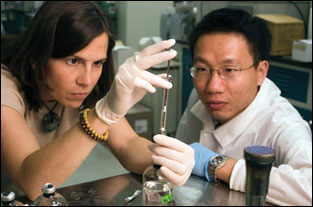 |  |
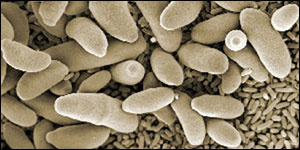 | Looking for Mr. Goodbug — Jennifer Becker and her student Yen-jung Lai check out a bacteria called D. ethenogenes (shown in micrograph, above, and glass bottle, above right. This microbe breathes a chemical called PCE, short for tetrachloroethene, a widely used, long-lived cleaning solvent which fouls groundwater under thousands of industrial sites. Top two photos by Michael Fincham and micrograph by Electron Microsope Laboratory, Berkeley, CA. |
As Becker leaves the lecture hall to walk back to her office, she doesn't linger long in the afternoon sunshine. She's in a hurry to meet her students in the lab to help them troubleshoot a problematic protocol. Focused and directed, she makes each second of her day count.
Becker's focus keeps her grounded in a challenging career juggling act. A young assistant professor with a big lab, Becker also holds an appointment in University of Maryland Extension as an extension specialist in waste management. She focuses on education and outreach in the community — "anything with a treatment process," ranging from animal manure to stormwater treatment to bioremediation. Each year, she also leads sessions in a job-training program in Baltimore, preparing individuals for entry-level jobs in environmental fields.
In any given week, Becker's days range from academic work based in the lab to applied practical work with citizens of the state. She's involved in a lot of traditional agricultural engineering extension, teaching farmers how to manage manure so "nutrients don't go where they're not supposed to go." This ties her work directly to the challenging issue of slowing the flow of nutrients to the Chesapeake Bay.
She's also been involved in recent efforts to educate farmers about changes that affect implementation of federal air quality regulations. A national study to monitor emissions from animal feeding operations seeks to set size limits for animal operations defined by their emission output — for example, a poultry operation with over 75,000 chickens might be determined to emit too much ammonia, explains Becker. Animal operations that exceed size-based thresholds will be considered emitters and subject to potential lawsuits under a violation of the Comprehensive Environmental Response, Compensation, and Liability Act (CERCLA). Becker works to keep citizens aware of what these changes could mean for their businesses.
"Finding a balance between my research and extension programs has been huge," says Becker. "Sometimes I do feel spread thin. But it is very rewarding to help farmers do their job better and to help people get jobs. That is very inspiring to me," she says.
Becker's balancing act seems to be working. In 2002, she received a prestigious Faculty Early Career Development Award (CAREER) from the National Science Foundation (NSF). NSF subsequently selected her from among CAREER grant awardees to receive a Presidential Early Career Award for Scientists and Engineers. This award, established by President Clinton in 1996, is considered to be "the highest honor bestowed by the United States government on scientists and engineers beginning their independent careers."
Nature may not always provide a convenient means of cleaning up human messes.
After a quick stop by her office, Becker heads down to the lab to work with her students on their troublesome protocol. She grabs a can of seltzer on the way down, but doesn't break for lunch. Her post-doc, Hong Yin, and student, Yen-jung Lai, are working with growth media used to maintain a large volume of bacterial culture. The media shows signs of contamination. They've recently seen white filamentous organisms growing in it that shouldn't be there. With Becker supervising, they plan to work through the preparation steps to see if together they can identify the problem.
As they prepare their laboratory equipment, Becker shifts mental gears and enters her practical problem-solving mode. She knows that her ability to prove her theory about how bacteria like D. ethenogenes compete in the environment depends on the success of these time-consuming experiments, which require meticulous attention to detail.
But Becker never loses sight of the bigger context for her research. She's propelled by the idea that the better we can understand how these PCE and TCE-breathing bacteria do what they do, the better we will become at harnessing their power to clean up contaminated sites.
She recognizes that her work on how pollutant-busting bacteria function in their natural environment touches on a question that is even bigger still. How did these bacteria "learn" to break down compounds that they've never encountered before?
The environment has only seen compounds like PCE and TCE for a short time, since after World War II, explains Becker. But bacteria that can break down these compounds did not appear out of nowhere. "Dehalococcoides did not magically evolve these enzymes overnight," agrees Rekha Seshadri, a microbiologist at the Institute for Genomic Research in Rockville, Maryland.
For centuries, bacteria have had natural compounds similar to PCE to work on, explains Becker. However, their concentrations are much lower than can be found at contaminated sites. Some insects, for example, produce chlorinated compounds to protect themselves in what could be considered chemical warfare, and volcanoes may also produce related compounds, Becker says.
Bacteria that break down these natural PCE-like compounds likely acquired mutations that allowed them to respire the man-made ones. Then as pollution in the environment became more widespread, bacteria that could live off these new toxins thrived, Seshadri says, thus selecting for bigger and bigger populations of these bacteria.
The microbial goings-on beneath the former Kings Cleaners remain a mystery.
Seshadri spearheaded the efforts of a group of scientists to sequence the genome of D. ethenogenes, which was published in Science last year. The bug's genetic code revealed its complete dedication to the process of breaking down compounds like PCE. Its genes contained very little extraneous information — only the bare bones necessary to encode the enzymes directly involved in the breakdown process.
The genome sequence also provided hints that D. ethenogenes is evolving rapidly and customizing its physiology to meet the demands of the environment, explains Seshadri. The group found that structures called "integrated islands" make up a surprisingly large percentage of the bug's total genetic material. These "islands" are like footprints of a recent genetic exchange. They reveal areas where D. ethenogenes may have swapped material with another species of bacteria.
Many bacteria like D. ethenogenes appear to evolve rapidly to meet the demands of new and increasingly obnoxious chemicals in the environment — acting as invisible checks and balances on the forces pulling the Earth away from equilibrium. Nature may not always provide a convenient means of cleaning up human messes, says Seshadri. And in the meantime, such pollutants continue to take their toll on human life and health.
Change comes to the human landscape, as the crumbling shell of an abandoned bowling alley makes way for a new warehouse. State officials are certifying that the soil is safe, but not the groundwater below. No wells will be allowed on this location. The subterranean aquifer must remain undisturbed. Photograph by Erica Goldman.

Becker finishes with her students in the lab. She has not definitively pinpointed the source of contamination, but she has identified some other problems with their protocol. For example, she notices that the iron solution that is added to the culture has turned orange, indicating that the solution was prematurely exposed to air. Iron helps sop up oxygen, which is harmful to the bacteria, explains Becker. Since this solution had already been in contact with air, it would not be effective at scavenging oxygen in the culture media.
"This is why it is good to get down to the lab," she says.
Becker takes her job as graduate mentor seriously. She has five graduate students and a post-doctoral fellow, and she meets with each one individually every Friday. She helps them to evaluate their work from the previous week and set goals for the next one. By the end of each Friday, her head is spinning but she feels that these meetings really help her students stay on track.
Every other week, her lab meets as a group to hear a presentation from one of its members. Now Becker hurries upstairs from the lab to a classroom to listen to one of her Ph.D. students, Deyang Huang, talk about his recent experiments. Huang is studying how fast another PCE-breather (Desulfitobacterium sp. strain PCE1) can carry out certain reactions. Unlike D. ethenogenes, strain PCE1 cannot completely detoxify PCE. This bug instead converts PCE to the related compound TCE. Bacteria such as strain PCE1 thrive at contaminated sites and can also contribute to the removal of PCE from groundwater, Becker explains. But these bugs may also divert resources, including PCE, away from other potentially important organisms like D. ethenogenes.
Huang's results leave Becker a little puzzled. The reaction rates that he measured in these so-called kinetic experiments do not seem to match the values that she has extrapolated from the scientific literature for her mathematical model. His data also show that the rate at which the bug breathes and metabolizes PCE depends on the age of the source culture, a likely indication that the culture had not achieved the desired "steady state" before he began the experiment. Although Huang's data are not conclusive, Becker expects that the experiment, which took months to complete, will need to be repeated before the results can be interpreted.
Meanwhile in a subterranean aquifer beneath former Kings Cleaners in Towson, roughly 60 miles north of Becker's lab, PCE persists in the groundwater at high concentrations, even as changes begin to unfold aboveground. Soon ABC Rentals, a business that rents tools and hardware, will build a warehouse on the part of the site where the bowling alley once stood. The footprint of the dry cleaners remains unclaimed as of yet, but several companies have placed bids for the space, says Debbie Haney, the broker handling the property for Mackenzie Commercial Real Estate Services.
The microbial goings-on beneath the former Kings Cleaners remain a mystery. Perhaps D. ethenogenes is already hard at work underground, respiring the toxin PCE and rendering it harmless. Or maybe the PCE-breather is nowhere to be found in this groundwater. Or perhaps other bacteria have beaten it to the punch, stealing the necessary resources and depriving it of the opportunity to work its metabolic magic. With each experiment, Becker's research unlocks new clues to how these microbes behave on their home turf, clues that will ultimately improve our ability to readily clean up contaminated groundwater. Her research findings will come too late to change the course of action for the site on East Joppa Road in Towson. But plenty of PCE-contaminated sites all over the country still need to be cleaned up. A clearer understanding of microbial competition promises to help the bioremediation industry encourage bacteria to do what they do — even better.