

By Jack Greer

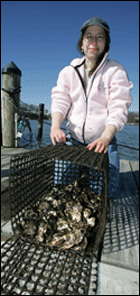
From the waters of Beards Creek Irene Hantman pulls a dripping line tied to the end of her community dock. At the other end floats a plastic crate full of oyster shells, and on those shells lie pale white juvenile oysters (or spat), about the size and shape of a fingernail, and almost as translucent. Hantman and a neighbor examine the spat's growth, but when Hantman pokes each developing shell, none of them close. Though the weather has remained relatively mild this year, she can see that the diminutive oysters have died. All of them.
Oysters have a tough time in Beards Creek. Salinity can drop fast here, when rainfall sends fresh water pouring in from the watershed, bad news for salt-loving oysters. But they've done well in other creeks nearby, and Hantman says that she has a gut-level intuition that there's something else that's making it hard for oysters to survive in Beards Creek.
For almost five years now Hantman and her neighbors have watched the creek's waters change color, especially just after a rain. Brown plumes work their way out from storm drain outlets on both sides of their community — from a pipe right by the community pier and from a marshy outlet to the south, where stormwater finds its way from neighborhood streets and roads and, increasingly, from construction sites.
Hantman and her neighbors believe that this fine cloud of clay and silt has killed their oysters and hurt the creek — they are well aware that scientists have fingered cloudy waters as a prime suspect in the disappearance of underwater grasses. And they know that sediment can cover and smother oyster bars.
What they don't know is exactly to what degree this is happening in their creek, and to what extent the development that has exploded in their Edgewater community has caused any ecological damage. Most of all, they don't know what to do about it.
Hantman and her neighbors believe that this fine cloud of clay and silt has killed their oysters and hurt the creek.
Stormwater runoff has become a new scourge on the Chesapeake landscape. In 2001, the Chesapeake Bay Program's Executive Council, including the governors of Maryland, Virginia, and Pennsylvania, issued a directive blaming stormwater for poor water quality in over 1,570 miles of streams in the Bay's watershed. According to that directive, "the vast majority of land developed prior to the early 1980s in the Chesapeake Bay watershed has no stormwater quality controls."
As a result, stormwater from urban, suburban, commercial, and residential development carries about 15 percent of the phosphorus, 14 percent of the nitrogen, and 9 percent of the sediment that annually enters Bay waters, according to estimates from the computerized watershed model used by the Chesapeake Bay Program. While agricultural runoff brings in greater loads (more than 40 percent of nitrogen and phosphorus and more than 60 percent of sediment entering the Bay), agricultural acreage is declining, while developed acreage is growing. And in rapidly urbanizing counties like Anne Arundel, stormwater, not agriculture, has already become the dominant source of both sediment and nutrients.
In the 2001 directive the leaders of the Bay states and the federal government agreed to implement innovative stormwater controls on state and federal lands, whether developing or already developed. This voluntary effort transcends existing regulation and serves as a model for municipalities and developers throughout the watershed.
But as Hantman began to learn, a wide ditch separates policy statements and even laws on the books from what may happen on a particular construction site at a particular time. Or in a particular creek.
Hantman is not, as they say, from around here. She grew up in the suburbs of Washington, D.C., in Montgomery County. Like so many others, she moved by the Bay to find a more pleasant life, and to be near the region's premiere natural asset.
Hantman is brown-haired, short in stature, and long on energy. With her eyeglasses and her intense intellectual curiosity, there is something almost scholarly about her, and she seems to take her nature seriously. She moved near Beards Creek in the fall of 2001. When she arrived with her husband Todd and their three-month-old daughter Fern, it never occurred to her that she would soon become a citizen expert in zoning ordinances and stormwater issues. All she knew of Beards Creek was that it lies on the southern shore of the South River and that their two-story wooden house in a modest neighborhood was only a two-block walk away from water.
Hantman has not lived in southern Anne Arundel County long enough to see the gradual changes that preceded her. The old draw bridge across the South River replaced by a fifty-three-foot-high fixed span. Bigger, more expensive waterfront homes sprouting up along the river shore. The arrival of South River Colony along Route 2, a large development bankrolled by a subsidiary of Exxon Corporation, with 900 homes and a shopping center anchored by a K-Mart two football fields long.
Beards Creek is only one of more than a dozen deep-water creeks branching gracefully off the South River that have seen the effects of changes in the watershed. For now, its marshy headwaters remain a haven for wildlife and a buffer for nutrients while development creeps closer — including a county highway facility constructed right on the edge of the wetland. The sounds of growling motorcycles and roaring cars and trucks on routes 2 and 214 have become the creek's new anthems.
Hantman began her unexpected foray into runoff and the affairs of the creek when a wave of development broke directly on her doorstep.
The angry phone calls and e-mails came in the spring of 2002, not long after she agreed to serve as secretary of her community association. An ugly brown plume had poured into the creek, something unusual for this quiet tributary, and neighbors were upset.
As a recent transplant to the region, Hantman was initially caught off-guard by her neighbors' emotional response. "It took about five e-mails before I finally began to get it," Hantman says.
The plume came from a construction site for Johnson's Lumber, a long-time Annapolis business recently relocated in Edgewater not far from Hantman's house. In an effort to be a good neighbor, the lumber company entered into a set of formal agreements, or covenants, with the community association, promising to minimize the impact of lighting, noise, and commercial access to neighborhood roads. But on the Friday evening of Memorial Day weekend, according to Hantman, contractors decided to empty a temporary stormwater pond used during construction. A filter was supposed to keep sediment from escaping, but fine silt washed directly down the community's storm system and into the creek.
The brown plume, the first of many to arrive from a number of different construction sites, drew Hantman into the world of sediment control and the bureaucratic labyrinths of stormwater management.
Hantman's first inquiries brought her to the Anne Arundel County Department of Inspections and Permits, the office in charge of permitting construction sites. They told her that in the case of Johnson's Lumber everything was being done according to county regulations. They would later tell her the same about other construction projects. And yet ugly plumes continued to darken the creek.
Some runoff during construction was inevitable, they said. Besides, she was told, there were several different issues here: one was the construction permit, another was the issue of sediment control, and yet another was the condition of the community's own stormwater system.
Hantman just wanted to stop the flow of silt into the creek, but she found no one at the county level who seemed to share her concern. "I was incredibly frustrated with the county," Hantman says.
Her association board asked Bea Poulin, a county-appointed community liaison, to attend one of their meetings. Poulin suggested that Hantman and her neighbors contact the county's Public Works Department to find out just what to do about their stormwater problem.
Hantman and other members headed to the Public Works office with a raft of questions. She had heard that new construction was supposed to maintain "predevelopment" runoff levels, but who determines exactly what "predevelopment" means? Who inspects the site before, during, and after construction? What role, if any, do local communities and homeowner associations have? Who would really be there when it started to rain?
Chris Phipps, chief engineer for the Public Works Department, had heard such questions and complaints before. He told Hantman and her neighbors that Anne Arundel County has a backlog of some $400 million dollars worth of repair work — to fix the pipes, ponds, and other devices that make up the area's stormwater infrastructure. He listened carefully and then suggested that while the county had no budget to undertake extensive repairs at present, he could support a study of their community's stormwater system. Hantman's felt encouraged. It seemed like a place to start.
She next contacted her county council representative to see if he could help — to support funding, for example, to actually repair the stormwater system. She also testified at council hearings, trying to draw more attention to the impact on her community and Beards Creek caused by development projects fringing her neighborhood.


Meanwhile development continued to arrive in a big way. For many years, a lone Giant food store marked the gateway to the neighborhood on the north side of Southdown Road, the main street leading into the neighborhood. A small bank stood on the other side, and south of the bank remained a stand of trees two blocks long. To the north, lay the last remaining farm fields in this area. Now their time had run out.
First one stand of trees fell to make way for a WaWa convenience store with gas pumps. Since construction plans called for runoff from the store and its parking lot to drain into the neighborhood's stormwater system, Hantman's community voiced its concern at a hearing before the county board of appeals. In the end, Hantman and her neighbors saw that the scale of the project remained essentially unchanged and felt their efforts had proven futile.
When the county finished its independent study of Hantman's community stormwater system in 2003, they reported that much of that system was failing. This confirmed Hantman's fear that new construction along Route 2 fed into a system already inadequate to keep stormwater from damaging the creek.
Hantman took this information to a county permit hearing, and questioned how new development could be allowed to tie into a stormwater system that the county itself labeled as failing. The answer confused her. County officials told her that projects like the new WaWa actually surpassed county requirements for stormwater management — they were, in fact, "overmanaging." Hantman asked exactly what that "overmanaging" meant, and was told that the convenience store would have large underground tanks that would catch the first flush of rainwater. But once the tanks filled, she understood, the stormwater would then empty into the community system.
No one seemed able to answer her question about how that would affect the community's stormwater system or the creek's water quality.
Then in 2004 a developer cleared land for a new subdivision adjacent to nearby Lee airport, and more silt found its way to the creek, more brown plumes wafted into the water. Soon after, another developer cleared what remained of the two-block stand of trees along the neighborhood's eastern edge to make way for a four-story apartment building. Change had clearly come to Hantman's little piece of Bay country.
What they don't know is exactly to what degree this is happening in their creek, and to what extent the development that has exploded in their Edgewater community has caused any ecological damage. Most of all, they don't know what to do about it.
Hantman trudged through the mud of the apartment construction site, along with two other representatives from her community. They followed the site manager as he pointed out stormwater devices and described their environmental protection measures. Although the company diligently graded the lot and installed silt fences, rainfall soon sent another brown plume down storm drains and into Beards Creek.
Something seemed wrong, and Hantman still questioned how permits could allow construction projects to tie into failing systems.
She decided to take her question to the next level, to the agency charged with keeping pollution out of the state's waterways, the Maryland Department of the Environment (MDE). There she found some very helpful information, and another twist in the bureaucratic maze.
Ken Pensyl, the administrator of MDE's Sediment, Stormwater and Dam Safety Program, like Hantman, takes the environment very seriously. Pensyl informed her that Maryland has a comprehensive stormwater management manual, and tries to maintain "as near as possible" the same runoff characteristics as before land is developed. He assured her that state stormwater rules are in place to reduce stream channel erosion, pollution, sedimentation, and local flooding. The state, he says, also requires local governments to include inspection and maintenance of stormwater practices, which can include specific maintenance agreements, with homeowners associations, for example. Hantman said that she had heard from a number of experts that Maryland's stormwater provisions serve as something of a model for the nation.
But what Pensyl told her next plumbed the heart of the matter. He said that actual decisions on the ground occur at the county level, through local zoning and permitting, and through local enforcement of construction practices.
Hantman found herself right back where she started — at the county level. Like someone lost in the woods who begins to recognize the same trees, she felt that she had come full circle.
Undeterred, she ratcheted the process up a notch, writing a formal complaint to the U.S. Environmental Protection Agency (EPA), and copying both of Maryland's U.S. senators and the Chesapeake Bay Foundation. She did this in her capacity as community association secretary — and because there must be, she felt, some way to step out of this endless cycle. It was now 2005, four years after her move to Beards Creek.
The EPA is the agency charged with enforcing the federal Clean Water Act, first passed by Congress in 1972. That law calls for the nation's waters to become fishable and swimmable, depending on their designated uses. A primary role of the EPA is to enforce limits on contaminants, including sediment and nutrients, that flow into the nation's waterways, so-called total maximum daily loads (TMDLs). The EPA keeps watch over stormwater management and can penalize states for not meeting the requirements of the Clean Water Act, but Hantman learned that the states have considerable latitude in precisely how they decide to manage stormwater.
The federal government depends on the states. The states depend on the counties. The counties depend on local input. Hantman saw that she would have to become part of that local input.
At hearings and in discussions with government agencies and even develop-ers, Hantman met a barrage of technical information. Runoff coefficients. Sheet flow. Predevelopment rates. If she were going to speak this language she needed to climb the learning curve. She signed up for an urban runoff symposium organized by Allen Davis, director of the University of Maryland Water Resources Research Center. An engineer, Davis is a leading researcher in the relatively new field of bioretention — designing ways to restore natural buffering capacity to highly developed landscapes. (See "Bend in the River".)
On a brisk November day as 2005 nears its end, Hantman finds her way onto the sprawling College Park campus of the University of Maryland, itself very much a part of the region's urbanized environment. Even finding a place to park can prove a challenge on the 35,000-student campus. She negotiates heavy traffic and a crowded parking deck to arrive at the Adele Stamp Student Union, three stories high and a city-block long, replete with movie theater, bowling alley, food court, and meeting rooms. She gets directions to a conference room on the second floor and arrives to find it packed. Government officials, resource managers, engineers, and others have all come to hear about stormwater and the effect of urbanization on Maryland's streams.
Hantman, it becomes clear, is not alone.
At the front of the room Davis and other experts describe what we know about stormwater impacts, and what we don't know. Hantman jots down notes and struggles to take it all in.
Davis presents data from his studies of bioretention, where he employs topography, substrate, and carefully selected vegetation to slow runoff and take up nutrients. His work includes four years of data on gutter filters along Route 1 in Prince Georges Country. He shows graphs that document how these filters not only slow the flow but at times absorb virtually all the load. The data also show a reduction of suspended solids, which means that less sediment is washing downstream.
Hantman learns that researchers like Davis are studying ways to degrade hydrocarbons like motor oil and nutrients like nitrate that find their way into stormwater. Microbes are key in both cases, explains Davis, who explores methods for boosting the degrading work that microbes do. For example, he has found that shredded newspaper provides a pretty good carbon source to nurture the right kind of bacteria to convert nitrates to nitrogen gas through the process of denitrification.
From other speakers Hantman learns that stormwater and its effects on streams and hydrology plague many developed areas throughout the Chesapeake Bay's 64,000-square-mile watershed. Margaret Palmer, director of the Chesapeake Biological Laboratory, one of three labs that comprise the University of Maryland Center for Environment Science, tells the audience that even when we work to restore streams, very little monitoring follows. This leaves citizens, scientists, and funding agencies largely in the dark about whether the methods we use to repair insults to the natural hydrology are working. Or not.
Other speakers detail how population has migrated to coastal areas, not only in the Chesapeake region, but in many parts of the United States and beyond. Gerrit Knaap, executive director of the National Smart Growth Center at the University of Maryland, describes the rise of "megacities" and the environmental impacts that follow when developed areas reach farther into farm and forestlands. The trends are disturbing.
For now, Davis and others argue, the key is to promote low impact development (LID) to reduce the amount of runoff — and whatever it carries — at or near the source. This means urging and requiring developers to install retention areas and other features as they build, and not waiting until development is already in place. The most cost-effective thing we can do, Davis says, is to construct these devices upfront, a golden opportunity in areas where development is just taking hold, an opportunity we don't want to lose.
Hantman packs up her notepad. She is bolstered by the knowledge that she is not alone in facing the stormwater issue, which represents a nationwide, even a global, challenge. But the talks also make clear the large gap between what is possible — what developers and others could be doing — and what is actually happening on the ground. She lingers to speak to some of the experts before she retrieves her car from the parking deck and returns to the complexities of her own community's struggle to slow the ravages of stormwater.
Do the personal energies that Hantman and other private citizens expend on the region's stormwater troubles make any difference? Can they bridge the gap between theory and practice, between regulation and reality?
According to Hantman, the answer is a qualified yes. Until recently, she explains, county regulations gave contractors two weeks to stabilize disturbed sites — two weeks when heavy rains might flush clay and silt from land scraped raw. They now have 48 hours. Hantman credits this change to the hard work of the South River Federation and other activists. Though there are still holes in the sediment control requirements, she says, this represents a real, tangible improvement.
And now inspectors show up more often. That is what Osprey Development and Harkins Builders, the developer and construction firm putting up that apartment building, have told her. "We have never seen an inspector so often," they said. The site manager believes that the county has been "sensitized" to Hantman's concerns. She and her colleagues have evidently been heard.
"Some days it seems that people are really beginning to understand how our behavior affects the Bay. I'm amazed at people in my community who Ôwant to do something.' But they need to know what little things they can do. Otherwise," she says, "the news can sound pretty hopeless."
She still believes that "every shoreline project, every oyster garden can make a difference." She is also a big believer in low impact development techniques, and hopes to win grant funds so her community can undertake stormwater abatement efforts beyond what the Department of Public Works can afford.
Her community's focus on low impact techniques should help, according to engineer Allen Davis. "People worry about what percentage of a watershed is covered by impervious surface," he says, "but that's not the whole picture." While impervious surface can clearly degrade a watershed, Davis points out that size and location make a difference. Is the impervious surface in huge areas, like giant parking lots (bad); or is it broken up into smaller pieces (better)? Is it downstream or upstream? Are there best management practices that could slow runoff coming from those impervious surfaces, such as rain gardens, sunken medians, or terraces?
"All watersheds," he says, "are not created equal."
There are signs of hope in Hantman's community. Gas stations and car dealerships with deep grassy swales instead of straight gutters. Parking lots with sunken medians, and roofs planted with vegetation to absorb rainwater.
But the biggest challenge, she feels, is a lack of funds and a lack of leadership. "The inspectors I speak to are sympathetic," she says. "They do what they can for tighter controls on construction projects. But they just cannot inspect all the sites. The county code calls for inspecting every two weeks, which is not really enough, and they can't even do that," she says. "They just don't have the manpower. I feel an incredible sense of frustration about that."
"We need the infrastructure to catch up with the advocates," Hantman says, adding that this may mean no new development in some areas. "Some people seem to think that Ôall development is good.' We need to be thoughtful about where we live and where we work." She says that development invariably means more impervious surface, which means more runoff — especially without aggressive bioretention efforts to help gather and slow the flow.
Hantman has not yet heard about her complaint to the EPA and says that she still hasn't gotten good answers to many of her questions. How can permits allow new projects to feed into a stormwater system that the county itself says is failing? How will the county handle that $400 million backlog of stormwater infrastructure projects? Who will pay? Who will make sure it happens?
For the past six months Hantman's been working to promote the idea of a Watershed Restoration Fund for Anne Arundel County, built on the concept of a stormwater utility. The utility calls for county residents to pay a small fee, perhaps five dollars a month, to support stormwater upgrades, maintenance, and repairs. This would provide a strategy for chipping away at that $400 million backlog, but so far the plan lacks political momentum.
In many ways, stormwater has changed Hantman's life, something she did not expect when she first moved near Beards Creek with her infant daughter. "I wasn't really ÔBay aware' until I moved down to the South River," she says. Largely she knew what she read in the newspapers. "I knew there was a 'dead zone,' but I didn't understand the scope of the problem."
Now Fern is almost five, and the demands on Hantman's time and energy have only grown. Hantman estimates that she has worked 10 to 20 hours a week for the last two years — for free of course. "It's been a real experience," she says.
She thinks about changing careers. "I might want to do this full time," she says. She's thought about a career in environmental policy work, and perhaps a degree in environmental law.
"It all started with the stormwater work," she says. Others have enlisted Hantman's help as well. She now serves on the Western Shore Tributary Team, used by the Maryland Department of Natural Resources to guide the state's Chesapeake Bay initiatives.
Hantman has connected with others who have taken similar journeys. She has strengthened ties with a network of activists in the Chesapeake Bay Foundation, the local Watershed Alliance, and the South River Federation. She has come to rely especially on Drew Koslow, the South River's full-time riverkeeper. A paid citizen watchdog, Koslow travels the length of the South River in his skiff, Remedy, and keeps track of trends and changes, and follows up on complaints. With all the development in the South River watershed, stormwater has risen to the top of his list of concerns. (See "The River's Keeper".)
Will the determined intervention of activists and new techniques from engineers finally slow stormwater's destructive tide?
Hantman says that her concerns leave her somewhere between hope and despair. She sees hope in new construction techniques and in stricter adherence to both the letter and the spirit of stormwater regulations. But at times she feels despair watching a development boom that appears to have no end, and that threatens to overwhelm even our best-laid plans. Most of all, she says she wonders whether they will ever be able to raise oysters at the end of the dock, and if it will ever be safe for her daughter to swim in Beards Creek.