

Dave Van Metre spends his layover day reading and napping. He's reading John Grisham's The Last Juror because he loves a thriller. He's taking naps because he was up late the night before leading a ship down from Baltimore to the mouth of the Chesapeake Bay. And in the night to come he'll be working all the way through to dawn, guiding a Norwegian ship on a night passage back up the Bay to Baltimore. Once he gets his call, he won't have time for another nap or another thriller.
Van Metre is a reader and, as it turns out, an occasional story teller. As a Maryland Bay pilot, however, he doesn't have a lot of hair-raising stories to pass on. Those who do are apparently not the ones you want on the bridge of a tanker carrying millions of gallons of oil, enough to pollute the entire Chesapeake. Like most pilots, Van Metre is cautious, risk averse by nature and trained to avoid collisions or groundings or weather traps by thinking ahead, way ahead. He spends his work days and nights trying to steer clear of trouble.
After 40 years on the job, Dave Van Metre is now a gray beard among the pilot corps. Behind the beard are a broad face, thinning hair, and a pervasive calmness that works well on the bridges of foreign ships. From all those years on all those ships, he has some tales to share, most of them short stories, not novels. But he will have one thriller to tell before his long passage is done.
When Dave Van Metre brings big ships up the Bay to Baltimore, he is running the longest single-pilot passage in America.
Maryland Bay pilots climb aboard nearly every large, non-military ship bound into or out of Maryland waters. Standing in wheelhouses among mostly foreign crews, they guide deep-draft ships through a long, shallow estuary. Their skills are similar to a ship captain's: piloting, navigating and shiphandling for vessels of any size. But they bring to the boat something the incoming captains don't have: detailed local knowledge of all the Chesapeake Bay's trenches, shoals and dredged-out channels.
There is a mystique to their profession. Here's Mark Twain writing about his years as a river pilot: "I loved the profession far better than any I have followed since, and I took a measureless pride in it. The reason is plain: a pilot, in those days, was the only unfettered and entirely independent human being that lived in the earth." Pilots in these days may be more fettered than Twain was, but it's clear they see their job as one of the pinnacles of the maritime professions — right up there with ship's captain, but without the four-month rotations at sea. These are sailors home from the sea nearly every other night.
The mystique is part history, part mystery. Pilots have been around since Biblical times and they have worked the Chesapeake Bay since Colonial times. In 1852 three dozen freelance pilots met in a hotel in Baltimore and set up the Association of Maryland Pilots, the first state-chartered pilots organization in the country. For a century and a half, the Association has recruited and trained the state's pilots, passing down a culture of competence and an impressive record of safety. The Coast Guard lists only two loss-of-life collisions involving Maryland pilots since 1947. They are a first line of defense against ecological disasters like the Exxon Valdez oil spill in Alaska's Prince William Sound. When they bring big ships up the Bay to Baltimore, they are running the longest single-pilot passage in America.
How a pilot does his job, however, remains a mystery to most boaters on the Bay. Those of us who go oystering or crabbing or fishing or sailing seldom see a pilot. We may see a giant ship jutting up against the horizon and perhaps catch a glimpse of a solitary silhouette high up on the bridge wing, holding binoculars. How does he (or she) get a ship that big to Baltimore — without crashing into something or running aground somewhere like so many of us do?
Dave Van Metre gets his call to go to work at 20:30. A ship steaming south towards the mouth of the Chesapeake Bay has radioed in. The call went first to a watch tower on the beach side of Cape Henry,Virginia, where observers track incoming and outgoing ships. The tower radioed the Maryland Pilot Station, a red-bricked, waterside structure along Lynnhaven Inlet where pilots like Van Metre can rest between assignments in bedrooms, a lounge or a well-stocked kitchen. A dispatcher then rings Van Metre's room, jolting him out of his last nap. He shuffles down the dark corridor to a communal bathroom. An hour later he is riding in a fast launch boat, bouncing across dark, choppy water.Ten miles out is his next job: A Norwegian cargo ship, towering in the darkness, waiting for a pilot.
Riding in the launch next to Van Metre, I ask him if he ever gets nervous about climbing a Jacob's ladder. A pilot usually boards a vessel at sea by stepping off the deck of the pilot launch, grabbing hold of a rope ladder dangling down the side of the ship, then clambering up its wooden treads. "I'm always wary," he says. "I always take my time." Ships are larger now than when he started, and Jacob's ladders are longer, but he's clearly not nervous. His companion might be.
I focus on the advice one of the launch operators gave me. When a swell is running, especially out of the southwest, the launch will rise and fall along the side of the ship. The first trick is stepping onto the ladder at the top of the swell. Step off too early and the launch keeps rising, squashing you against the side of the ship. Step off too late — when the launch is falling away — and it may still lift up on the next swell and mash you.
Another trick is holding on. Always keep one hand gripping a rope and one foot standing on a tread. Never let go until the other hand has a new grip, never step up until the other foot has a new tread.
I try to forget the story that came with the advice. A pilot was in the middle of reaching for the ladder, when the launch suddenly sank away before he had a strong grip. He fell, landing on his back on the rails of the boat. He survived.Others have not.
Through the windows of the launch we see two triangles of lights, low on the horizon, barely moving against the dark sky. One is our target, the
As the launch closes in, the Taiko takes shadowy shape, a denser blackness against the night. A sudden spotlight switches on, and we see a rust-red wall, four-stories tall, looming above us. The operator matches our speed with the ship, holds the rudder over, and keeps the launch pressed against the big hull. We seem to be motionless, a stable platform parked on the sea. Van Metre walks forward to the bow of the launch, hands his travel bag and laptop to a deckhand, then steps lightly onto the ladder and starts climbing the wall.
Sliding warily along the deck, I look down and immediately regret it. Our platform is rushing across the ocean at a good clip, much faster than anybody can swim. I hand my bag and camera to the deckhand and look up. In the Bible, Jacob saw a ladder reaching from earth to heaven with angels gliding up and down on it. The only heaven I can see is half-way up the side, a square opening with a little platform jutting out and an orange-jacketed deckhand peering down. I step off, repeating my little mantra: Reach, grip, step, let go. Reach, grip, step, let go. I don't look down until the deckhand hauls me onto the platform.
 |  To board a vessel, a pilot must climb a Jacob's ladder several stories high (left) from a small launch boat moving alongside the big ship, a daunting task even when seas are stable. During rough weather, getting on board can be treacherous. The Bay pilot is directing the Taiko's trip northward, but Captain Torbjørn Pedersen (above) keeps close watch on everything the pilot does. |
On the bridge of the ship, Van Metre starts with basics. He shakes hands with the ship's master, Captain Torbjørn Pedersen, and starts running through his questions: Who is on board, what's the ship's draft (depth below waterline), what speed does the master want to make, what's the stopping time, where's the whistle, the rudder angle indicator, the radar? Van Metre has been on this ship before and knows most of the answers. It's a brief, laconic conversation, part of his ritual for taking control of the ship. Pilots call it "taking the conn.''
The Taiko, he learns, has 5 officers from Norway, 3 from India and 22 crew from the Philippines. She draws 30.5 feet, she can make a top speed of 20 knots, the captain wants to reach Baltimore by dawn.
Van Metre has his sailing orders. He walks over to the radar console on the left side of the bridge and stares down at the green-on-black screen, checking for the ship's position. The wheelhouse is 60 feet wide, larger than the control room of the Starship Enterprise, but darker and nearly deserted with only three men visible- in the shadows. The captain and a mate talk quietly in Norwegian, and a Filipino helmsman stands rock still in the center of the bridge, staring at the compass-.
The ship he's piloting is stuffed with vehicles. The Taiko is called a Ro/Ro ship for the huge roll on/roll off ramp it carries on its backside. It can hold up to 4,400 automobiles, enough to fill most of the new car lots in Baltimore. On this trip it's also carrying trucks, bulldozers, excavators, helicopters, airplanes. One of its sister ships once hauled a Russian space shuttle to a museum in Australia. "You name it, we got it," Captain Pedersen tells me.
Van Metre gives his first command — Full ahead. The Taiko had slowed for the pilot launch and Van Metre needs at least 12 knots for good maneuvering in the face of winds and tide. He asks for 10-degree turn to starboard, then walks forward to the huge wheelhouse windows.
 |  Zigzagging from one shore to the other, a big ship heading to Baltimore must take a crooked route (left) through dredged channels and ancient trenches left behind by previous ice ages to safely navigate the shallow waters of the Chesapeake Bay (adapted from a map by the U.S. Army Corps of Engineers, Baltimore District). Dave Van Metre (above), on the bridge of the Taiko, has steered ships through these passages for 40 years. |
The view from the bridge of the Taiko looks a lot like the view from the cockpit of a Boeing 757 heading in for a nighttime landing. From his high-altitude perch, Van Metre looks out past the distant bow to two parallel lines of lit buoys. Red on the right, green on the left, they are laid out on the black sea like landing lights on an airport runway.
Van Metre asks the captain to switch on a tiny bow light, a small bright reference point that gives him a stronger feel for the size of his ship. Like the rifle sight at the end of a gun barrel, it helps him aim 66,000 tons of ship straight down the channel.
His first target for the Taiko is the TH channel, named after the Tail of the Horseshoe, one of the offshore shoals fronting the entrance to the Bay. With four 10-degree course changes, he gradually swings the ship into a 332-degree compass heading, keeping it north of the shoals, getting a feel for the ship's handling. He's moving through an ebb tide that began flowing out of the Bay half an hour before.
With the ship steadied up in the channel, Van Metre walks outside onto the portside bridge wing and clamps a small antenna to a metal strut. The Maryland pilots all carry a Differ-ential Global Position-ing System that takes bearings from up to 14 satellites and one land-based transmitter. All these data streams help each pilot nail his or her position to within three feet. It's a moonless night, but I can't see any satellites overhead, just a backdrop of a million stars. I stare upwards, searching for the Big Dipper and the North Star, wondering how the first ships ever made it up the Bay.
Back in the wheelhouse, Van Metre hooks up his laptop to the antenna wire, plugs in the computer and boots up. There on the black screen, a glowing green outline of the Chesapeake channel, each buoy pinpointed, and there in the middle of the channel a tiny boat-shaped blip, the Taiko, plods forward. About 10 miles ahead of us, another boat blip, the Patriot, also inches its way up the screen towards Baltimore.
With a glance at his high-tech visual aid, Van Metre focuses on his next target: the lights of the Chesapeake Bay Bridge Tunnel, a chain of causeways, small bridges and underwater tunnels that range across the mouth of the Bay. As the Taiko picks up more speed, he goes back to his ritual call-and-response with the helmsman.
Port 10, this, quietly, from Van Metre, asking for a right rudder.
Port 10, this, quickly, from the helmsman, letting the pilot know what he has heard.
Three twenty-five, this from Van Metre again, giving the compass heading he wants the ship to center on.
Three twenty-five, the helmsman, staring intently at the compass, letting the pilot know they are now on his course.
"Very well, thank you," says Van Metre. He projects a polite, almost courtly manner, but he keeps a close eye on the rudder angle indicator. Helmsmen have been known to turn the wrong way.
This ping-pong patter will continue all night. Keeping an 870-foot leviathan in its channel takes constant, tiny 10-degree adjustments. The pilot and helmsman seem to be tinkering with the ship, rather than turning it. What they're tinkering with is the implacable physics that underlies ship handling. A thing at rest tends to stay at rest, a thing in motion tends to stay in motion. If the thing in motion is 66,000 tons driving through the water towards a large bridge, you can't let it go very long in the wrong direction.
It was here in these offshore waters outside the mouth of the Chesapeake that Dave Van Metre began his career. He came up the old way, without a degree, working with deckhands on the old pilot boat, a kind of floating hotel for off-duty pilots and a training ground for apprentices. In 1965, off-duty pilots had no red-bricked waterside station with dorm rooms, spacious lounge and well-stocked kitchen. They spent their layovers crammed onto a 200-foot yacht that held 15 crew and 15 pilots in semi-comfort. Pilots waiting to work a ship back to Baltimore would spend their time resting, reading, eating, talking. Apprentices would scrape the decks, paint the decks, man the helm, and drive the small launches that ferried pilots to and from their ships.
Like a lot of older pilots, Van Metre had a family connection to the business. His father was not a pilot, but his great uncle was, and that bond would alter his life. He was a freshman lacrosse player at the University of Maryland when an opening came up with the Association of Maryland Pilots. With his great uncle as sponsor he won admission. At age 19, he was working the decks of the pilot boat and riding large ships up and down the Bay.
That career path is now largely closed for would-be pilots. Current applicants usually have to graduate from one of the country's merchant marine academies, then go to sea and work their way up the ladder from third mate to second mate to first mate to master. That's a tough climb to complete even by age 30, especially in an age of scarce jobs in a shrinking U.S. merchant marine fleet. With a master's license finally in hand, a would-be pilot applies for a five-year training program with the Maryland pilots: two years as an Apprentice Pilot, three years as a Junior Pilot. Family connections don't count.
Working in the old system, Van Metre spent three years as an apprentice, riding more than 500 ships up and down the Bay — observing, learning, preparing, memorizing buoys, taking exams, climbing the ladder. Twenty-four hours between trips, a progress review every six months, a week off every year — and not much of a social life. At year three, he spent two weeks taking the Coast Guard exam for his first-class pilot's license.
They handed him a blank sheet of paper, told him a starting point and a destination and asked him to draw all the charts for the entire route. Pencil, paper, parallel rulers, dividers. No visual aids to work with. No books, no maps, only memory. You start with the first buoy, its color, its flashing pattern, its location. Then the distance to the next one. Include lighthouses, their flash pattern, their luminous range. Don't forget water depths, old wrecks and other odd obstructions.
Then he did it again: different starting point, different destination. Then again. And again. Until he had drawn all the major charts for the entire Chesapeake Bay. Part way up the Potomac, all the way up to Chesapeake City and the C&D canal. He spent an entire day on each chart. All the charts from memory, and forty years later, this is his memory: "It was quite tedious. And it still is tedious today for anybody doing it. Everybody dreads it."
It's a big step up the ladder. Passing his chart test made him a Junior Pilot at age 22. He could pilot ships now, but only alongside a Senior Pilot. Then came his state piloting licenses: at year four he could pilot boats drawing 24 feet, then 27 feet, then 30. Climbing the ladder. At year six, another Coast Guard exam, his Inland Unlimited Master's license and promotion to Senior Pilot. The top of the ladder at 25. He could step on board any ship of any size and pilot it anywhere in the Bay. And he could do it alone.
By the time the Taiko reaches the Bay Bridge Tunnel, we are up to 17 knots, and the Bay pilot and the sea captain are talking books. Both are fans, it turns out, of John Grisham's legal thrillers.
Captain Torbjørn Pedersen, appropriately enough, is working his way through Master and Commander, Patrick O'Brian's adventure novel about the British Navy of the early 19th century. The book, however, has proved slow going with all its terminology about long-gone sailing ships. "It is really hard to read for a Norwegian," Pedersen tells his pilot. "So many technical words."
The book talk is more than a way of passing time on a long night watch. It is a kind of feeling-out process for pilot and captain. Think of it as a quiet negotiation. Who is the real master and commander on the Taiko as it transits the Chesapeake Bay? The pilot is clearly giving all the orders, while the ship's master is only watching.
Captain Pedersen does his watching from a tall swivel chair on the right side of the bridge. When I ask him how he feels about turning control of his ship over to a pilot, he's suddenly the commander. "The pilot is only the adviser," he says. "The pilot is never in command. That is very important to state." To maritime courts, however, the issue of command — and liability — is less clear than it is to Pedersen. He props his feet on the ledge of the front window and stares out past the distant bow of his vessel. "I can put him aside whenever I want to."
Like the pilot he is watching, Captain Pedersen is old school — but old school Norwegian style. Norway, he tells me, is the third busiest seafaring nation in the world, and Wilhelmsen, the company he works for, is one of the oldest shipping lines in the world. Pedersen's father and grandfather went to sea, so he went to sea also, starting out at 16, working three years on deck and becoming an able bodied seaman before he ever started maritime classes. Climbing the ladder from bosun to second mate and first mate, he made ship's master at 30 years old. That system of training is gone now, he says, replaced with a maritime cadet system that has no prerequisites about on-the-deck training.
After that long climb up the old ladder, Pedersen is not going to give up his bridge until he's comfortable with his pilot. "If something wrong happens, then the pilot will step aside right away and say she's all yours captain. And then I have to decide what to do and so on," he says. "That's what I am mainly doing up here. I am sitting in."
On a long run like this, ship speed can become an issue between adviser and commander, a matter for quiet negotiation. It's already costing $50,000 a day to operate the Taiko, according to Captain Pedersen, or better than $2,000 an hour. At those rates a ship's captain generally wants to move as fast as he can. For a pilot, however, high speeds have a problem: it takes a long time to slow down.
Van Metre decides to keep the Taiko at 17 knots, at least down here in the lower Bay with its larger shoals and longer channels. The captain goes along without complaint, but he hangs around well past the end of his watch, keeping his eye on the pilot as he lines us up with the next channel.
Just past the Chesapeake Bay Bridge Tunnel, Van Metre makes a small starboard swing into the York Spit Channel. It is here in the shipping channels of the Chesapeake that ship captains get nervous and Bay pilots earn their hefty fees.
Think of Van Metre as a jockey riding a ponderous, slow-turning beast. Then think of the Bay as an obstacle course — but with barriers and blockages hidden out of sight below the water.
The pilot as jockey has his cut-throughs and workarounds, all underwater. These are the shipping channels cut into the bottom of the Bay at great expense, all in hopes of keeping the port of Baltimore open to ocean-going ships. I can see the channels on charts or outlined- on the black water by red and green buoys. Van Metre can see them in his head. He can see them when the buoys are under the ice, when the visibility- is zero, when the radar is down.
As Van Metre prods the Taiko through the starting gate of the York Spit channel, he's beginning a 16-mile run that shoots between two large shoals: the Tail of the Horseshoe and the Middle Ground, a wide shallows once famous for grounding ships and breaking them apart.
Running past a shoals is a challenge because a dredged channel changes the hydrodynamics of ship handling (see "Big Boats, Narrow Channels"). A ship will "squat" lower in a channel, it will twist its bow towards the middle, it will shift its stern towards the side bank. Van Metre has techniques for handling "squat" and "bank suction" and the niceties of passing a ship in the night in a narrow channel, tricks and technologies that Bay pilots have evolved and passed down over the last century and a half.
He'll need them all. The long passage to Baltimore is littered with deeps and shallows that evolved over thousands of centuries. According to classic geology, the Bay is a drowned river valley created by the retreat of the last ice age. During the last big freeze, 18,000 years ago, this Bay was a river we now call the Susquehanna. It carved a deep valley down through Maryland and Virginia, then flowed across the continental shelf and emptied into an ocean that was 50 miles offshore of the current Virginia Beach. As the ice melted and the glaciers shrank, the sea rose and flooded back up the river valley, turning it into an estuary and shoving the Susquehanna back up to Havre de Grace. According to Jerry Schubel, a long-time marine geologist, there have been many ice ages and Chesapeake Bays and Susquehanna Rivers — and they all left obstacles behind.
The Middle Ground shoals we're moving past was part of the main channel of an older Susquehanna and an older Chesapeake that ran east of the current estuary. As all estuaries do over time, that Chesapeake filled its main channel with sediment, leaving a blockage that Van Metre has to work his way around.
There will be other legacies later in the passage. The archipelago of islands that now line the Eastern Shore includes Hooper, Taylors, Poplar and Kent — islands that once lined the bottom of earlier Susquehanna rivers. According to Jeff Halka of the Maryland Geological Survey, those old channels filled up with sediment over the centuries, heaping up islands that now hold villages, condos and marinas.
So Dave Van Metre — like Mark Twain — is also a river pilot, picking his way through deeps and shoals that were dug out and shifted around by ancient rivers in their millennial wanderings. Like all of us, he's afloat in the river of time, but he's going in the opposite direction. As he winds his way up the current Chesapeake, he's working his way up through time — from an older estuary to a younger one. The last great flooding took thousands of years, making the Bay mouth and southern Bay the oldest parts of the estuary, first invaded some 10,000 years ago, according to Schubel. Where Van Metre passes the Potomac, the estuary is about 8,000 years old. Where he passes Annapolis, it's about 5,000 years old. When he docks at Baltimore at the end of his long passage, he'll be an older man in a younger estuary-.
As Van Metre bends the Taiko rightwards into the second leg of the York Spit Channel, he takes his turn in small 10-degree chunks, a trick to keep the big ship from swinging out of control. A pilot carries the layout of the channels embedded in his brain from thousands of trips, but on each trip he has to find his feel for his new ship fairly quickly. Van Metre starts with a 10-degree starboard rudder, then fairly quickly calls Midships, returning the rudder to a straight ahead angle. He calls this "checking the swing."
Standing out on the bridge wing, I can see the turning, but I can't feel it. The Taiko is so massive, it creates its own gravity field. It becomes a still point in a turning world. Everything ahead of us is shifting: the lines of red and green buoys, the ship lights on the horizon, they are all drifting leftwards past our distant bow light. The planet is revolving around us.
Some of those lights I see are a ship heading towards us. Inside the wheelhouse, Van Metre has been tracking it on radar, but out on the bridge wing, working without technology, the oncoming approach is hard to read: simply a triangle of lights standing way off the starboard bow, one red and two white lights that seem to blur together. They give no hint of the speed or size of the ship.
Ship lights on the Bay at night are never easy to read, even for experienced seamen, but reading them right is the first step to pulling off a safe ship-to-ship passing. The worst ship collision of the last half century began with Coast Guard officers misreading the lights of an oncoming ship.
On an October night in 1978, the Coast Guard officer in command of the cutter Cuyahoga peered through his binoculars at distant lights and decided he was looking at the lights of a small fishing vessel. His 125-foot cutter was steaming north up the Bay with plans to turn left into the Potomac River for an overnight anchorage. On board were 29 crew members, many of them officers in training. He walked into the chartroom, checked the radar contact and decided the fishing vessel was already headed into the Potomac River.
The lights were not a "small fishing vessel" but a 571-foot cargo ship, and it was not headed into the Potomac River. The Santa Cruz II, an Argentine coal ship, was steaming straight south past the Potomac. On board was a Maryland Bay pilot who read the lights of the northbound Cuyahoga accurately and prepared to steam past it on a basic port-to-port passing, much like two cars on a highway.
With the ships closing fast, however, and with no ship-to-ship warning, the Coast Guard officer ordered a series of left turns, curving his small cutter directly in the path of the larger cargo ship. The Bay pilot aboard the Santa Cruz made all the right moves according to the nautical rules of the road: he sounded a whistle blast signaling he was holding course as the "privileged vessel." Then he sounded another blast, followed by five short danger blasts, then five more.
The Cuyahoga commander ordered stop engines and full astern, slowing his cutter directly in front of the oncoming cargo ship. On the flying bridge a young seaman saw a terrifying sight: the lights of the "fishing vessel" became a cargo ship on a collision course.
The Santa Cruz plowed into the Cuyahoga just aft of its wheelhouse, bulldozing the cutter backwards at 13 knots for more than 30 seconds. Below decks the impact caused fractured skulls and broken necks and frantic scrambling to escape a sinking ship. The Cuyahoga sank stern first within two minutes, taking eleven crew members to their deaths.
Major investigations followed, then congressional hearings, a court martial and changes in Coast Guard training. The episode highlighted how easily human error can override high-tech navigational aids and unleash disaster, even death on the water, especially in the close quarters of a ship-to-ship passing.


From the bridge wing of the Taiko, I see what the crew of the Cuyahoga saw: ship lights headed down in this direction, one of them a red portside running light. But inside the wheelhouse Van Metre knows the track of the ship from the radar screen, and from his laptop GPS he also knows the name of the oncoming ship, its size, speed and cargo. Behind those approach-ing lights is the Tasmania, 708 feet long, drawing 35.5 feet, five feet deeper than us. The laptop screen also shows the name of the other pilot: Jim Mead, a veteran who joined the Associa-tion of Mary-land Pilots one year before Van Metre did.
The radio crackles and Van Metre responds. "Stand by, Jim. Good Evening. One whistle, port to port, sounds good." A short conversation, two old friends passing in the night, but it's a key communication. Each pilot is letting the other know well ahead of time what he's planning to do with his ship. It's a conversation the commander of the Cuyahoga never tried.
When ships pass in a dredged channel, however, Van Metre has more underwater physics to think about. He moves the Taiko away from the centerline, creating more separation for the Tasmania and its deeper draft. As the hull of the Taiko slides along the side wall of the underwater cut, its stern is sucked even closer to the bank of the channel.
As it closes on the oncoming ship, the Taiko displaces tons of water outward, pushing a hefty bow wave towards the oncoming ship. The same physics is working on the Tasmania along the other side of the channel. The solution: In a tight channel passing, both pilots actually curve back towards the center, aiming their bows back towards the other ship, slanting away from the side wall and letting the collision of bow waves straighten their ships out.
That's tricky enough to make any captain nervous, and the approach of the Tasmania brings Captain Pedersen to the bridge wing as another lookout. As it closes on us, the Tasmania remains to the eye only three small lights ghosting down the nighttime Bay. The lights, I realize, are hanging high above the water, the first sign this is a large ship. Tasmania finally takes shape as a container ship, its deck loaded with trailers ready to go on trucks. The ship, all 708 feet of it, slides by so quietly all we can hear is the hissing of its bow water. That's the last ship out of Baltimore this night, Van Metre tells us.
It's suddenly a lonely Bay out here in the middle of the night with only three large ships moving through: the Taiko, the Tasmania behind us, and the Patriot ahead of us. When Van Metre began as an apprentice and Pedersen began as a deckhand, Baltimore was drawing many more ships to the Chesapeake — ships that were smaller, but more "shiplike." "Thirty years ago," says Van Metre, "you'd have maybe eight ships to carry this amount of cargo."
Many of the behemoths now nosing up the Bay barely resemble ships. A typical car carrier is a floating box. There's a traditional flaring bow but it's followed by a long, blank-sided box that stretches three to four city blocks back and towers 15 stories high. A container ship carries truck trailers stacked high behind the bow, obliterating the sweep of its lines. A Ro/Ro carries a cargo ramp for a stern.
Mostly gone are the "break-bulk" carriers with a classic merchant ship profile: the high, sharp bow sweeping down to a cargo deck topped with derricks and booms, then further back a high-standing superstructure with wheelhouse on top and bridge wings to each side. You see this profile on posters and billboards advertising Balti-more as a port city, you seldom see it on the Bay.
At the end of the York Spit channel, Van Metre glides the Taiko into a deepwater tract called the Virginian Sea Trench. Here in these wide sudden deeps along the Delmarva Peninsula, a pilot's work gets easier — no worries about shoals for awhile. Van Metre is steering across the crash site of another collision, one more catastrophic by far than the sinking of the Cuyahoga.
Thirty-five million years ago, a giant meteor came blazing through the solar system headed for earth. The era was the late Eocene, a warmer epoch when the Atlantic Ocean reached inland almost to the Appalachians, covering the Bay and all the sites like Norfolk and Baltimore that would later become the cities of the Coastal Plain. If Van Metre were working these earlier waters, he'd have no shoals to worry about until west of Richmond. If he'd looked skyward to check the stars, he'd have glimpsed a terrifying sight: a light in the night that became a meteor. And that light would have been the last thing he ever saw.
The meteor shot through the earth's atmosphere at six times the speed of a bullet and smashed into the ocean. A blast wave immediately incinerated all life forms within six hundred miles and sent tsunamis roaring across the Coastal Plain towards the Piedmont Plateau. The impact blasted a crater 50 miles across and a mile deep, centered on what is now Cape Charles City, and then nearly filled it up again as fragments of rock fell back into the hole.
That crater and its rim, buried beneath 35 million years of earth, shaped the southern Bay we're sailing through — according to researcher C. Wylie Poag, of the U.S. Geological Survey, and a number of other geologists. There is evidence, they say, that rivers like the James, the York and the Susquehanna once ran separately to the sea — and might still do so today without meteorite intervention. Norfolk might be a port on James Bay, Yorktown on York Bay and Baltimore, perhaps-, on Susquehanna Bay.
But the meteorite left a crater that would gather together these three rivers into one basin. Over millions of years, the crater's center kept sinking faster than the rim, creating a downhill path, drawing together the York, the James and the Susque-hanna rivers. As ice ages came and left, the York and the James eventually merged with the mightier Susquehanna and ran as one river to the sea. These deeps above the old crater now give Van Metre some easy piloting on his long passage through the newest Chesapeake.
Meteorites and ice ages could come again — and the best piloting can do nothing to prevent them. Within five million miles of earth, there are ninety-nine asteroids larger than half-a-mile in diameter-, according to a survey by the National Aeronautic and Space Administration, and any one of them could rearrange the Chesapeake Bay again and wipe out life — including city life — along the Mid-Atlantic.
On the bridge wing of the Taiko, I look up at the stars again. Lights in the sky, like lights on the Bay, are hard to read. What's a shooting star? What's an oncoming disaster?
We're nearing the upper edge of the Virginian Sea Trench when Captain Pedersen, master of the Taiko, decides he has seen enough of this pilot.
Van Metre will soon come up against the Rappahannock Shoals, the largest underwater shallows in the Chesapeake, but the sea captain is finally comfortable giving up the bridge. He has seen Van Metre maneuver through three channels and pass one ship. "I have an old pilot who has been there before," Pedersen says, standing by the exit door. "I go down and take some paperwork." And perhaps some sleep.
With the captain below, Van Metre swings sharply west by northwest into the Rappahannock Channel, a 14-mile furrow that cuts through the Rappahannock Shoals. There are no natural troughs around this huge, Baywide hump, and no satisfactory explanation for why it's here. Van Metre runs the channel on a 322 compass heading, adjusting for drift from an ebb tide that's pushing against the hull.
At the end of the shoals, Van Metre calls for Zero-Zero-Zero: We're headed due north up the Deep Trench, the long paleo-channel- dug out by the Susque-hanna River during the last ice age. Here the Bay bottom drops away to depths of 100 feet and more. We're not halfway to Baltimore yet, but the Deep Trench, long and straight, has the look of the home stretch at the Preakness. And Van Metre, the ship jockey, takes a gentle whip to his big horse, asking with his courtly manners for more RPM. The Taiko slowly ramps up to 19 knots.
Van Metre gets through nights like this with coffee and conversation. The first mate from Norway tells him about rehabbing the Taiko in China. Van Metre tells him about fishing Eastern Shore rivers with Indian names and watching dozens of oyster buyboats stacked high with harvest. The bridge radio crackles with tugboat talk, some of it drifting down the night from Delaware Bay.
As the night deepens and he rides yet another ship up the Trench, one of 4,000 or more ships he's piloted, he thinks also about retirement — climbing down the Jacob's ladder for a last time. "It's a big decision. You do something all your life," he says, "and then you look at the rest of your life and decide what you want to be doing with it." Fishing, gardening, raising Japanese koi fish, watching more lacrosse, the game he played at the University of Maryland — these are some of the things he would be doing. But what does he do with all those buoys and lights and channels he carries around in his head?
In the gray pre-dawn, the Bay Bridge is a dim skeleton asleep in distant haze. By the time the Taiko cruises under it, cars and trucks are crossing above us, headlights on, early morning drivers off to work. In the wheelhouse of a Ro/Ro carrying even more cars to Baltimore, Van Metre gets ready to finish his work day. Just north of the Bay Bridge he starts the Taiko through the last, tricky stretch: the Baltimore entrance channels.
Seven channels in all, some named for the engineers who dug the trenches: four Craighill channels, the Brewerton channel, then Fort Carroll, and finally the Fort McHenry Channel leading under the Francis Scott Key Bridge — a series of linked cuts that allows Van Metre to squeeze his big ship through shoals built up by the unending sediment flows washing down the Patapsco and Susquehanna rivers.
Because of these channels, Baltimore is still a port city. In the 18th century, Van Metre would have been piloting ships upriver to Joppatown and Georgetown, Bladensburg and Upper Marlboro and Piscataway. All were busy seaports, but all clogged up and closed down shortly after the arrival of deep plowing and deforestation. The first age of plowing, like the last age of ice, altered the evolution of the estuary — as did the building booms of the 20th century that raised so many cities, suburbs, shopping centers, and highways and flushed so much earth down towards the Bay.
Whatever washes into these channels the Army Corps of Engineers has to dredge out. They've been working the Baltimore channels since 1836 when the controlling depth was 17 feet, and Con-gress decided it was in the national interest to have one major port in Mary-land. The channels deepened in small chunks, growing finally to 50 feet deep and 800 feet wide in most cases. Most of the dredging money came from the federal government. Most of the dirt dredged out of these cuts came from the farms of Pennsylvania.
The master of the Taiko is back on the bridge, bright-eyed after a couple hours sleep. Captain Pedersen got his wish — Baltimore by dawn — but he's still a man in a hurry. His next goals are the port of Savannah, a flight home to Norway, and the start of a four-month vacation. What does a ship captain do with his time off? "Travel," he laughs. "Everything."
He's working his binoculars, checking out the early morning sights — after 10 days of empty ocean, this is his first city. The sun, still low, has burned off the haze and great slabs of light are falling on the smoking towers and shipyards and steelworks at Sparrows Point. From the smokestacks to the north, from the cooling towers to the south, pillars of steam bracket the channel, opening a bright gateway to Baltimore.
For a moment, it's a gateway back in time. Steaming under Key Bridge is the Guadalajara, an old fashioned freighter gliding towards pilot and captain like a vision out of the past. A high-strapping bow, swooping back to a cargo deck with derricks, and a tall superstructure beyond. "It looks like 1970 again," says Van Metre. Both veterans are working the binoculars now. This is what ships looked like when both were young and working their way up the old ladder from deckhands to ship drivers. "They don't build them like that anymore," says Pedersen.
Van Metre's passage ends just inside the Key Bridge. A docking pilot is already making his way up the Jacob's ladder. For pilots working the Bay out of Baltimore, the bridge is the gateway out, the gateway home. For Van Metre it's the site of his worst nightmare, the one thriller he has to tell me.
He was taking a container ship out of Baltimore for a night run down the Bay. The year was 1980, the ship was the TFL Freedom, a name that rings in his mind after 25 years. He had the ship up to 11 knots, picking up speed, headed for Key Bridge, when everything failed: power, lights, steering. It's called "losing the plant," and it can bring disaster in a port or a close ship-to-ship passing — or a bridge approach.
Standing in the wheelhouse in the darkness, Van Metre had 30,000 tons in motion headed for an immovable object. And all he had to work with was his own hand-held radio, his shiphandling and his judgment.
His only hope was the ship's anchors, but that's a tricky, one-shot chance. If he lets the anchors out too soon while the ship is moving too fast, they will run all the way out and break free from the windlass. The anchors are gone and the ship is still moving. If he waits too long, he may not have time to stop the ship from smashing into the bridgeworks. If he drops the anchors in shallow waters, they may tear a hole in the bottom of the boat. He has to judge the speed by eye, the distance by eye, and the channel by memory.
And he has to be prepared. Because he was leaving the dock, he had a man waiting forward by the anchor, a safety precaution. Then he had to wait, watching the water for speed, watching the bridge for distance, watching for his one shot. When he ordered the anchors let go, he waited some more, hearing them clank overboard, waiting for them to bite the bottom, waiting for the brakes to grab — and not break.
He brought the Freedom to rest just short of the bridge. He was, at the end, looking almost straight up at the bridge, seeing the nighttime traffic humming above him. It remains, he says, his most terrifying experience. It's why they pay pilots well.
With the Taiko in the harbor, Van Metre gives up the bridge quickly. A brief conversation with the docking pilot. "Dead slow, Merrill, we're 7.2 knots, bow and stern thrusters working, 30.6. Okay?" Tall and light-haired, Captain Merrill Brunson will handle docking duties, using tugboats to muscle the Taiko up to the pier.
Van Metre and Pedersen shake hands, both courtly and polite and pleased with their trip, both headed home. Walking with the chief mate, Van Metre starts the long descent down elevators and stairwells to the pilot platform.
Then down again, holding the ropes, hitting the wooden treads, working his way down the years to a waiting pilot launch, the kind of boat where he began his career. Stepping lightly on the launch, he looks up, waves and lets go of the ladder.
Ship Shape for the Future?
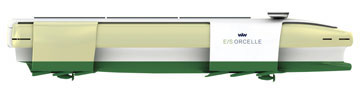
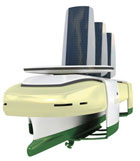
A zero-emission ship? That's the daring concept from Wallenius-Wilhelmsen, the progressive partnership of two historic- Scandanavian companies. The Wallenius Line began in Sweden in 1934 with one small coastal tanker carrying vegetable oil. The Wilhelmsen Line began earlier with less, starting in Norway in 1861with part ownership of one ship. Joined in 1999, these family-owned companies now operate more car carriers and roll-on/roll-off ships than any company in the world.
The E/S Orcelle represents their vision for the future. Named for an endangered dolphin, it has a streamlined shape, tall sails, solar cells and five long slender hulls that create energy out of ocean waves. No engines, no burnt hydrocarbons, no ballast water: zero emissions.
It's a ship of ideas that may never be built in its entirety, according to Wallenius-Wilhelmsen, but its design elements should start showing up in their future ships. Let's hope the cars they carry will also be zero-emission.
For More Information
The Chesapeake Bay Pilots. 1953. M.V. Brewington. Maryland Historical Magazine 48:109-133.
Chesapeake Invader: Discovering America's Giant Meteorite Crater. 1999. C. Wylie Poag, Princeton University Press.
The Life and Death of the Chesapeake Bay. J.R. Schubel. 1996. Maryland Sea Grant College.
Baltimore Harbor: A Pictorial History. Robert C. Keith. 2005. The Johns Hopkins University Press: Baltimore and London.
Minding the Helm: Marine Navigation and Piloting. 1994. The National Academy of Sciences.
Ancient Channels of the Susquehanna River beneath Chesapeake Bay and the Delmarva Peninsula. 1990. Steven M. Colman, Jeffrey P. Halka, et al. Geological Society of America Bulletin 102 (September):1268-1279.
Effects of Soil Erosion on Navigation in Upper Chesapeake Bay. 1945. L.C. Gottshalk. Geographical Review 35 (2/April):219-238.