|
A Few Good Filter Feeders
|
|
|
The benthos encompasses a diverse and somewhat mysterious group of organisms, each playing a distinct role in moving nutrients through the Bay's food web. As they eat, filter (suspension) feeders remove algae from the water column. Some of these organisms, like certain clams and worms, live entirely within the sediment (infauna). But many of the stellar filter feeders of the benthos attach to hard substrate and live on the bottom (epifauna) rather than in it. Epifauna — oysters, mussels, barnacles, sea squirts, and others — are not sampled systematically by the Bay Program and therefore not used in the calculation of the benthic index. According to some researchers, these groups should be added to the annual count.
See this issue's videos to see some of these filter feeders in action.
|
|
|
Mussels (5 species in brackish/saltwater; more than a dozen in freshwater)*
Attached to rocks and other surfaces by fine fibers called byssal threads, mussels open their shells during high tide to draw in water and filter out food particles over their gills.
|
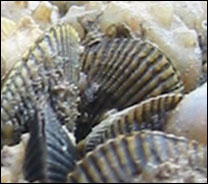
Hooked mussel ( Ischadium recurvum)
|
|
Clams (37 species)*
Clams draw water in one siphon, and push it out another, catching plankton material in the process within mucus on their gills.
|
|
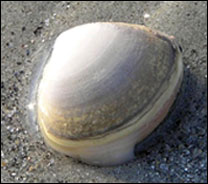
Hard clam ( Mercenaria mercenaria)
|
|
Oysters (1 species)*
Still the go-to filter feeder in the Bay, oysters can process water at rates 2-3 times that of other bivalves. Beating cilia draw water over the gills where plankton and other particles are trapped in mucus and sent to the mouth.
|
|
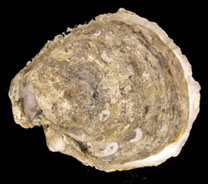
Eastern oyster ( Crassostrea virginica)
|
|
Sea squirts (3 species)*
Though immobile and almost plant-like, these filter-feeding sea squirts are chordates and thus more closely related to humans than hydroids. They siphon water in and filter out small particles through a ciliated sac. Then they expel water through a second opening, sometimes with enough force to make them worthy of their name.
|
|
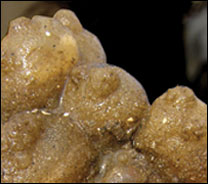
Sea grape ( Molgula manhattensis)
|
|
Polychaete worms (50 species of suspension or interface feeders)**
Suspension-feeding polychaetes create a tube where they wait until their long tentacle-like palps can grasp suspended prey. Of 175 species in the Bay, only 9 species are true suspension feeders. Another 41 species feed at the interface of the sediment and water, using suspension-feeding techniques when local conditions are right.
|
|
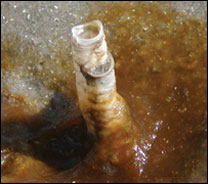
Parchment worm ( Chaetopterus variopedatus)
|
|
Barnacles (3 species)*
Attached to pilings, boats, rocks, and even other animals, barnacles have hard outer plates that open upon submersion to reveal feather-like legs called cirri, which whisk plankton into an internal cavity.
|
|
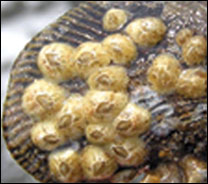
Barnacle ( Balanus improvisus)
|
|
*
|
Source: Chesapeake Bay Benthic Monitoring Program
|
|
**
|
Source: Linda Schaffner
|
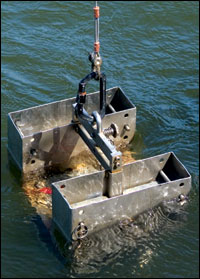
Photo credits: Grab sampler (upper left) by Erica Goldman. The five filter feeders (hooked mussel, hard clam, Eastern oyster, sea grape, parchment worm and barnacle) by Adam Frederick.
|

![[Maryland Sea Grant]](/images/uploads/siteimages/CQ/MD-Logo.png)